
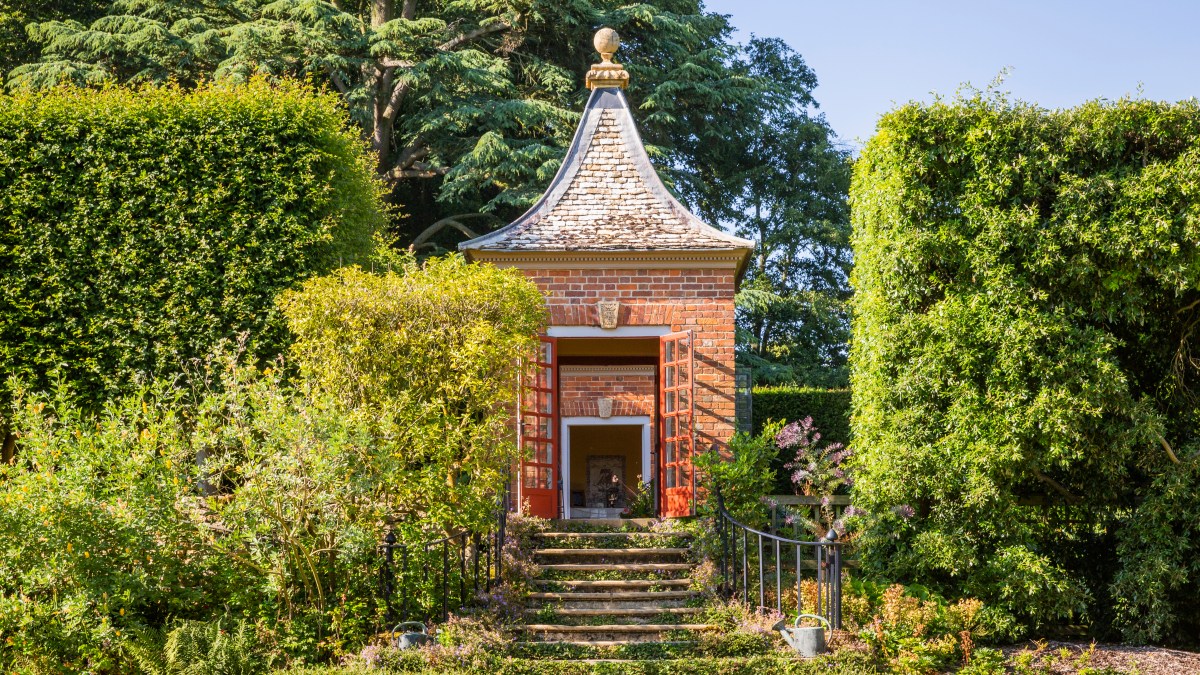
I travelled to Hidcote in the Cotswolds recently on a bit of a pilgrimage. It’s world famous now, renowned for a garden that is a quintessential example of Arts and Crafts style but also for the name alone, attached to the lavender that was cultivated here and is now hugely popular. The entire garden, ten and a half acres in total, is the creation of a transplanted American named Lawrence Johnston, who made it for the sheer pleasure of it.
Johnston was a soldier and plantsman, an interesting combination for a garden designer. He was born in Paris in 1871 to wealthy American parents, who relocated to New York when he was a child. He seems to have felt more at home in England than America, becoming a British citizen in 1900 and serving in the Northumberland Hussars, fighting in the Boer and First World Wars.
• What Cedric Morris’s garden taught me
It was after the Boer War that he became seriously interested in plants. His gardening bible (checked out many times from the RHS library in London) was Thomas H Mawson’s The Art & Craft of Garden Making. It wasn’t until 1907, when he bought Hidcote Manor, that he would have the chance to try out the ideas, though war interrupted his plans: Major Johnston was wounded in Ypres and recuperated in London (where he studied more garden books), before returning to fight.
Vita Sackville-West, who was inspired by Hidcote, has described the garden as “a jungle of beauty controlled by a single mind”. It is now owned by the National Trust and I asked the assistant head gardener Sarah Davis to give me a tour with a nod to providing insight into how Arts and Crafts style can be used for gardens today. We began in the smaller garden “rooms” near the house and moved on to the outer and more informal areas. You really don’t need a large space to use Arts and Crafts ideas: the smaller “rooms” here are comparable in size to small and middle-sized residential gardens (including urban patios). Here are some of the key ideas I took away.
Try adding topiary 
Even the simplest topiary gives structure
NATIONAL TRUST IMAGES/JAMES DOBSON
Topiary, which can be any size or shape, will add a real zing to borders, contrasting well with the interplanted perennials. Simpler shapes, such as pillars or columns, give structure to what is otherwise a riot of planting.
Hedges can do several jobs
The hedges, which are mostly yew, serve many purposes at Hidcote. In smaller spaces they create microclimates for tender plants. Doorways or gaps offer sightlines for focal points. Low evergreen borders provide crisp edges. One particular inspiration is a tapestry hedge that mixes beech and holly, which at this time of year is stunning.
Create several options of paths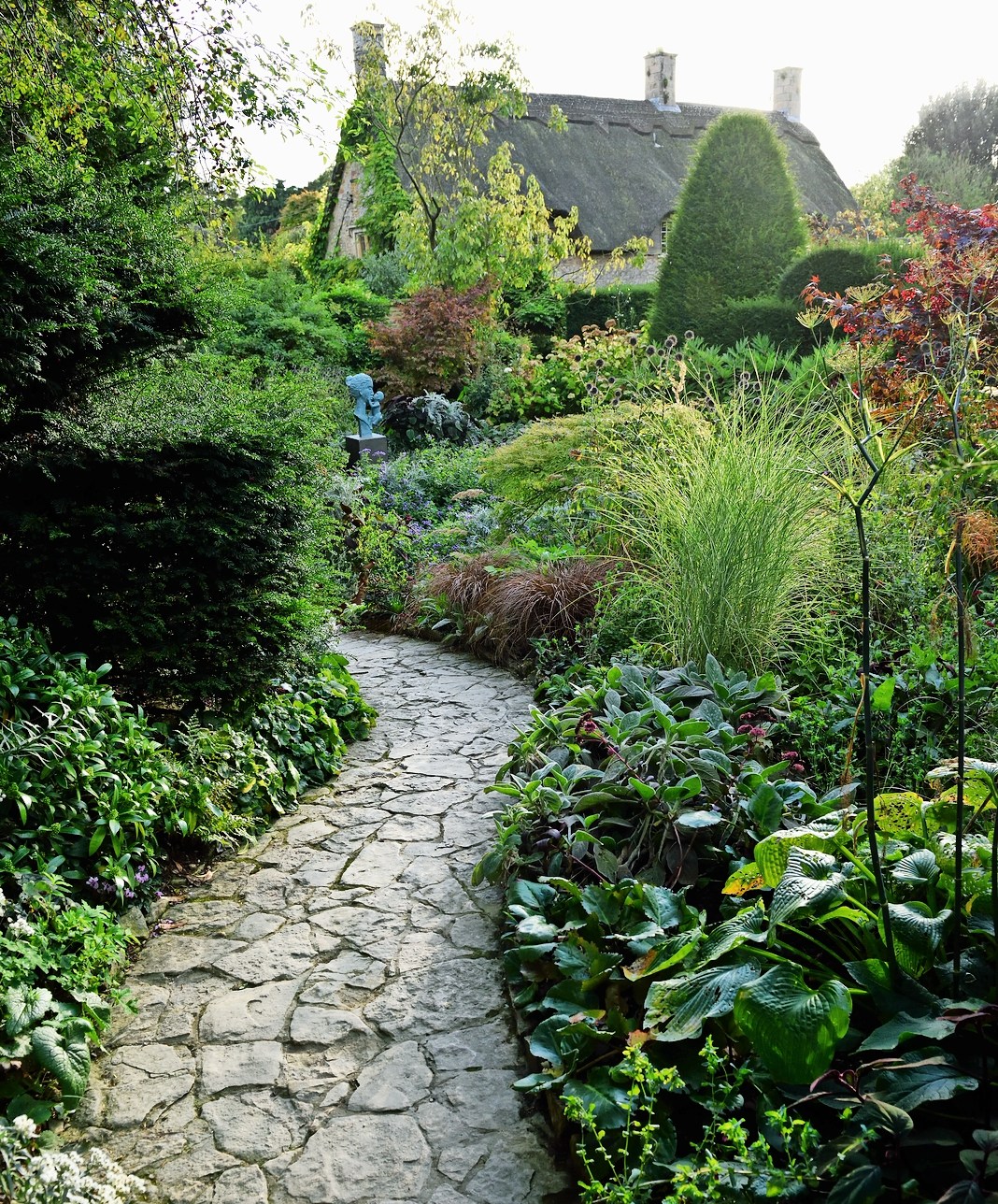
Winding paths add intrigue, especially with varied paving
NATIONAL TRUST IMAGES/JOHN MILLAR
In every Hidcote area there is a choice of paths. It can be as simple as a small crossroads or one large path that goes straight and another smaller one that sneaks around the edge, behind a tree or corner, heading to some surprise location (probably a shed but you never know). Davis says children love the choice, though many adults keep consulting their maps, wondering which is the “right” one (clue: all are OK).
Use local materials
Paths at Hidcote use local brick and stone in various patterns including mosaics and swirls, often mixing materials such as cobbles and brick.
Choose limited colour palettes
Limit the palette, particularly in smaller spaces
NATIONAL TRUST IMAGES/JAMES DOBSON
In the smaller gardens, such as the White Garden, the Major (as he was called) restricted the palette to a small number of plants (say, seven), which included those with silver leaves or white flowers such as lilac, geranium, phlox andVeronicastrum.
Try sensory planting
The Major favoured the aromatic and scented, and in the larger gardens used the planting to create a surround-smell and a feeling of being enveloped by it.
• Bleak borders? What to put in your pots now
Create focal points
There are plenty of vistas at Hidcote but not all of us have access to a horizon view. Seating, pots and topiary can also be used as focal points and my personal favourite is a well-placed bench on which to simply sit and enjoy.
Mix the informal and formal
“A lot of the structure of the garden nearest the house is quite formal”, Davis says. “We’ve got clipped topiary, which is quintessential Arts and Crafts, and yew hedges. Then the borders are billowy and romantic. It’s the contrast between the formality of the layout and the hard landscaping and then the romantic, big flower borders.”
What to plant
Here are some of the plants grown at Hidcote Manor and loved by the Major

The Wisteria and Plant House at Hidcote
NATIONAL TRUST IMAGES/JONATHAN BUCKLEY
Wisteria There are multiple types here, including Wisteria floribunda ‘Alba’.
Lilacs An old-fashioned (and now out of fashion) shrub, including the dark purple Syringa vulgaris ‘Andenken an Ludwig Späth’ and the pale ‘Capitaine Baltet’.
Gallica roses Including deep red ‘Surpasse Tout’, and ‘Marcel Bourgouin’ and ‘Tuscany Superb’, both with semi-double blood red petals.
Lavender ‘Hidcote’ and ‘Hidcote Giant’ — the bushy dwarf cultivar grows to half a metre while the latter will grow to a metre.
Hypericum ‘Hidcote’ Another out-of-fashion plant that is loved here for its reliable long-lasting yellow flowers.
Hidcote, run by the National Trust, is open Friday to Sunday in November and January and daily from mid-February. See nationaltrust.org.uk
Do you have a gardening question? Ask Ann Treneman
Send your question to gardenquestions@thetimes.co.uk for Ann’s new segment on gardeners’ dilemmas
Comments are closed.