
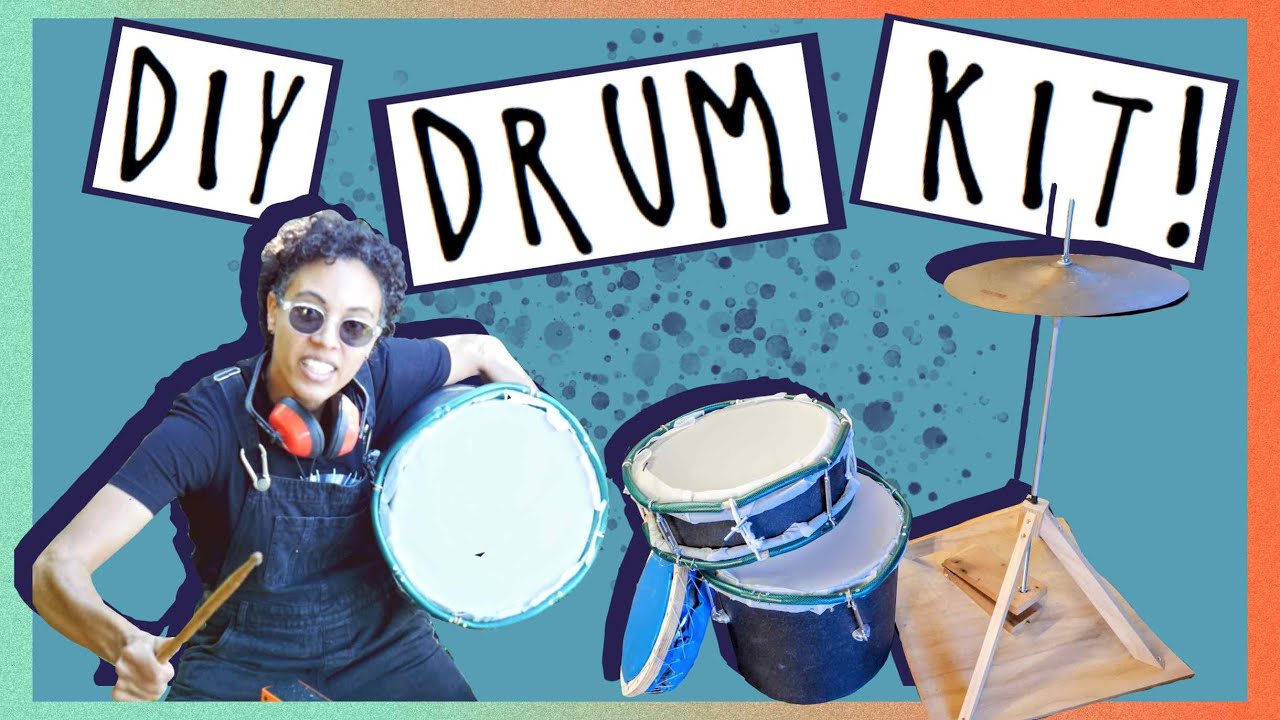
…Well, most of a drum kit, anyway. This week we did our best to conquer a snare drum, a tom drum, and a hi-hat, and you know what? It wasn’t a complete disaster!
With the help of the Vinyl Friday Construction Correspondent, for this month’s special episode…we’re making drums.
Happy Friday, folks.
For those of you with a burning desire to generally support what I do, I’m here to help you along in that journey: https://www.buymeacoffee.com/fathommusicnz (but no pressure, friends☺️)
Want to look at pictures of what I’m working on? https://www.instagram.com/fathommusicnz/
Interested in what my original music sounds like? Here’s a playlist of everything I’ve ever released: https://open.spotify.com/playlist/2kpFRFWOate78egjWsMvbP?si=703989426a68418f
Keen to purchase music I’ve made? https://fathomnz.bandcamp.com
Fathom albums “The World to Breathe” and “Modern Reflections, Vol. 1” are available on all streaming platforms.
Tweed’s album “High Brow Blues” is ALSO available on all streaming platforms!
Thanks for your sharing your attention with me. 🙂
0:00 hello!
00:39 how did all of this start?
3:47 the tom drum
12:04 the snare drum
17:34 the hi-hat
29:10 trying it on for size
29:35 goodbye!
#drums #drum #snaredrums #hihats #percussion #diy #diyinstruments #diycrafts #diyprojects #diymusician #musicalinstrument #musicalinstruments #maker
[Music] [Applause] [Music] Hello and welcome to this month’s special episode of Final Friday. I can usually be found on the internet talking about my records like a big nerd. Baby, I’m amazed the way you love me all the time. [Applause] I physically feel that chord and breaking them down musically or making unusual cover music videos. But in addition to those things, I also make experimental musical instruments. It actually started around 2020 during the first lockdown in New Zealand. I’m not an essential worker and I don’t have the kind of job that I can do remotely. So I found myself doing these sort of quirky projects around the house and one of those projects was to arrange and cover a song by a friend of mine. The arrangement that I had written called for a cello and I don’t own a cello and I don’t actually even play a cello. But I did some googling and I thought I probably can make an adequate substitute. So, I took a couple of old guitar strings and a fenced post and a tin can and I made a cello and which looks and sounds like [Music] this. When the lockdown finished, I realized that I had access to things like hardware stores and demolition yards. So, I set out and I thought, I can do this cello thing, but I can do it much better. That looks like this and it sounds like this. But today’s story is not about that instrument. I ended up making probably 50 individual little experimental musical instruments in this way. I made wind instruments and stringed instruments and percussion instruments and what have you. But as the lockdowns ended, I had to go back to work and suddenly I had a lot less free time on my hands and consequently the flow of new instrument making projects did slow. Of those 50 odd instruments, I found that drums were a perennial challenge. They’re sort of an unusual challenge in that they are simultaneously the easiest instrument to make. Basically, if you hit anything, it becomes a percussion instrument. On the other hand though, if you’re trying to recreate the sound of a conventional drum kit, that can be a whole lot trickier. And it’s something that I’d been trying to get right since the very beginning essentially. Probably the first instrument that I made was an attempt at a snare, which um I sort of achieved or did not achieve depending on your perspective, using a tin paint can and some coins on the top. I decided this year was the year that I was going to do drums properly. I’ve got a fairly big project in mind for this year’s Christmas cover. And I know it’s only April, but I don’t like to do things by halves. So, yeah, I thought this is the year I do a drum kit properly. Fortuitously, this is one of those beautiful years where the Easter public holidays are only a few days apart from the Anzac Day public holiday, which means that you can take like a couple of days off work and get a full week, like Friday to the following Sunday. And I’ve done my best to use that time to make a drum kit. Obviously, I’m no longer restricted by the limitations of lockdowns. I can go out and buy whatever materials I like. Finances allowing. But I do still like to create things from accessible items. This project is made primarily from gardening equipment and materials left over from previous builds. The first drum that was made was a tom drum. I’ve asked someone very special to help out with today’s episode. She usually hangs out behind the scenes, but today she’s going to find herself in front of the camera. Please give a warm welcome to the construction correspondent. Good morning, good people of the internet. Oh, and I should mention that there is a rugby game happening nearby. Some of the neighbors don’t love it, but I like to pretend I’m being cheered on as I go about my household chores. The order of the day is that I’m going to try and make a Tom out of this planter pot and also this 10 mm dowel and also various fixings and hardware and a garden hose. Oh, there go all the fixings and hardware. Anyway, I don’t know whether this is going to be a video of success or a video of failure, and nor do you. So, let’s go. The first thing she’s going to do, obviously, is unwrap the pot. The pot is going to serve as the body of the drum. First, we’ve got to cut off its bottom. Don’t try this at home. Cutting off your bottom. I can’t recommend it. Yes. Yes. Very funny. Always remember to protect your ears. [Music] Try turning it on at the wall. Here we see the pot in two parts. Now I’m going to take all the sharp off the edges. We’re going to start with a file, then some rough sandpaper, then some less rough sandpaper. We pause to check whether it’s actually fiberglass, not plastic, and then we sand. And here she’s making the rim that’s going to go at the top of the drum. The drum rims support the skins, which allow the tension to be applied. Traditionally, these are made of metal, but in this case, she’s going to make them out of hose. Garden hose. Here we see her measuring the hose against the perimeter of the pot to make sure it’s the right size. Let’s cut the hose construction correspondent. Try taking the guard off first. At this point, the construction correspondent is cutting little bits of 10 mm dowel to insert into the hose. This will reinforce the hose, which is wibbly wobbly by nature. She test fits the dowel. Now that she knows it fits, she’s going to secure it with screws. Screws. Let’s get some screws. God, screws. Oh, the screws are in the downstairs place. Let’s go play them downstairs. Found some. We’re going manual. She does a test fit with the dowel in place. The next stage is to attach a drum skin to the hoop. Unfortunately, our construction correspondent, a noob, forgot to turn the camera on for this. Not to worry, you will get to see it later. Uh, so I possibly forgot to turn the camera back on, but what I’ve done for this project, the construction correspondent is using a sheet of drafting film from an art supply store. It’s made of myar. Now we’re going to do the one that’s going to lock it in place. Hoop two. While hoop one has skin attached to it, it isn’t fixed to a drum shell. Hoop two is. It sits on top of the first hoop and traps the skin in place and is then pulled down, which stretches the skin over the shell of the drum. It’s turnbuckle time muscles. A turnbuckle is a contraption that looks like this. And it’s used to bring two items together, two things together. You fasten each end to something and you tighten it. In this case, the two ends being fastened are the the top drum skin and the drum shell, but it needs to be unwound first so that it’s long enough. This takes ages. Show us what you’ve got, construction correspondent. Here we have our hose. We have our little wooden dowel. We have our little turnbuckle, which is going to be our tensioner. I’ve made space for two, but I have a suspicion I may need four. We’ll find out once we’ve got it all together, which is very soon. Turn buckle two. This is the point where she starts fighting with the drum skin. This is the trickiest part, wrangling the skin. Once it’s under tension, it is very well behaved, but until that point, it is a right menace. She’s now test fitting the hoops together. She learns from the experience and in the next drum project, she’ll make the top hoop smaller than the bottom hoop, which will make this whole painful process much easier. See, it’s already making trouble. What this situation needs is more tape. The hardware that’s currently being affixed is what the other half of the turnbuckle is going to be connected to. Now, when the buckle is turned, the top rim will be pulled down towards the bottom buckle. Preliminary holes have been drilled to determine position. And now she’s sizing up with bigger drill bits to accommodate the fixing. The name of which I’ve completely forgotten, but which is connected to the inside of the planter pot with two nuts. Don’t even, please. Sounds like a drum already. That’s all worked. So, she’ll now attach the three remaining turnbuckles. And we’re attached. It’s time to attach the rest of the turnbuckles to the shell. She’s clipping the last turnbuckles in. And we’ll note that the hooks are around the wrong way, but she will figure this out in due course. And now we add our tension. Still kind of sounds the same. Now we’re getting somewhere. Once satisfied that the skin isn’t going to pop up, she can now take off the tape. Okay, my friends, check this out. See if we can get it any tighter. Huh? I think we can. Now, let’s test out the final product. Oh, need to get a drumstick. Yes, that would help. Good people of the internet, here it is. [Music] So, what we’ve changed, it’s basically the same as last time, but I’ve reinforced the edges a little bit more so that it’s not quite as bendy and the bits aren’t allow me to take over because she’s drumming over her explanations and is largely incoherent after a long day of work. Basically, what she’s done here is she has added extra reinforcements around the hoop perimeter using the little 10 mm dowel pieces that she had cut earlier. This stops the edges of the hoop from riding up and reducing the tension on the skin. Well, that’s where I was bleeding blood and sweat and not tears cuz it was actually surprisingly successful venture. But we have one of two toms. She will not be making a second tom. As it happens, this project lost its intrigue once she had triumphed. And and I can actually tension it. I can change the pitch of this thing. Anyway, basically no improvements were made to this drum after the camera was turned off. This is it in its final form. It sounds like this. [Applause] Turnbuckles, plant put hose, drafting film. Let’s move on to the snare drum. Good day, friends of the internet. It’s another day and now we’re working on a snare. I had another pot, pot plant pot, and I’ve cut it into a little shell like this. Now, we’re going to make a double skin. I’ve made a whole bunch of these things. It took ages. I prepared them earlier so you didn’t have to sit through me making them, but we’re going to make a double skin. This time, this snare will differ from our tom in that instead of having an open bottom, it will have skins on both sides with the snares attached to the bottom skin. This will cause the drum to rattle when it’s struck, hence the name. So, uh, this is how the skin process goes. Because she forgot to turn the camera on last time around, if you’ll recall, first she’ll mark out the dimensions of the shell on another sheet of drafting film. Okay, that’s the diameter. I mean, that’s the that’s the circle. Damn it. Now, I’m going to make a pretty wide circle around it because I didn’t make it wide enough for the other one for the Tom. And I would like to have enough for it to have a bit of a tail, which I’m hoping will make a bit more sense to you shortly. When she says tail, she just means excess material. If it’s too short, the skin can slip out between the two rims when they’re brought together. That’s not in frame, but she is a newbie with this camera business. She’s fixing the skin to the hoop, in case you’re wondering. Here, the construction correspondent is doing her best to tape down the edges of the drafting film. No pause. A big part of this process is trial and error. And to be honest, it’s mostly error. But, you know, that’s how you arrive at a thing that works, by making mistakes. lots and lots of mistakes. Process repeats. A second skin is made in very much the same way as the first. Okay. So, whereas with the toms, the turnbuckles were attached to the side of the drum, in this case, they’ll be attached to the opposite skins. This here is the trickiest part of the process because they don’t want to sit placidly in place while you connect them, which is why the skin tails are taped down. Eventually, she’ll realize that you just need to connect everything and start tightening and that it will all fall into line. This part takes ages, but it will slowly start to come together and sound and feel like a drum. The construction correspondent has run out of turnbuckles, and the spaces between the turnbuckles were buckling, not holding tension. So, she’s opting for a much more rudimentary tightening mechanism. String. I’m so glad I was able to find this string. This is how the tightening works with the string. You place a long stick, in this case a bold, between the strings and you rotate them. This brings the skins closer together, which increases the tension, which is what we want. She’ll do this for all of them. This is the most exciting part of the process. It’s slow and laborious, but the anticipation is mounting as this is the final stage of the process, and we’ll soon get to hear what the final product sounds like. One of the best aspects of making your own instruments is not knowing exactly what they’ll sound like until the very end of the project. Once again, now that she’s satisfied that there’s enough tension on the hoops that the skin won’t immediately loosen and come off, she’s going to take off the tape and cut off the excess plastic. She’ll repeat with the other skin. And finally, she’ll trim off the excess string. It’s time to make the snares. They’re made from a very thin and bendable wire, which are wrapped tightly around something narrow and cylindrical. She starts with a bamboo skewer, but as the wire needs to be slid off, she later switches to the screwdriver. She’ll find the wire slips much more easily off the screwdriver. This is the construction correspondent’s first attempt at fixing the snares to the rims. This was an incredibly difficult task for her. It’s a good example of the trial and error that I described earlier. It took a couple of goes. The snares have to be in direct contact with the skin or they won’t rattle. For her first attempt, she tried tucking the ends into the points where the rims met. It’s no good. It’s not going to work. You see, the snare’s not sitting flat, so it’s not rattling. Hey. Hey. The first snare is in place. It looks like a win, but as the other snares are added, she’ll soon find that they won’t stay in place and easily get tangled with each other. More snares. See, here we are. The snares are beginning to get tangled with one another and they’re popping out. It’s a tangled mess. Her next attempt will involve taping the snares to the skin of the drum. We tried three or four other ways of attaching the snares, but landed on this design. I hope this is visible. Each of the snares is taped to a bamboo skewer, which is also wrapped in tape. So, the bamboo skewer did get used in the project in the end. I’m pleased to report. And then the bamboo is tied by a wire to the bottom rim of the drum. This means that the snares sit directly against the drum and they rattle when the drum is struck. These here are the turnbuckles. You rotate them very easily like so. And it um increases the tension on this on the skin. These are the strings in between. It sounds like this. That rattling is the snare. And notice how different it sounds from the tom. It’s time to move on to the most challenging part of this entire project, the high hat. Hello, internet people. Welcome to the third and I think final installment. I’m squishing my arm. The third and I think final installment of this making drum from equipment found around the house. I’m going to try and make a high hat stand today. It’s not going to be made from gardening supplies, despite what the title of this video may indicate. Here’s what I’ve laid out. I’ve got an M8 rod threaded, several blocks of wood in different orientations. These I have prepared earlier, a hinge, some screws, always useful. A little bit of plastic tube, three hex nuts, two washers, a spring, some wing nuts. Love a good set of wing nuts. And these I purchased separately. It cost $40 for the two symbols at an online auction. Cool. Let’s see what I can do. Before she starts, she’s got to tidy the space from yesterday’s project, which was sewing something. Also, cable ties and some good tunes. Always be sure to have good tunes. She’s going to start with a foot pedal, although the ped prefix implies foot. Anyway, so that’s entirely total rookie error. Here at this channel, we learn from our [Music] mistakes. Put a little edge on that with the sander. I’ll be right back. The edge of the wood is a little bit sharp, so she’s going to put a slight bevel on it, which will stop it from digging into the bottom of her foot when she’s playing it. Remember kids, you should never do sanding projects in your living room. She’ll now attach the other side of the hinge. This fixes the top and the bottom of the pedal at one end. She positions the spring. The spring forces the pedal back up when the foot isn’t applying pressure. Ideally, when the project is completed, when the pedal is depressed, it will bring a top symbol crashing into a fixed bottom symbol, and it will make a pleasing clash. Someone’s just smell gorgeous. And this is one of them. Like butter. I’ve cut the aluminium pipe such that the rod can slide inside it. That’s what that horrible noise was just then. This rod connects the pedal to the top symbol. Okay, we’re going to put this aside for a minute. The aluminium pipe will feed into a little square block and the unmoving symbol is going to be fixed to said pipe. As we saw earlier, the rod will slide inside of the pipe attached at one end to the pedal and at the other to the top symbol. The legs of the stand are also attached to the square block. Here we can see the construction correspondent marking the depth of the drill so as not to drill through her floor. Very responsible construction correspondent. It’s definitely at an angle. And this is what comes with not owning a drill press and trying your best. Crookedness. Bane of my existence. It’s fine. It’ll still work. She’s got sawdust all over her face and she doesn’t even [Music] realize. Almost there. That’s probably good enough. Actually, spoiler alert. It’s not good enough. It’s tightly wedged at the moment, so she doesn’t think that it needs to be fastened in place. But as work continues, the wood, which is pine, will shift and soften, and the pipe will loosen, as we’ll see. She test fits the rod in the pipe. And this is where the legs pull off figuratively and literally. It was smooth sailing up until this point. She widens the hole so that she can easily counterink the screw head. So, here’s the downfall. Here’s the big problem. The wood she’s using from one of the legs is the wrong dimension. It’s slightly wider, about 5 mm wider than all of the others. And this presents a cascade of issues, including that the screws that she’s prepared are too short. And that means that the driver head is too short to drive the screws in the hallway, and so on and so on. Let’s try something different. Longer screws again. Okay, this time hopefully I brought what I think are 40 mm screws and 50s. I have nothing in between. I’m hoping like hell that at least one of these will work. It should work. It won’t work. Famous last words. Not perfect. The 30 mm screws are still too short. Okay, bringing in the big guns. She means the 50 mm screws. I should have just found another piece of wood that was the same dimensions as the other ones that I’m working with. This is correct. That would have been a smart thing to do. It would have. This was supposed to be smooth and impressive. Oh well. Going for realism. We’ve changed our approach. Pray for me. Please go away. Well, we’re connected. Let’s uh see where we get to with screw number two. We may be connected, but and this is a big butt, it’s going to create significant issues down the line. Yes, that’s better. It’s not better. I think possibly we found the thing in the middle. Subtle foreshadowing. Well, I think that’s as good as it’s going to get. Not as good as a connection as I’d like, but sometimes in life, these things happen. We must move on. One, two, three feet. A stand. Let’s tidy up a bit. Our workstation is disgusting, quite frankly. By workstation, I do mean the floor. I cracked myself up. The cable ties were going to be to make sure that this didn’t drop any further into its little housing here, but it doesn’t look like it’s going anywhere. So, I don’t think I actually need them. This will turn out to be wishful thinking on her part. Wait, are we up to our moment of truth? We most certainly are not. All right, here we go. We were about to meet the consequences of our actions. The rod. Oh, come on. Come on. Don’t be a Come on. Went before. Come on. Come on. Oh god. What are we stuck on? She is stuck on the extra-L long screws which have pierced the pipe and left sharp little indentations on the inside. Oh, is it a screw? It is. Oh man, we’re so close. The problems persist. You really don’t want to come out, do you? I should have just used the same bit of wood again. Yes. Now damaged the rod. The pipe doesn’t want to come out of the wood. Well, nope. Now we have more problems than we began with. Oh, I was so close, you guys. Maybe maybe I can use a drill. Maybe I can drill my way in. Let’s try that. Maybe not all hope is lost. You know what? I can always change that leg if I need to. It’s not the end of the world. That’s the spirit. Well, didn’t like that. Ooh, that’s leaving little metal shavings everywhere. I think it’s working though. I think this will work. Will it though? Oh dear. The drill is stuck in the pipe. Okay. Um Okay. Pliers. Maybe I’ll get a set of pliers. Okay. Now, with a little luck, what will happen is I won’t squash the original pipe. Now, it wouldn’t be the end of the world if I did because I do have a spare. But I’m a lazy person. I don’t want to have to do this twice. That’s where we’re at. Well, that didn’t help. There we got it. Hey, it worked. I’ve spilled screws everywhere and it’s all gone to hell in a hand basket. Unfortunately, in an attempt to get the stand back together, she’s going to have a repeat of the issue she just dug herself out of. Ah, now what? I suspect the same problem as last time. Oh Jesus. This was going so well. Come on, man. At least she knows how to fix it this time. We’re going to leave that leg and we’re going to figure out what to do with that at another time. Yeah, that’s what we’re going to do with that. It’s okay. We haven’t done this before. It’s our first go. One must always leave room for some self-compassion when one is building things. I say first go, but I tend not to enjoy doing repeats of things. That’s not entirely true. I’ve been trying to make this bloody drum kit for years. I press down on the pedal. The rod is coming with me and that is what I want. So, I don’t know if this will work, but it’s worth a try. It won’t at first, but it will once the pipe has been wrapped in electrical tape. This helps to stop the cable tie from sliding around. I I never said it was going to be a good high hat, you know. Hey, it works. Okay, good. Oh, you can’t see. Ignore the the sewing kit in the background. This is one of those trial and error moments. Let’s skip ahead. The next stage is to attach the bottom symbol. This is where we first meet the electrical tape. It’s important that this side doesn’t move around too much. This much. I know it’s not as foam as I wanted it. Not as foam at all. Let’s Let’s test it. If this doesn’t work, then we’ll try something else. She’s actually very close at this stage. She ended up using the little bit of plastic pipe that was going to be on the pedal but was discarded, plus more electrical tape and a bit of garden hose. So, I guess this project does use gardening supplies. I’ll show you shortly. All right. This, my friends, is the moment of truth. It’s not. But we have to admire her enthusiasm. For a start, the stand only has three of its four legs. It is at a jaunty angle. It’s not meant to be that jaunty. Well, that seems like a good height. Let’s try that. It’s the jankiest shittiest [Music] The leg’s falling off. Tune in tomorrow, folks. Luckily, we found one last bit of wood at the right width to cut one more leg, a fifth leg. Initially, it was still a little bit wobbly once we got to kicking it around. So, we ended up just making a new floor for it out of plywood and screwing it directly to that floor. And it sounds like [Applause] [Music] this. Maybe build some more stands about flat top. And that’s it for this week. Oh. Oh, and if you enjoyed this episode or you would like to support any of the weird things I do, um, including this, music videos, talking about my records, original music. I’ll leave a link in the description uh to my buy me a coffee page where you can make a donation or sign up as a member if you wish. No pressure, friends. Thanks for hanging out with me. I already did that bit. Bye. I’ll see you here next week. Have a great weekend. Muscles. That’s what I [Music] want. Muscles. The best things in life are free. So, we did get to use the bamboo. Squar squar. I need money. What I want. That’s what I want.
25 Comments
Out of curiosity…what would YOU have done differently?
WOW. Renaissance Woman.
This video was quite interesting and as for me , I likely would have done the same in constructing the instruments.
Raspberries pop music ribaldry at 22:52
🔥🔥🔥
next video – multiple Fathoms with home-made instruments form marching band for Anzac parade
I love your creativity!
I also listened to one of your albums recently, I thought it was pretty good 🙂
👏👏👏 for your skills. i was trying to will you over the lineall the way, especially with the high hat, but LMAO when the drill got stuck in the pipe. honestly it was so funny it was…ah… right you didn't think so… awkward…
anyway. what would i do differently. call jimmy chamberlin.
new zealanders are so darn competitive/determined as evidenced here but i didn't realize they played rugby 🏉 no siree🤪.
You are insanely skilled!
Thoroughly enjoyed the workmanship of home made instruments you have achieved. You should start a school of rock and get some kids to play your home made equipment and turn it into a movie.🥁🎸🎹🎺🎷🪕🎻🎶🎵🪘🎤📯🎼🎙
You Ma’am are a force of nature and a joy to watch at your work! 😎👍🏼
Brilliant!
This was so wonderful.
Very! Speaking of which, what is the Elementary Penguin concert calendar in second half of 2026?
I want to be like you when I grow up (I'm 59).
I have a question 🙋. I have a basic understanding of most instruments (I play bass and guitar) but I have next to no understanding of how drums work. Because you can’t change keys on drums. Do you have to tune drums?
Anyway my question where is a good place to start learning about drumming? For someone who can’t/won’t play them?
The woman is crazy gifted.
I appreciate you and thank you for making content.
And now the story of the musical prodigy
Without the prodigious income
But who pushes onwards
Nevertheless
Come what may
It's
AIN'T RESTIN' DEVELOPMENT
📺
"Ohmygod, screws."
It is very important to be able to crack oneself up.
"I'm a very lazy person, and I don't want to have to do this twice."
I resemble this remark.
I gently suggest that lazy people do not build drum kits from scratch with unique materials.
Oh! You went right for Come Together. Nice. And then Mellow Yellow. 😀
I am someone who's had times when I didn't have a drum set, couldn't play one where I lived if I did, and/or couldn't record one properly without a favor from someone. While I love (and would still do anyway) using interesting items as percussion, I know sometimes, you just want a drum kit.
I think this bodes well for your next album. 😀
Speaking of which as a side note… while I haven't managed a sit down listen to all of your album, I have heard a couple songs now often enough that they can earworm their way into my head. Those being Mother Star and Dialects (I love that fast part, slow part, fast part again structure).
Keep on rockin'.
-RTA
If you can't mercilessly heckle yourself on your own channel, what can you do?
I always envy people who are good at practical stuff. I wouldn't even have known where to start with any of that… I struggled enough sewing my coat pocket. I did spend much of yesterday assembling some drums, but in my case I was assembling some drum loops into my DAW.
What was that music you were playing while you were making the hi-hat?
Back in late 2009/early 2010, I did something similar for a song I was recording, initially with a friend of mine that was a drummer, except that I wasn’t constructing anything ! I used my son’s space hopper {in the States, they call them a “Sit and Bounce”} as the bass drum, a spring drum as the snare, timbales, bongos and a frame drum as the toms, “One-Shot” shakers as the hi-hat and a small hand cymbal as the cymbal.
We basically had to record each bit on its own and my friend never really quite got the concept. He was also a percussionist and found it hard to not play each part as a percussionist. I had to do a lot of jiggery-pokery to get it all to approximate a drum kit !
In 2012 on another song, on one of its sections I used a hammer on the instrument case of my son’s euphonium as a bass drum, an IKEA shopping bag as the snare, a game box and metal filing cabinet drawers as the toms, a wok as the hi-hat and the same wok, along with some pan lids, all recorded at different speeds to alter pitch, as the cymbals. I also had the tuba playing the role of the bass guitar. I thought it sounded quite funky ! In the past, I’ve used guitars and amplified bass guitar strings or even the bridge of an amplified mandolin for some great percussive sounds. There are lots of great home-found objects one can use, such as keys, scissors, glasses and cups {a cup run up and down a bass is a glorious sound}, even the sound of running water. If you listen really closely to water coming out of a tap, depending on the kind of tap and the water pressure, you can get the most incredible sounds. You can also play your laps, face or buttocks {or someone else’s !!} as a percussion or drum part. Heavily compress as you go in and the sky’s the limit ! I’ve also used tablas and congas as toms. And for a little extra craziness, I’ve used a headphone to simultaneously double as a microphone and a bass drum. If you DI a headphone and tap it, not only can you get it to sound like a kick drum, it also records what you are doing {if I want a really dirty guitar sound, a headphone makes a useful mic}. I often use it to record a quick idea {not the final take !} when I couldn’t be bothered to set up the mic and leads.
Hamish Kilgour (rest in peace) is looking down right now and saying to himself, "Damn this lady made a fucking drum set" lol
6:22 but is it timey-wimey?