
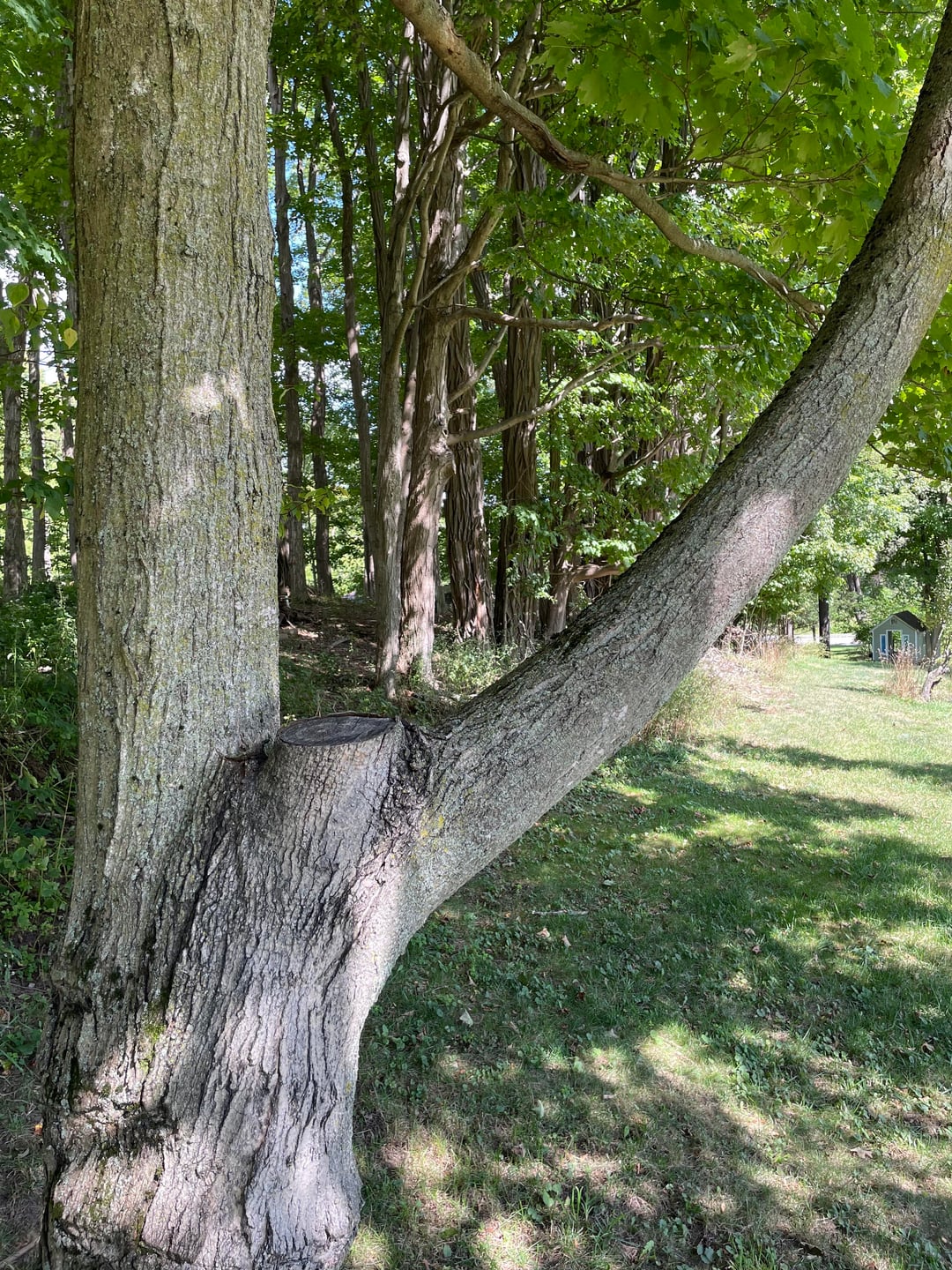
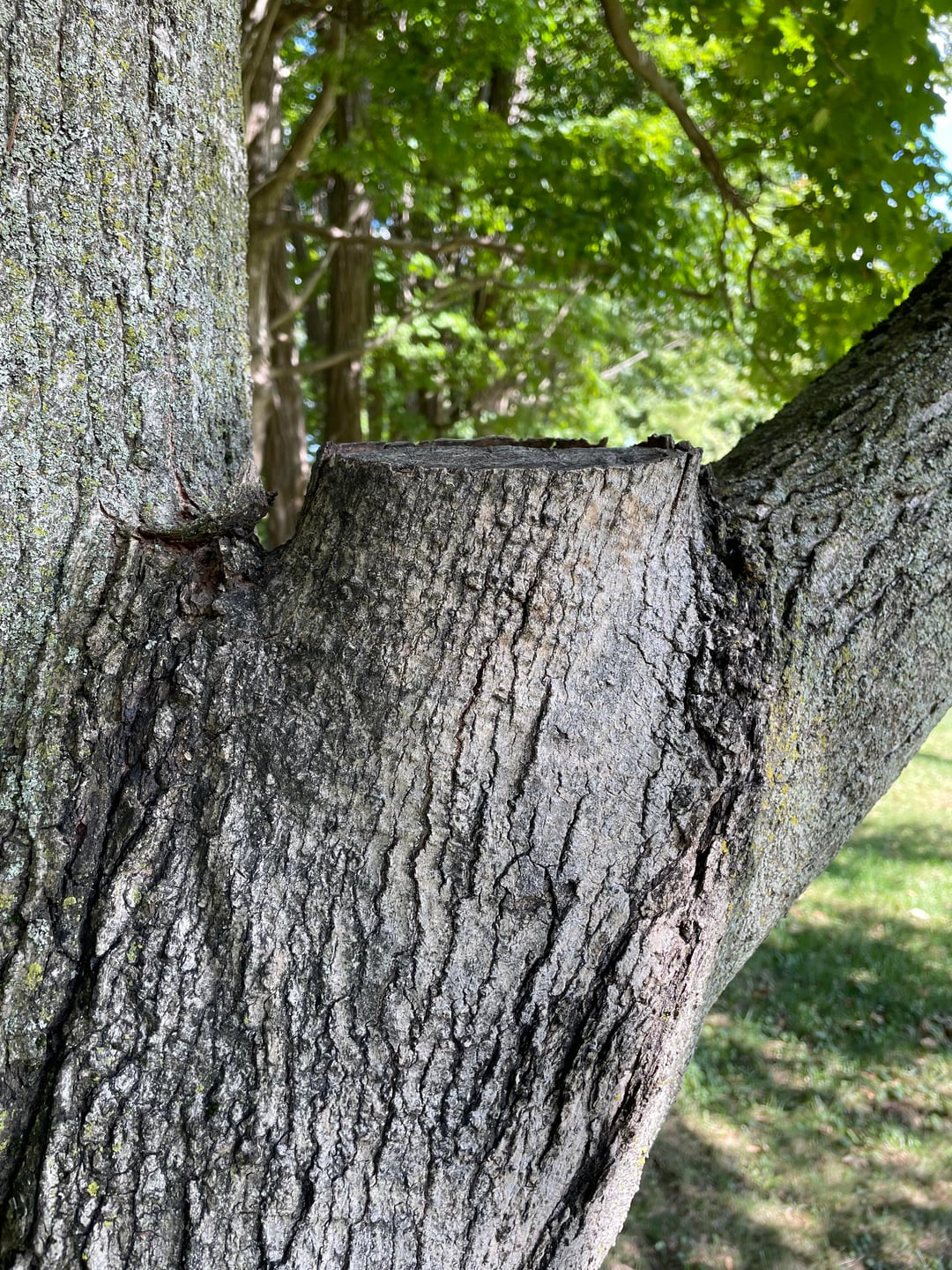
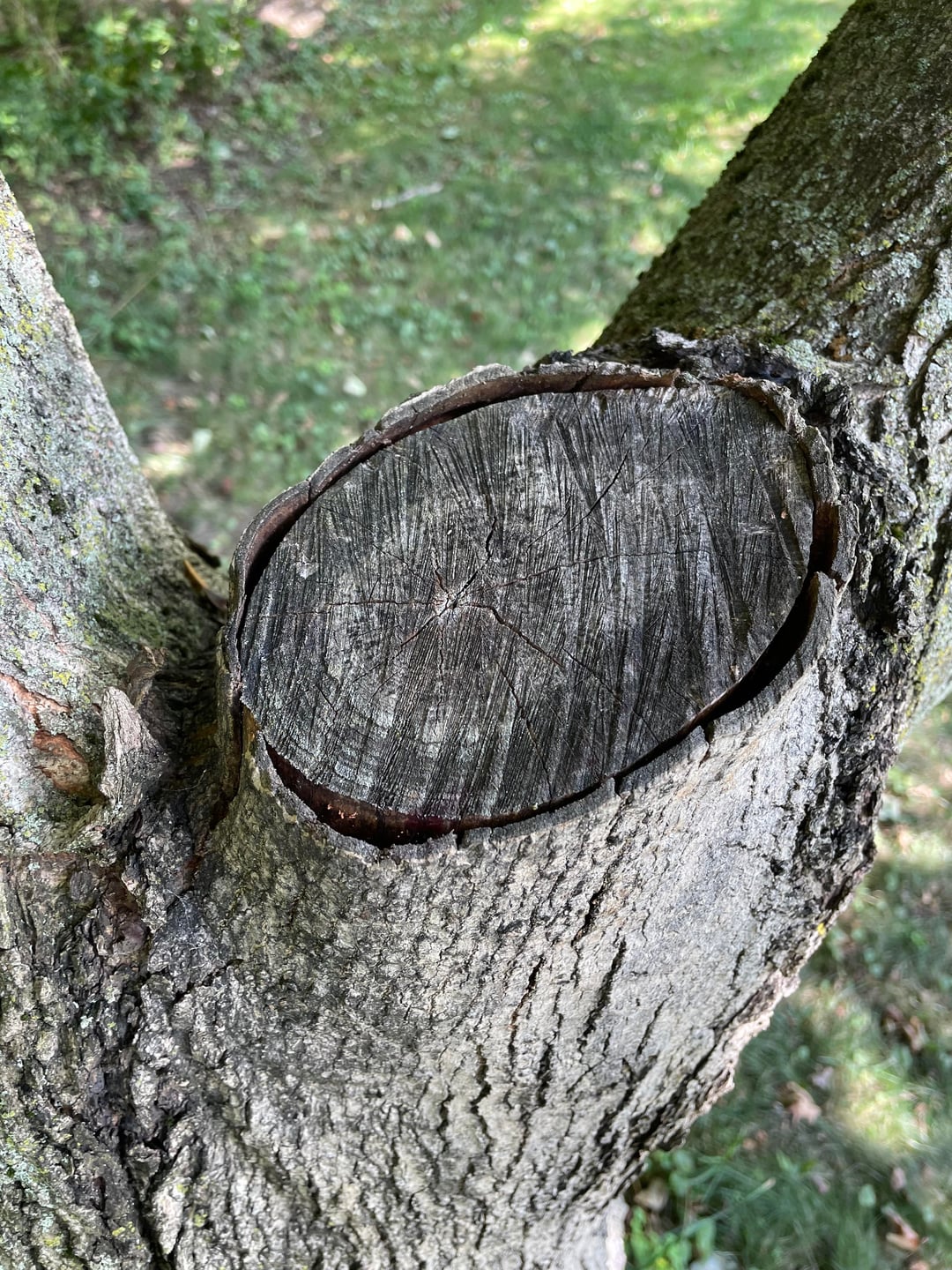
I pruned this maple 2 years ago, the removed branch was growing parallel to the ground and rubbing against the right fork. I thought I left enough branch collar, but I’m seeing no signs of healing. Feedback so I can do better next time please.
by Select-Government-69
9 Comments
Usually you want to cut on an angle so water doesn’t pool on it.
Also, that’s a big ass branch, so it’s harder to scar over.
Also, it’s a Maple and they kinda suck.
Also, I’m a lawyer, and I don’t know what I’m talking about
Maples “heal” or compartmentalize very poorly. It’s hard to say without seeing what it looked like before, but if possible, I would’ve reduced that lead only where it was rubbing on the other and kept as much as I could.
All the above comments are correct.
I winced , and crossed my legs
That’s a tough one, I’d say you did your best
There is no branch collar because that wasn’t a branch– at least, not anatomically. You had three stems growing alongside each other, and you removed the middle one. Note the grain of the bark, and in particular the way those ridge lines run down to the left and right of your cut. Those ridge lines are the boundaries between stems.
The two remaining stems aren’t going to send resources up the cut leader because that’s not how trees do resource distribution. You were on the right track that it would be a different matter if the cut lead was an actual branch with a branch collar, but it’s not.
Structurally, this an exception to the rule about stubs. In this situation, you WANT a taller stub because that lead on the right is applying torque to the now-dead wood of the central lead, and the torque risks delaminating the dead wood fibers. Wood fibers have enormous tensile strength, but here the wood in the middle is being asked to bear a load that pulls the fibers apart from each other. In other words, it’s weak for the same reason that you can split firewood along the grain but not across the grain.
As others have mentioned, age and species are also issues here. If you’d done this to a crape myrtle, the tree would be like, “Wow, that was weird,” and be well on its way to closing up within a few years.
The structural issue clearly hasn’t been a problem yet, as the trunk hasn’t split; just keep in mind that the right lead is a little sketchy.
As far as what you should have done to help compartmentalization, I’m not sure you had any good options. You needed some green on whatever was left of that lead, or the tree needed to sprout some new green from the stub. I’m guessing, though, that you didn’t have a good candidate intersection to reduce it to.
So what now? Remove the right fork or the whole tree?
You cut it, that was not a branch you wanted to cut lol
Looks like the cut has compartmentalized. Trees don’t heal, they seal the wound and then carry on adding a new layer each year as usual.
It would take many many years for a large tree to grow over something like that. It’s not going to grow over one bit because it got cut, it’s growing a new layer over the entire tree every year. Eventually they can engulf large cuts but for a tree that’s already big, it’ll take a long time.
Looks fine and normal. No signs of rot or decay.