
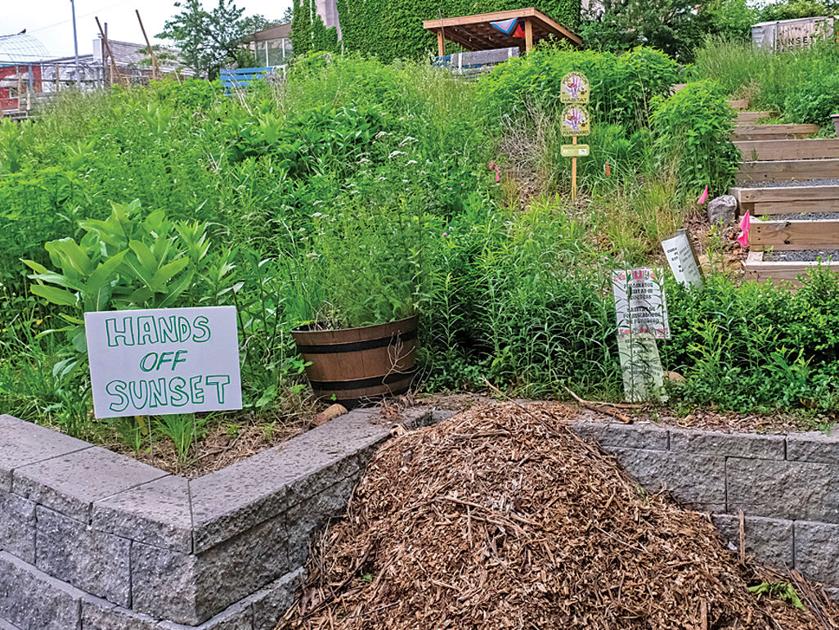
The group behind Ridgewood’s Sunset Community Garden last Thursday took its case against the city Parks Department to federal court.
After voluntarily dropping the proceedings in New York County State Supreme Court, the group in a statement alleged that Judge Hasa Kingo had been partial toward the city. The plaintiff’s attorney, Jonathan Wallace, also wrote a letter to the judge criticizing the court’s handling of the case.
“After Judge Kingo’s display of bias, the city appears to have reneged on their agreement to negotiate, and we hope that filing suit in Federal Court will help resume negotiations,” the group said.
The case began after Parks in May moved to terminate the garden’s license agreement, stating that it had violated the rules for community gardens by requiring ideological commitments from members. Among the required pledges is one to interrupt behaviors expressing hate, including homophobia, racism, Zionism and anti-Semitism.
The garden’s values also say members stand with “oppressed and marginalized people … across the globe,” including in Palestine, amid the ongoing conflict in Gaza.
“We live in a borough that prides itself on its diversity, and our public resources shouldn’t be run by people who openly discriminate against any segment of the population,” said area historian Christina Wilkinson, a key figure in the garden’s establishment.
Wilkinson has faced harassment on social media due to her opposition, she previously told the Chronicle.
And some Jewish community members have said they feel unwelcome in the space.
Parks said it had been working with members on compliance since last September. The group said the city falsely labeled its community values as discriminatory.
The garden, which members now call Jardin de Santa Cecilia, also displayed a memorial for the late transgender activist Cecilia Gentili. Parks said it did not qualify for permanent installation, and suggested ways for it to remain on view that members did not accept. Members alleged that the city selectively enforced its rules for public art.
The plaintiff, a garden member representing the entire group, in the June 16 complaint sought redress for “unlawful discrimination” contrary to the New York City Human Rights Law and for free speech violations. The group alleged that the city engaged in a “targeted campaign” to suppress the garden’s cultural and community expression.
The plaintiff withdrew the garden’s request for a preliminary injunction last month. Both parties agreed to a control date of July 18 to explore a resolution.
According to a transcript of a July 17 appearance, Blake Ahlberg, counsel for the city, asked that the date be adjourned to Aug. 1. Wallace said the garden group had made offers involving changes to its bylaws that were winding through the levels of approval within the city, which takes time.
Kingo then questioned the court’s involvement, suggesting to withdraw the case as negotiations go on. Wallace refused, reiterating the plaintiffs’ First Amendment claim. He said the group would lose any leverage it had in reaching a resolution.
Wallace said in his July 31 letter that Kingo’s reference to another case at that hearing “completely misapprehends” the First Amendment and mischaracterizes the plaintiff as the state. The group said the judge “blindly adopted the city’s baseless arguments” and declared that the garden’s community values violated free speech, “ignoring clear legal precedent that restricts government-compelled speech.”
“Your use of your authority to ensure that the case would neither be settled nor continued in your courtroom has the most drastic implications for the future of our Constitution and system of government,” Wallace said in his letter. The plaintiff ended the case last week and refiled in federal court.
The garden group said members also have faced harassment, including Islamophobic and transphobic threats, which are “precisely the types of threats the garden sought to protect against” with its bylaws. They said threats followed two New York Post articles that aired some residents’ grievances.
Wallace also said in his letter that his clients are “a community group composed largely of trans people of color, many of whom are immigrants, and who share a powerfully-rooted moral opposition to the horrifying violence committed by a political entity, the nation-state Israel, against the people of Gaza.”
Describing himself as “an old white proudly Jewish attorney,” he said he is “content” to be associated with them, who do not support violence, terrorism or have “an iota of anti-Semitism in their opposition to Israel.”
He said the city’s corporation counsel would typically be trusted to determine what is legal for the city “without being forced to justify their choices” in a courtroom with the Post present.
“It’s rather hypocritical for the garden group’s attorney to complain about the presence of a reporter in a courtroom while arguing that his clients’ First Amendment rights were somehow violated as they imposed a blatantly unconstitutional litmus test for access to this public space,” Wilkinson said.
A Parks spokesperson said the agency does not comment on ongoing litigation. Al Baker, a state Office of Court Administration spokesperson, said the Unified Court System had no comment, but dissatisfied litigants may appeal a decision, and parties concerned about the ethics of a judge’s actions may file a complaint with the Commission on Judicial Conduct.
Comments are closed.