
As Dr. Tally-Schumacher explains, “If you have more favorable conditions, you can grow more grain to feed a larger army which means more conquest and more expansion, more trade, wider networks, more movement, and more enslavement. People are moving and plants, too, are moving.”
It was not only the plants and people that were suddenly moving far and wide, but crucially also with them, knowledge. “During this time there is an incredible horticultural revolution,” says Dr. Tally-Schumacher. “We have new terminology, new and different types of gardeners, new categories; new words are created to describe them all. It really illustrates the specialization and growth that defines this period.”
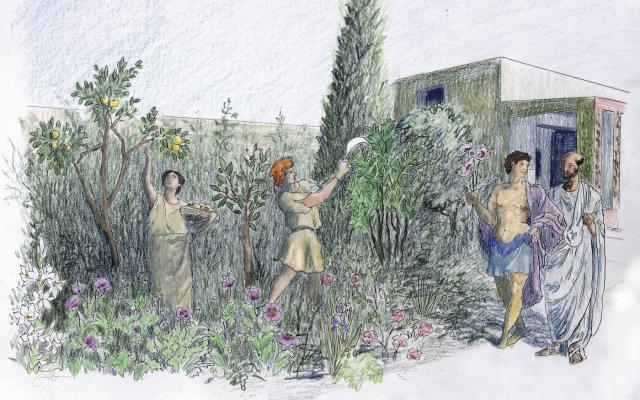
Dr. Feito’s analyses, for example, have identified a range of plants present in the garden from ornamental species, such as floral species, to food-producing ones such as grape, walnut, and olive. This range helps us not only reconstruct what the garden may have looked like but also allows us to say something about the specialized knowledge required for its upkeep. As Dr. Feito explains, “Different plants require different techniques to grow and maintain them.”
By speaking with modern gardeners at historic Italian castles and villas, Dr. Tally-Schumacher has found surprising ways in which Roman gardeners were diverse in their specializations as well as their innovation with the care of their plants.