
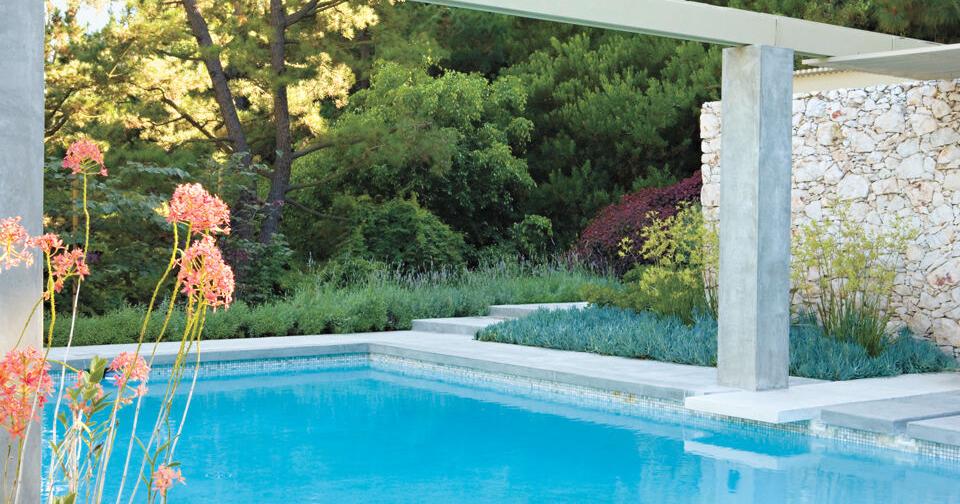

Landscape architect Patricia Benner uses lush plantings to bring softness to the pool area at a home in Pacific Palisades.
Karyn Millet
Location, location, location—the familiar adage about real estate is also very relevant to pool design. For landscape architects, it is the starting point for any projects that include pools. “It’s really the first thing we position and design—[the pool’s] location in relationship to the house or the site,” says David Thorne, who founded his namesake Oakland practice in 1983. “Everything else falls into place after that.”
Factoring into the siting, size, and style of the pool are the client’s aspirations for the aquatic element as well as the overall landscape. Are swimming laps and playing water sports priorities? Does there need to be an outdoor kitchen nearby, or a cozy firepit for gatherings? Is the pool a destination on the property? How much plant maintenance is realistic? What makes sense with the topography? Of course, then there are visual determinants, namely views—of the pool itself or those seen from the water—and the architecture of the house.
At his clients’ behest, Oakland landscape architect David Thorne created a serene outdoor space with plenty of sun and shade.
Paul Dyer
Over the past few decades, rectangular pools have overtaken freeform shapes for good reason: Built-in automatic covers, which address safety issues and reduce water evaporation, are more readily available for rectangular- and square-shaped pools. (Safety concerns have also made diving boards less popular.)
Meanwhile, the materials used for pool construction have vastly expanded. When Thorne was just getting started, concrete coping and blue tiles were everywhere. Now stone has come into use, and there is an “amazing” array of tiles, he says, pointing to those by Fireclay Tile and McIntyre Tile. For the plaster lining the pool’s interior, high-end finishes embedded with pebbles and seashells can enhance the aesthetics of the surface.
David Thorne had to contend with a steep slope and grade change when connecting the main house and renovated pool at this Alamo home.
Paul Dyer
While landscape architects like Thorne spearhead the design of a pool, the installation process—whether starting from scratch, remodeling, or replacing—is a broader collaborative effort. Structural and soil engineers are consulted, and a pool contractor brings the design concept to fruition.
Patricia Benner, a landscape architect for 25 years, has offices in Berkeley and Los Angeles. In one of her projects in Pacific Palisades, the brand-new main and guesthouses occupied much of the lot. “The client wanted to look out the main axis of the house to the pool,” she says—hence the pool’s proximity to the house. A pergola allows for shaded seating, and lushness abounds despite the lack of acreage, as Benner incorporated a lawn, including around the perimeter of the pool. “We didn’t want to have it all be hardscape,” she says. “The grass gives it a softer aspect.”
Properties with ample land can translate to more siting options—and complexities. For one of his projects in Alamo, Thorne contended with an exceptionally steep hillside. The house is perched at the top, with an existing pool about 35 feet below. Although the pool’s location stayed the same, a remodel resulted in upgraded materials—for example, Italian bluestone coping. According to Thorne, the main challenge was reimagining access: “How can we entice people to go down to the pool in a safe and beautiful path of circulation?”
Thorne devised “floating deck stairway systems that wind their way above the ground, so we didn’t have to do any grading,” he says of the modern design comprising Thermory and powder-coated metal. “The staircase weaves through the native trees, with a series of pause points, including landings, that give you the opportunity to catch your breath [and] take in the views of the oak trees, Mount Diablo, and the pool below.” Native plantings, large pavers, and a Concreteworks fire feature are now part of the poolside landscape.
A grass lawn around the pool perimeter balances the hardscape of the deck at this Patricia Benner project.
Karyn Millet
When Joseph Huettl, whose landscape architecture firm is headquartered in Walnut Creek, was enlisted for a sloped site in Danville, he conceived a pool area several feet below the house, about half the distance he initially thought, which ultimately made the pool more accessible from the home. “The soil engineer had a bunch of soil available from the excavation of the Danville Hotel,” says Huettl. “So they brought the soil over and engineer-filled the yard.”
Since a level yard was not the end goal, the pool is still terraced down. The slope was ideal for adding in a whimsical element—the concrete embankment slide that descends from a cedar-clad cabana, whose form and materials echo the main house. Among the other alfresco attractions are a dining patio with a kitchen, an expansive lawn, and trees and plants bearing fruits and vegetables.
Flowing water spouts and greenery bring visual interest to an Orinda backyard designed by landscape architect Joseph Huettl.
Courtesy of Huettl Landscape Architecture
In recent years, Benner’s clients who boast views and a drop-off on their properties have increasingly requested infinity-edge pools. “Those look more like water features and less like traditional swimming pools,” she notes. Indeed, while a pool can serve both aesthetic and athletic purposes, in many instances, it is primarily the former.
Some of the smaller pools that Huettl designs double as spas—thus, the “spools” nickname—not to mention water features that can be enjoyed from afar. He frequently integrates spouts on a wall, from which water then flows into the pool. “If you’re not using the pool, it’s still something beautiful to look at,” he says. “At night, when you have a back wall and light up the pool, the movement of the water creates a mesmerizing effect. It’s like dancing lights.”
Joseph Huettl uses native and Mediterranean plantings to frame alfresco entertaining areas of this home on the west side of Danville.
Courtesy of Huettl Landscape Architecture
When it comes to the plant palette, the architectural style of the house and pool is key. In a more formal setting, for instance, Thorne might introduce clipped hedges and boxwoods. A modern residence would likely call for fewer plants, and perhaps a reliance on grasses, which can temper hard lines.
Huettl favors grasses and rushes, too, which are traditionally associated with water in natural environments. With greenery closer to a pool, there are also practical considerations. Plantings that litter the water with leaves, seeds, and pods are generally less desirable. Huettl also tries to keep some space between the pool and flowering plants that are especially attractive to bees (for example, kangaroo paw may be preferable to lavender). For bold texture, succulents do the trick and are low maintenance.
In the late 1980s, when Huettl first began his landscape architecture career, “there were a lot of undesigned yards,” he recalls. “Because they didn’t have a designer, people would just plop the pool in. They didn’t have firepits and outdoor kitchens and all that stuff. The pool was their jewel, so they’d put it front and center—like ‘Hey, come and look at my pool!’ Now, pools are a piece of the puzzle; they have to fit with everything else.”