
More than 70 of the 1,600 trees died and many more are suffering or missing. A multidisciplinary team is seeking solutions.
By Timothy A. Schuler
Signs that the trees were struggling at the Flight 93 National Memorial were apparent almost as soon as the saplings went in. Located on a former coal strip mine outside Shanksville, Pennsylvania, the memorial was designed by Nelson Byrd Woltz Landscape Architects and Paul Murdoch Architects. It features roughly 2,000 trees arranged in a 1.2-mile-long allée of red maples and 40 memorial groves, one for each of Flight 93’s victims. Within three years of the memorial’s completion in 2016, the trees were showing symptoms of stress and early mortality, so much so that National Park Service (NPS) staff began documenting the issue.
 Image by Nina Bassuk, et al.
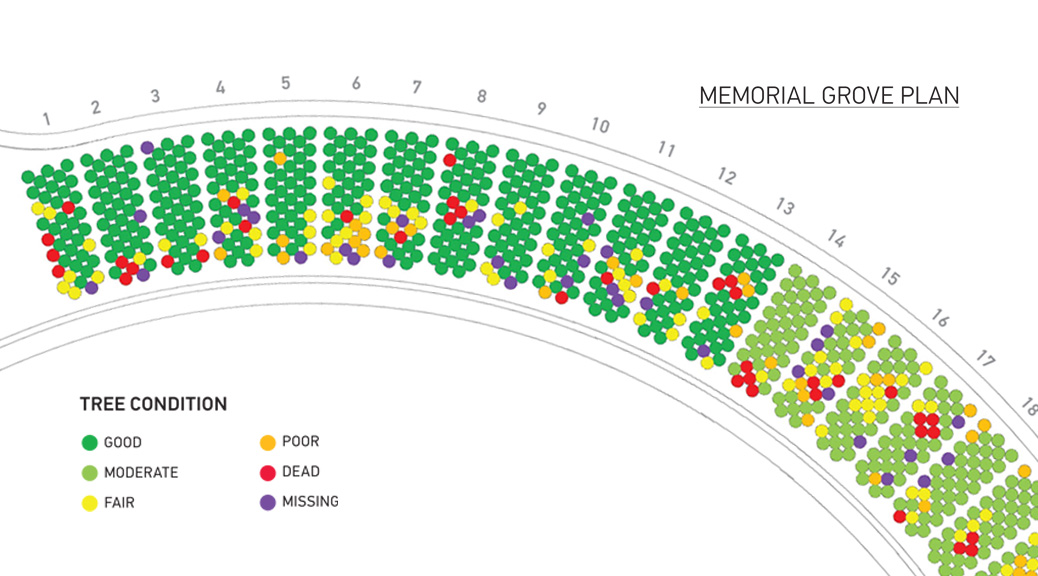
A 2020 conditions assessment conducted by Cornell University found that of the 1,600 trees in the memorial groves, 76 had died, 276 were in fair or poor condition, and 175 were simply missing. Now, a team of arborists, soil experts, and landscape architects from Cornell, NPS’s Olmsted Center for Landscape Preservation, and the Center for Cultural Landscape Preservation at the State University of New York College of Environmental Science and Forestry (SUNY-ESF) is working to understand the underlying causes of the decline and develop a long-range management plan.
One of the contributing issues is that after 50 years of coal mining, the site was remediated with just a few inches of soil and some treatment ponds. Paul Josey, ASLA, who managed the Flight 93 National Memorial project for Nelson Byrd Woltz, says that the designers’ initial recommendation to truck in new topsoil was scrapped for budgetary reasons, leaving them to develop less-costly work-arounds, including “ripping” the soils to decompact them. In addition, this work was completed for just the first phase of planting, which is discernible a decade later. “There’s a real correlation with the phasing, where we’re completely replacing most of the groves that were planted during the second phase,” says Robert Page, FASLA, the director of the Olmsted Center.
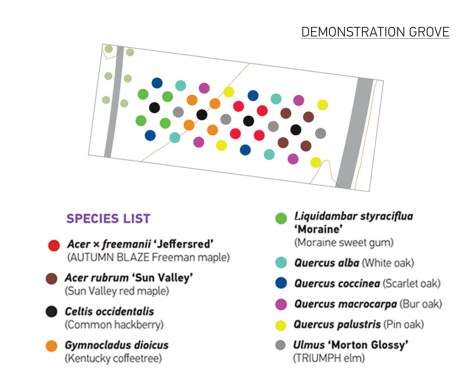 An updated palette of trees was developed based on field observations and advanced digital modeling. Image by SUNY-ESF.
The current team is testing a two-pronged rehabilitation strategy: first, amending the soils in the phase two groves before replanting, and second, rethinking the species selection. Helping guide the latter is SUNY-ESF’s Aidan Ackerman, ASLA. Using a plug-in for Blender called (appropriately enough) The Grove, Ackerman and his students built a digital model of the proposed composition of the grove and then digitally “grew” the trees to various levels of maturity. “One of the things that the software does really well is when you have multiple trees together, it responds to available light, as well as things like branching,” Ackerman says.
The modeling helped the team grasp how a tree’s morphology would alter the character of the groves and test the effects of future mortality. “If a certain number of trees were lost within the grove over 5, 10, 20 years, would it still read as a grove?” says John Auwaerter, ASLA, who co-directs the Center for Cultural Landscape Preservation. In 2022, NPS replanted memorial grove number 40 as a demonstration grove using the soil amendment strategy and a new composition of species. Ongoing evaluation of its performance will guide future replanting efforts, including three additional groves and a section of the allée, preparation for which began in 2024 and is expected to commence this year.
Timothy A. Schuler is a contributing editor at the magazine. His writing has appeared in Metropolis, Bloomberg CityLab, and Places Journal, among others.
Like this:
Like Loading…