
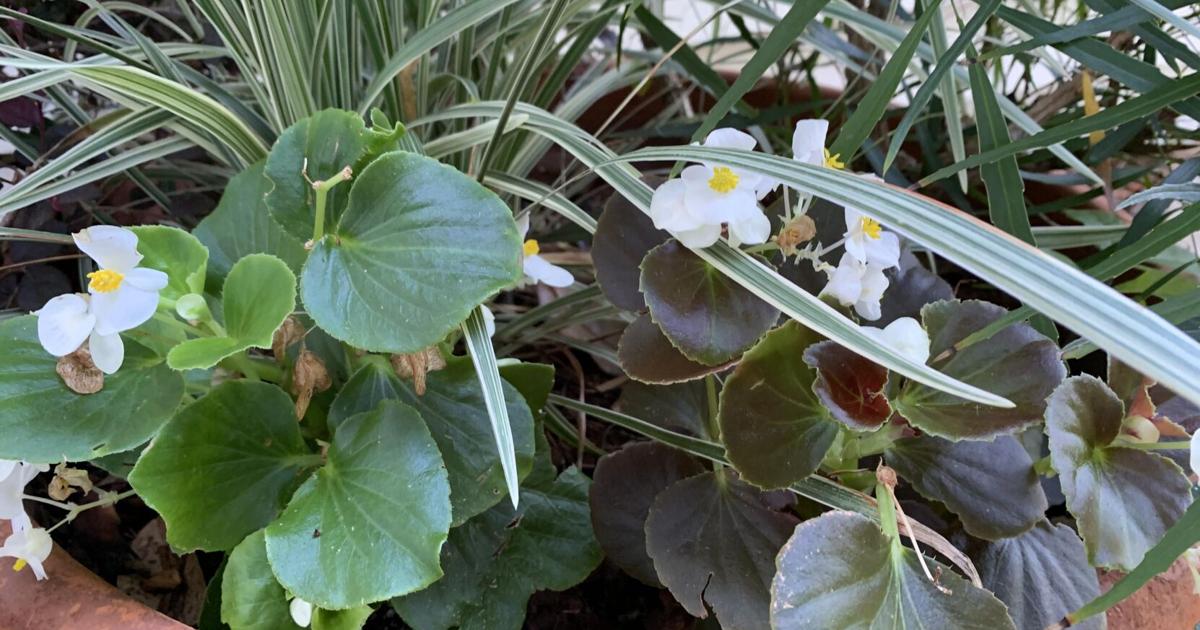
Begonias (Begonia semperflorens-cultorum) are warm-season annuals with a long blooming period; the “semperflorens” part of the species name means “always flowering.” Another very useful characteristic of begonias is that they grow in sun or shade.
Many types of begonias
The easiest types of begonias to grow are annual begonias used as bedding plants and spreading begonias that are excellent choices for hanging baskets.

Begonias are perfect for a strawberry jar because they tolerate dry soil.
Anthony Keinath/Provided
Annual begonias, also called wax begonias because of their naturally shiny leaves, come in six basic color combinations. Their flowers are either white, pink or scarlet red and their leaves are bright green or bronze. Most garden centers stock only some of the possible leaf-flower color combinations.
While a number of different cultivars will hang over the edge of a pot, I absolutely love the Hula spreading begonia. My “Hula Red” plant has been blooming non-stop in its original plastic hanging basket for two years, summer and winter. I don’t know many other plants that can match that record.
The secret to its continuous bloom is that Hula and a sister cultivar “BabyWing” are day-neutral. Flowering is not controlled by a minimum number of hours of daylight, like it is for wax begonias and other spreading cultivars like “Dragon Wing.”
Spreading begonias, which are hybrids of wax begonias and other Begonia species, also come in different leaf and flower colors. “Hula Red” has green leaves, but with age or when exposed to winter temperatures, the leaves turn reddish bronze.
Angel wing begonias have large spotted leaves with a red underside.
Anthony Keinath/Provided
Wax begonias have round, heart-shaped leaves. “Dragon Wing” and angel wing begonias are named for their much larger leaf shape resembling a bird’s wing, but these two begonias grow very differently. “Dragon Wing” is a popular cultivar of spreading begonia with shiny green or red leaves.
Angel wing begonias are a different species (Begonia coccinea) with stiff, upright stems and dull, blue-green leaves with distinct white spots. The species name “coccinea,” which means “red,” probably refers to the red leaf undersides. Indoors, stems reach three feet or more and need staking. Stems can be cut back, but note that the plant will sprout at the height of the cut, not below it. Angel wing begonias are frost sensitive.