
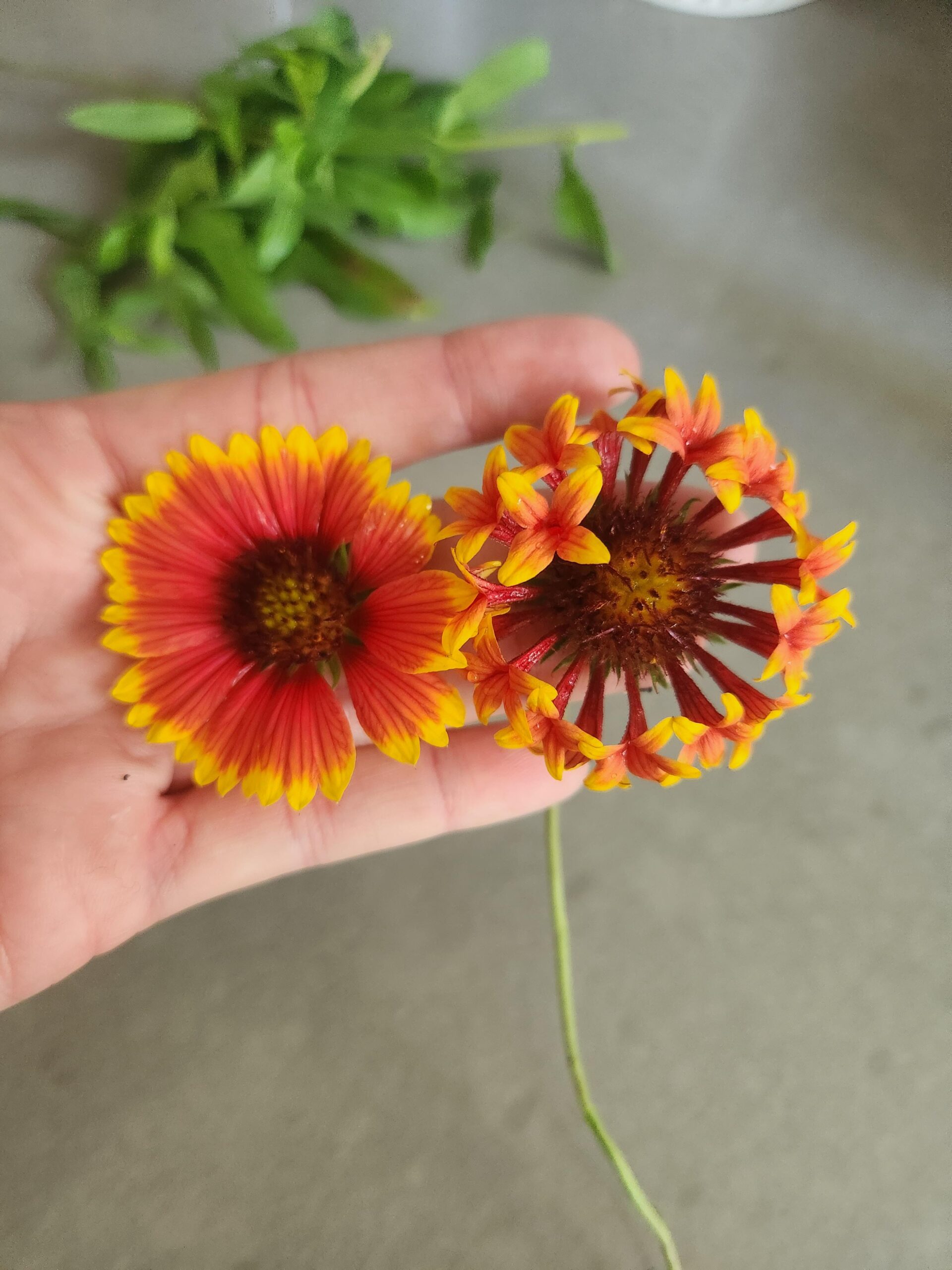
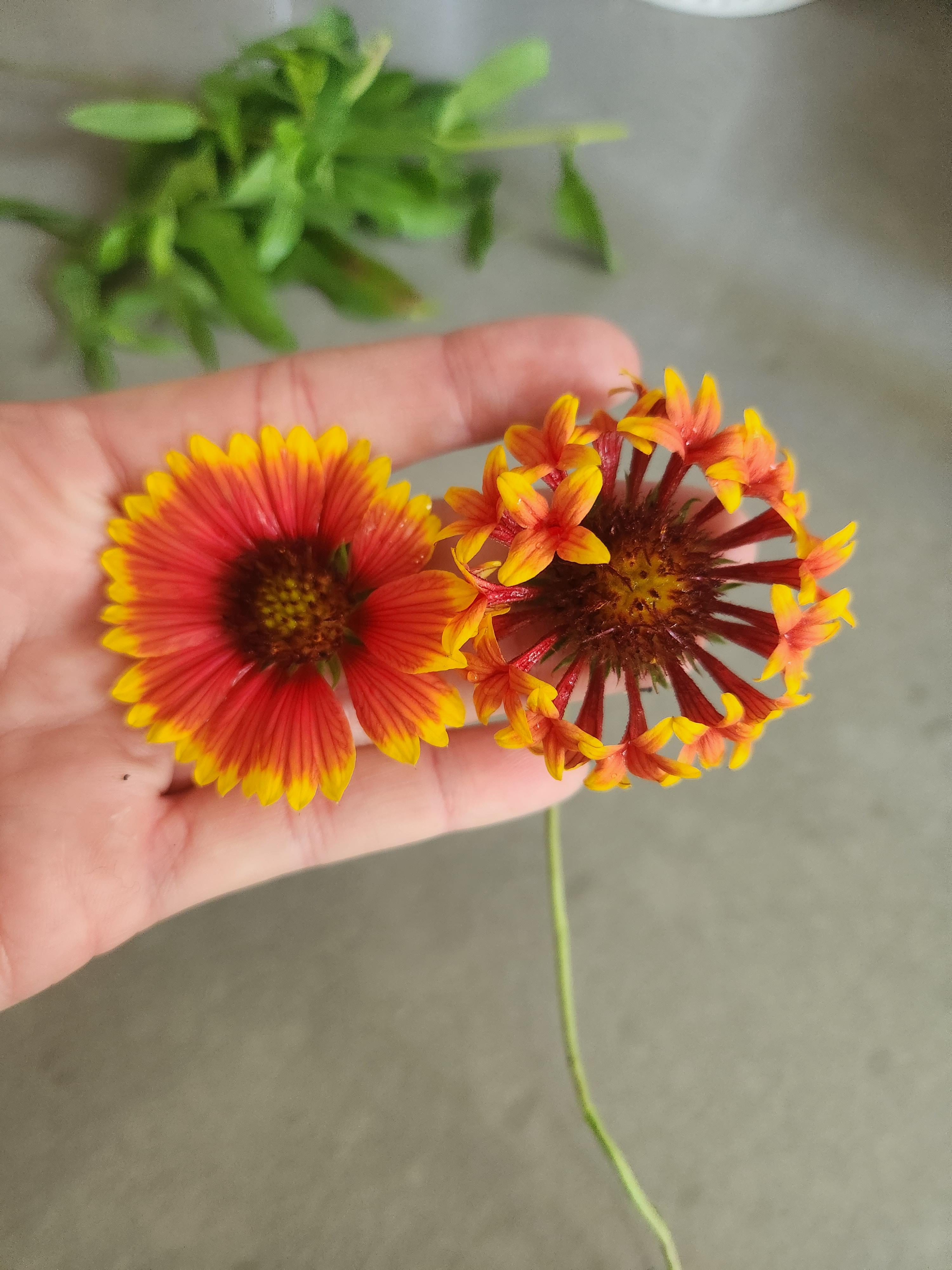
The one on the left is the normal phenotype, and the one on the right is the only flower on the plant that looks like this. Almost looks like it’s been crossed with butterfly milkweed, which is also growing in the same bed. Seeds were purchased at Walmart!
by yung_barfight
19 Comments
Welcome to being a plant breeder. I haven’t seen blanket flower like that yet.
By the looks, milkweed is in a different family than asteraceae, so very very unlikely of cross breeding.
Apples for example do the same thing, when a new stem deviates from the mother tree and makes a new variety by genetic mutation.
Keep the seed off that flower, and the seed from the remaining plant, and try to grow them again next year. I keep the mutated flowers seed and grow that to test if the variation continues in the sub generation, and I usually grow some from the rest of the same plant to check if the potential has and probability of repeating. Keep as much of the seed off the mutant as possible.
Lots of work, truly, but if you have a genetically unique variant, there is good money in that variety if people like it and it sells well. Otherwise, you get to name the variety of you just wanna put a stamp on the gardening world.
Save the seed and select for it in the next generation.
In plants with ray flowers, like the aster family, the flowers only have 1 petal, and they are arranged along the outside of the disk.
Your mutated plant still has petals on the outside of the disk, but it has all 4 or 5 petals per flower, not just the one.
Fascinating mutation!
So mutations like this happen. Are the rest of the flowers on the plant like that? If it was just this one flower, it doesn’t mean anything. You probably can’t reproduce it. If they’re all like that on the same plant, you might be able to.
There’s varieties of Gaillardia that look like this, some even have multiple layers of trumpet shaped petals and look like puffballs. Look up “Double Sunset” or “Lorenziana” Gaillardia.
Thats so goddamn cool
“Double” gaillardia looks like this. It could be a mutation or the seeds got cross pollinated by a double one.
Gallardia Aristata? Mine come in early season as the left phenotype and then the blooms later in the season look like the one on the right.
Kinda cool. Your flower grew flowers!
I hope this is stable. Most Likely won’t grow true next year, but awesome if it does!
Its a common(ish) mutation. If you go to a nursery in the spring while the blanket flowers are first blooming; youll find an easy 4 or 5 on a table of 100 seed plants.
I have a lot of blanket flower in my garden; even normal looking plants will occasionally throw one with the florets.
That’s what all of mine look like! Flowers have flowers for petals. So cool
This is actually so exciting
Asteraceae have compound flowers called capitulae (singular: Capitula). These are often composed of disc-shaped arrangements of smaller florets (the actual flowers with stamen and pistils). Each of these florets have their own set of petals, but usually they’re quite small and nondescript. Typically only the outer florets have long luxurious petals like you see on the blanket flower on the right (and in the classic outer floret ‘ray petals’ of daisies and sunflowers), which contrasts with the lesser-petaled inner florets that are usually darker colored. This floral structure gives the benefit of producing a large array of nectar/pollen delivery sites (and ovaries) while investing relatively little in decorating it with flashy advertising.
Every cell in the developing flower has the same genes, but different populations of cells start to *express* their genes in different ways as they differentiate into their final cell-types. Even though the inner florets have all the genes to make the fancy petals, they don’t because those genetic programs are shut off. Sometimes you find crazy mutants that have ray petals on every floret. Similarly, the outer florets have all the genes necessary to make their fancy petals entirely encircle each floret, but under normal circumstances the floret only produces a single petal facing outward relative to the whole capitula.
Whatever mutation you’ve happened across has impressively made those outer florets produce the ray petals in a complete corolla. Super cool!
Gorg
This is so cool!!
Looks like it had unprotected sex with lantana.
When your flower decides it wants to wear a flower-crown, too.
OP: When you name your new flower, please name it “Starboy.”
I named my dog Starboy, after the song by The Weeknd. The best dog name and **the best dog in the multiverse.**