
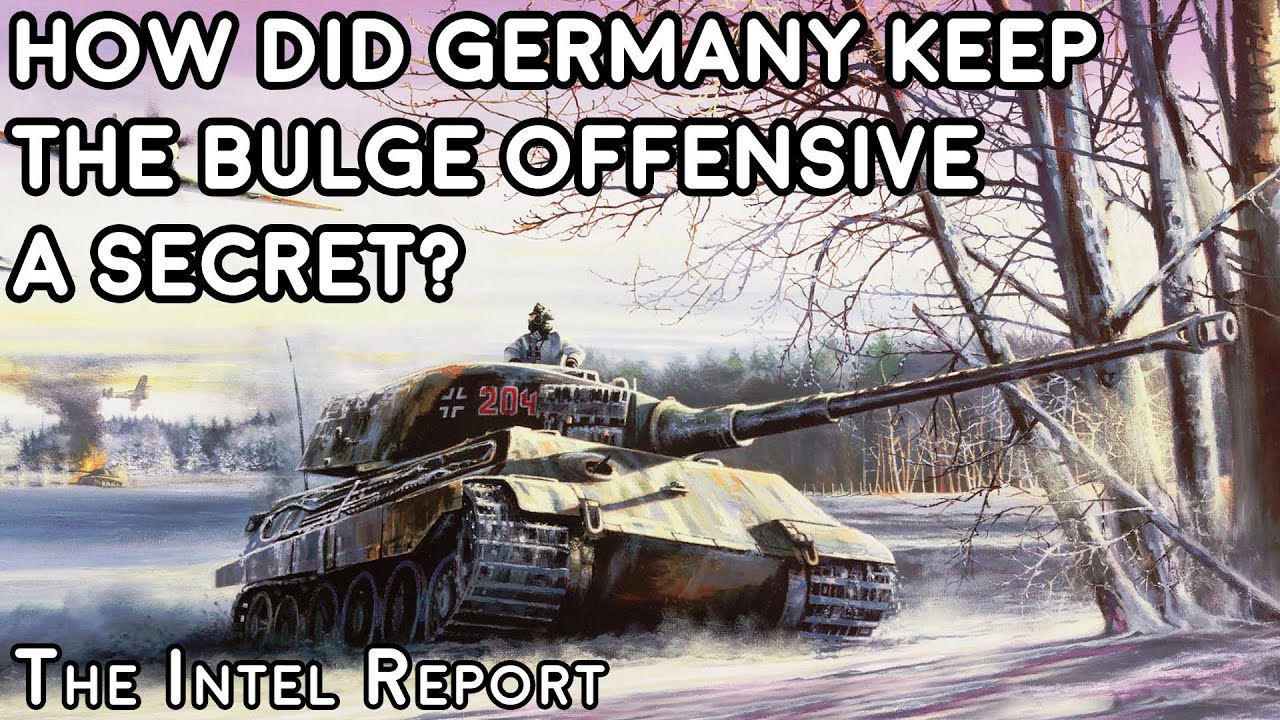
How did the Wehrmacht succeed in keeping the buildup a complete secret, considering the allies had air superiority for aerial recon, and ULTRA?
In December 1944, the Allies have pushed back the Third Reich to it’s own borders. The Fuhrer grows desperate for a decisive victory to defeat the western Allies so he can turn his full attention to the Eastern Front. Three German Panzer Armies are secretly assembled at a quiet sector of the front, and on the 16th December 1944, the panzers launch their assault.
Bibliography
Ambrose, Stephen E. Band of Brothers: E Company, 506th Regiment, 101st Airborne from Normandy to Hitler’s Eagle’s Nest. New York, NY: Simon & Schuster Paperbacks, 2017.
Beevor, Antony. Ardennes, 1944: Hitler’s Last Gamble. London, UK: Viking, an imprint of Penguin Books, 2016.
Caddick-Adams, Peter. Snow & Steel: The Battle of the Bulge, 1944-45. New York, NY: Oxford University Press, 2017.
Cole, Hugh M. The Ardennes: The Official History of the Battle of the Bulge. St. Petersburg, FL: Red and Black Publishers, 2011.
Johnston, Wesley. Combat Interviews of the 7th Armored Division Combat Commands: St. Vith and Manhay, Belgium, December 16-23, 1944. S.l.: CreateSpace Independent Publishing Platform, 2014.
Jordan, David. Battle of the Bulge: The First 24 Hours. London, UK: Amber Books, 2019.
Whiting, Charles. Decision at St.-Vith: The Story of the U.S. 106th, The Division Hitler Smashed in the Battle of the Bulge. New York, NY: Ballantine Books, 1969.
Zaloga, Steve, Howard Gerrard, and Peter Dennis. The Battle of the Bulge: St. Vith, the Northern Shoulder and Bastogne. Minnetonka, MN: History Channel Club, 2005.
Zaloga, Steve, Peter Dennis, and Howard Gerrard. Battle of the Bulge 1944. Oxford, UK: Osprey Publishing, 2004.
23 Comments
I love this
Man, this channel was such a good idea. Thank you for all of the content.
✌
That's not Benjamin Dickson. That's General Simpson
Germans still aren't as good as Russians concerning 'maskirovka'…
general yodel lmao
I'm thinking this might apply to modern Kherson contemplations? Or, perhaps Belarus/Kiev…or both at the same time?
3 ideas
Germans probably had an inkling that their code had been compromised and went full blackout mode just to be safe.
This same Eifel region was used strategically in 1940 it was remote territory. Germans knew it, US and Brits were new to it.
Allied forces were stretched to their full extent on supplies and replacements, they were tired.
Similar to the US being caught unprepared for the Tet offensive in Viet Nam.
Given the amount of fuel they had left – this operation was doomed from the start.
What they might have done ….
Was to take those units dressed as Americans – and use them to find the American Supply Dumps with all that fuel. THEN – make seizing those dumps the first priority of the battle, using Paratroopers and those disguised units.
It still probably wouldn't have any that much difference but … maybe Piper wouldn't have had to blow up his own tanks and walk back.
One of the things that happened – was there WAS a large fuel dump close to where the Germans were. But – Engineers blew up all the bridges over the river the Germans had to cross and created Road Blocks to keep the Germans from it – all while emptying that dump as fast as they could.
Of course – the BEST chance the Germans had of winning the war – was if Halifax had wanted the job …
Still ….
The thing is … in the first half of 1941 – the Germans were winning the war. They only had the British to fight – and had already demonstrated that they could beat them.
IF the Germans had NOT attacked the Russians – but – put a fraction of the Resources into North Africa that they put into Barbarossa – they could have taken Suez, Kirkuk (a French Oil Field) and the oil fields in Iran the British were using. That – and they would have had land access to all of Africa – with all those rare metals the RN was blockading them from getting.
But – instead … in the last half of 1941 – the Germans CHOSE to go to war with the Soviet Union AND The United States.
After that – they were doomed no matter what they did.
.
It’s obvious, most all war leaders believe their own bullshit, and lots of other people die as a result.
PATTON SAW IT COMING, "Brad could get himself in a lot of trouble up there." Even had 3 different battle plans just-in-case. Eisenhower didn't like Patton and wouldn't listen, but Patton saved his tushi anyway.
The official US Army histories I've read paint a very different picture of Col. Dickson. You say he "correctly identified the threatened area." The official histories I've read state, to the contrary, that Dickson "identified an area well north of the Ardennes as the most likely point of attack, and he failed to give a probable time for the operation." Also the official accounts don't have him being ordered to Paris. It was his birthday and he went to celebrate, which, again, the official histories say that is "something he would not have done had he correctly guessed at the German battle plan." Do you have a source for your version? Koch, Strong, Dickson, and others seemed to have had an inkling something was up, but nothing concrete. Or, there was a massive cover up?
8:25 dependency on ULTRA
a clear example of tunnel vision. If the general staff believed ULTRA to be infailable, it limited their gaze and thought
Thanks
Good video !
Only a few months earlier a failure to identify German troop concentrations in the area of Market Garden caused its failure.
I should note that Colonel Dixon’s leave to Paris was for his birthday, and not necessarily a punishment by his superiors.
04:34 Hitler assassinated in alternate universe 😉
Please cover other conflicts.
Could you do a series about dday, that would be awesome
The idea that the Allies should have penetrated German secrecy and figured out that the Ardennes offensive was coming is not supported by evidence. There is no evidence that decent evidence of the German plan was uncovered, was supplied to leadership, who then chose to ignore it. There was all sorts of intel speculations of what the Germans might do, including the possibility of an Ardennes attack. Leadership does not make critical decisions based on speculations. And the likelihood of such an attack, without decent intel that it was being planned, was remote. One reason is shown by the actual battle events – the attack struggled in making meaningful progress because the terrain and weather were huge obstacles. It was a crappy plan, so reasonable not to expect it.
Of course, one reason that the German military genius Hitler picked this shitty plan was that it would therefore be a surprise, which allegedly made it brilliant. No, it was still crap, but it could be a surprise if the Germans maintained secrecy.
Which brings up the real question – was surprise for an offensive of this nature unusual, and therefore due to failure to detect it? The answer is clearly no, as revealed by other large offensives in WWII. In 1942, the Germans fooled the Russians as to their plan to attack in the south. The Russians were expecting a resumption of an attack in the center toward Moscow, and were caught unaware and out of position. Later in 1942, the Russians successfully concealed their major counter offensive that resulted in the encirclement of Stalingrad. In 1944, the Russians fooled the Germans as to Operation Bagration, and the Germans positioned their entire strategic reserve to defend an alleged attack in the Ukraine, where it was rendered useless. It resulted in a surprise attack that inflicted the greatest loss on a German army in history.
Compared to those offensives, the Bulge was a minor offensive. That it was successfully concealed was typical for WWII. The narrative that the surprise attack reflected a significant Allied intel failure is just wrong. The wise generals in WWII were aware that surprise was always a real possibility, and a mobile strategic reserve was essential for all parts of the front. The key was the mobile counterattack in response to a major attack. Eisenhower was aware of this, and immediately saw the Bulge as an opportunity for a counterattack that would destroy major elements of German strength far easily than if it had remained in defense. And that is what happened.
What would've happened if the Battle of the Bulge been successful? would it accomplished what Hitler was hoping or would it be just a setback for the Allies? Has anyone ever analyzed this?
In my opinion, had the Germans captured Antwerp, they'd still have lost the war, just would have taken longer. They didn't have the strength to capture Antwerp and destroy or for the withdrawal or surrender of the 21st Army group or the Americans.