
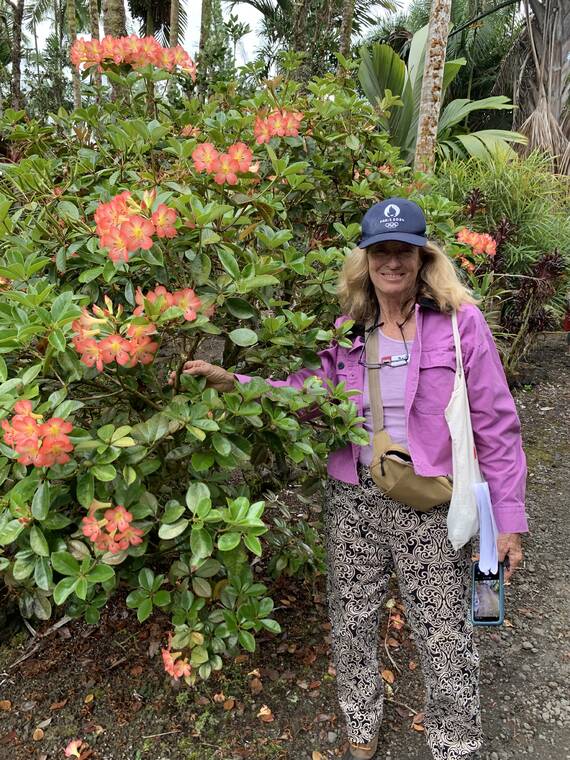
With shorter days, most folks are getting chronic Hawaiian Spring Fever in the fall. This means being close to nature with plants.
Hydrangeas are coming on the market with blue, pink or white flowers. They are intermittently available from now to Mother’s Day. Hydrangeas generally grow in cool wet areas like Volcano and Waimea, but may be grown almost anywhere if given enough moisture and shade in sunny locations.
Also look for members of the rhododendron family. Throughout the Northwest U.S. and Japan, one of the highlights of cooler weather is the mass blooming of azaleas and rhododendrons. In Hawaii, these attractive garden shrubs are popular in cool, mauka areas. This year, the plants are also available as potted houseplants at our local garden shops and nurseries.
If you are looking for some cool season color to perk up your home or garden, azaleas and tropical vireya rhododendrons are a natural. They are great gifts for the holidays that are coming soon. In fact, they are perfect for a gift just about anytime, since living gifts are gifts of aloha.
Azaleas and vireyas are part of a small but widely distributed family found in many parts of the world. They are usually found in cool, moist regions such as the Pacific Northwest and the Himalayas. Some species are even found on high mountains in Borneo and New Guinea.
Many species of this group are adapted to temperate regions, but some have found Hawaii a good place to live especially the vireyas. Some are terrestrial and some are epiphytic. Some you will find on the market bloom in reds, whites, pinks, yellows and even mixes of white-pink and white-red. They are relatively slow growing in Hawaii. You may also grow them from cuttings that may be started now so they will be gifts for spring holidays like Easter and Mother’s Day. That is why a gift of an azalea is something special. Once you grow or buy your living bouquets, they are easy to care for if you follow a few simple rules.
The plants will take on a healthy look with an occasional leaf washing. This will discourage insect and mite buildup. The proper watering of plants is more important than giving them a bath. In general, plants require a thorough soaking at least once a week.
In warmer temperatures or air conditioning, plants may require more water. Applying too little moisture may allow the soil to dry, causing the plant to wilt or die. On the other hand, keeping the plant roots soggy wet will also cause injury. Make sure the pot has sufficient drainage. Protect the plants from being broiled alive by direct sun, hot or windy areas. In cool mauka areas, they may be placed in sun. They like their food served at regular intervals. Special acid azalea fertilizers are available. The best suggestion of feeding is to follow the directions on the plant food container.
Here are some tips on diagnosing plant troubles.
Brown tips or burned margins may mean you’ve applied too much fertilizer, you’ve let the plant roots dry out, or you’ve let the plant become wind burned. Yellowing of leaves indicates over watering, poor drainage, or poor soil aeration. Small leaves suggest a tight or heavy soil mixture, lack of fertilizer, or not enough moisture. Weak growth or light green color on otherwise healthy foliage indicates too much light, lack of fertilizer, root-rot, or poor root systems. Yellowing, wilting, or soft growth means too much heat or root injury. Remember, most require an acid soil.
If you decide to plant them in the garden or repot them, give plants a mix high in peat moss. Make sure you don’t plant them in soils that are high in calcium. Avoid planting in concrete containers, near sidewalks or concrete foundations since these contain calcium and will cause nutrient deficiencies. Also remember, they should not be planted near the ocean or in hot, dry or windy areas.
If you want to learn more about the rhododendron family visit the Panaewa Zoo in Hilo. They have a great collection of vireya or tropical rhododendrons to view. Also you may call the UHCTAHR Master Gardeners at 808-322-4893 in Kona or East Hawaii at 808-981-5199.
Comments are closed.