
CLEVELAND, Ohio — An article in the summer of 2024 featured reader Jay in Lakewood, who asked about native shrubs that can safely be planted near a house foundation because he wanted to replace a row of overgrown nonnative shrubs.
His site is typical of many older Northeast Ohio properties: dry, mostly shady, clay soil, and the garden bed runs east to west and is protected from wind. In the original article, several area experts recommended he plant a mix of Gro low fragrant sumac (Rhus aromatica ‘Gro-Low’), Virginia sweetspire (Itea virginica), and witch hazel (Hamamelis virginiana).
Read all of Susan Brownstein’s columns here.
 Reader Jay’s Lakewood foundation planting before its native plant makeover.Reader submitted photo
This fall Jay shared an update, along with photos that show what a difference one year can make. But before the progress came some hard work: One of his notes began with, “I had a heck of a time clearing the garden bed out.”
Jay spent July of 2024 removing three large Japanese yews and an entrenched colony of Rose of Sharon, including the stumps. The clay in this area of the yard was dense but not terrible, and he relied on patience, water, and a tool that piqued my curiosity: the Pullerbear stump remover.
If you spend any time on native gardening or homesteading social media, you have probably seen Pullerbear products mentioned. They are made by a small Canadian company and function like an industrial strength lever that grips a trunk or sapling and pulls it out using the gardener’s body weight. They are not inexpensive, running $100-200 (including shipping), and I had never actually met anyone who owned one until I spoke with Jay.
Jay said that while the Pullerbear did not pop out the biggest Japanese yew shrubs, it made short work of the many Rose of Sharon saplings and saved him significant time and frustration. Because the site preparation was during a dry July, he soaked the soil with a hose before each session, used the Pullerbear where possible, and dug by hand when necessary. As he put it, “Be prepared for a lot of effort, but it is worth it.”
 This photo shows the five gro-low fragrant sumacs, three Virginia sweetspires, and three witch hazels on the day they were planted in fall of 2024.Reader submitted photo
Once the space was cleared, Jay planted five Gro low sumacs, three Virginia sweetspires, and three witch hazels, all sourced as larger container shrubs from Direct Native Plants. He organized the planting to look “deliberate,” with witch hazel in the back.
He topped the bed with free wood chips from a nearby park. (“Lots of trips in the car with buckets,” he noted, which is a familiar ritual for many frugal gardeners.) During the past summer, he watered once a week during dry spells but otherwise let the plants settle in on their own. The clay soil remained unamended, yet every shrub survived the first year, and one witch hazel even flowered this fall.
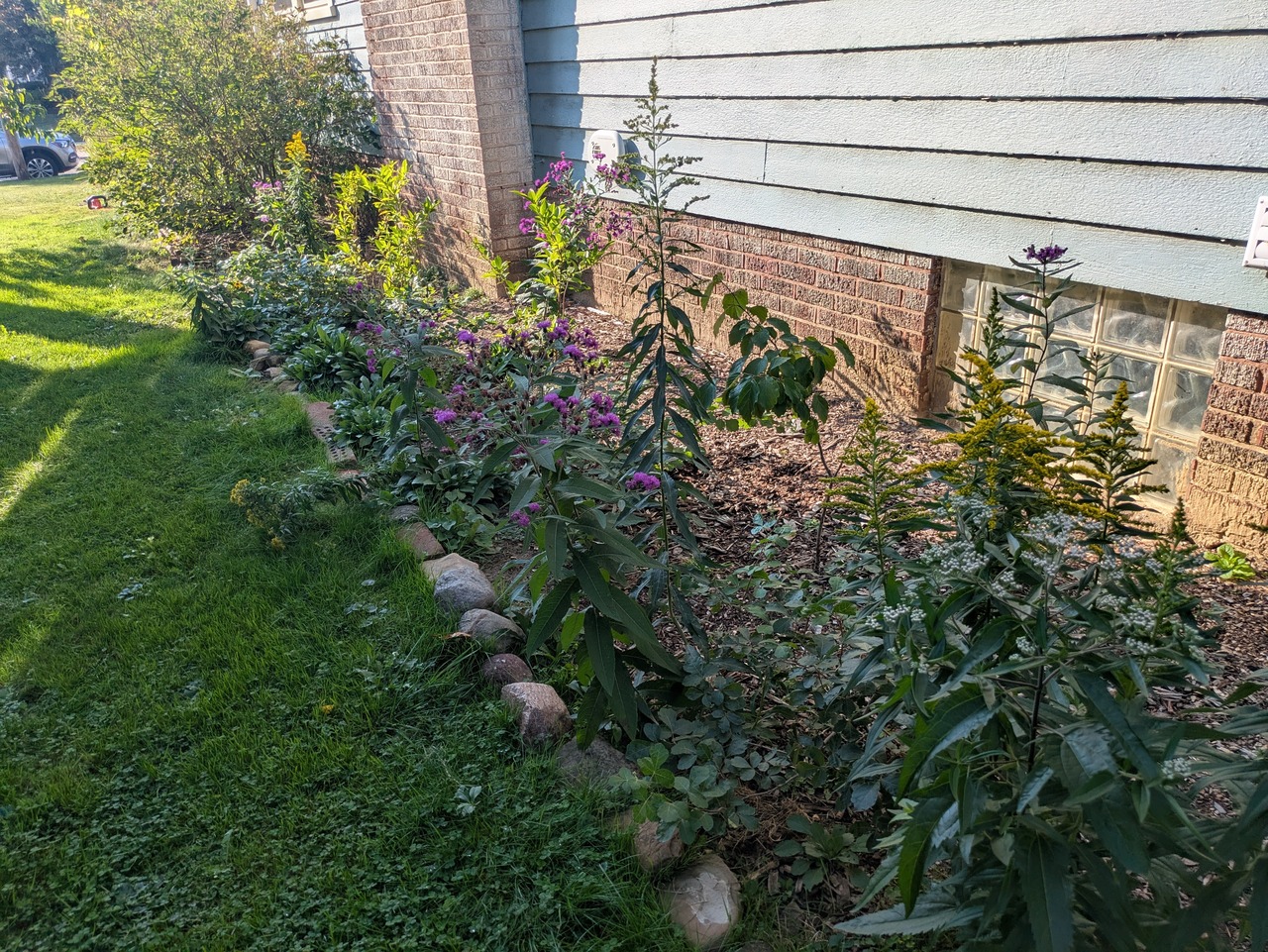
What surprised Jay, and what shows up clearly in the photos, is how many other native plants filled in around the new shrubs.
Goldenrods, ironweed, several types of milkweed, and black eyed Susans all migrated into the bed during the spring and summer, reminding Jay of what ecologist Doug Tallamy calls “addition by subtraction.” Sort of the inverse of “build it and they will come,” the concept is that once we remove nonnative shrubs, natives will arrive to fill the void.
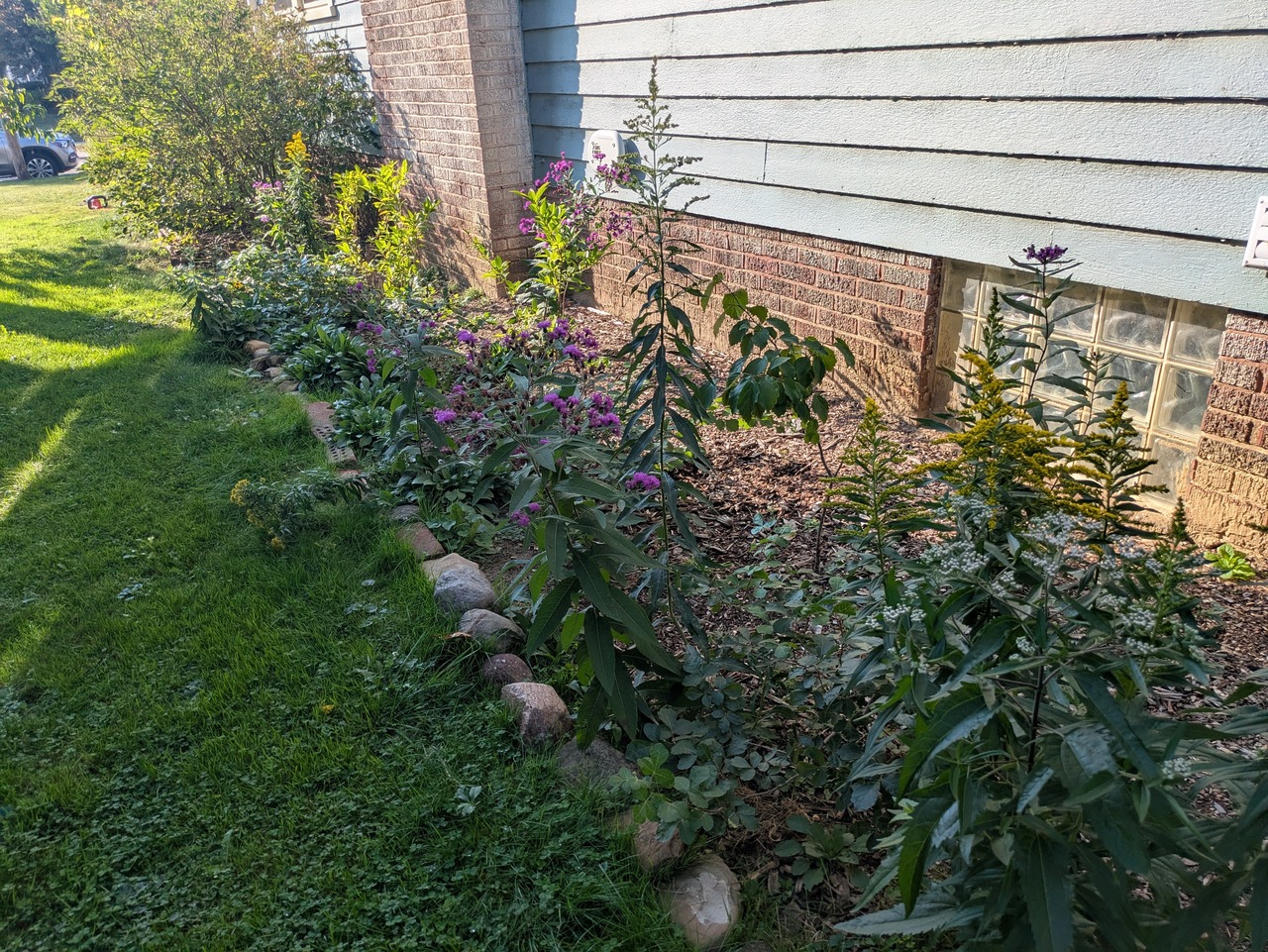 One year later, the native shrubs have taken root–and so have native perennials like ironweed and goldenrod.Reader submitted photo
In Jay’s case, this happened because he already had healthy stands of these species elsewhere in the yard. Goldenrod, milkweed, and ironweed are known for their seed dispersal and likely traveled by wind from his nearby perennials and were not necessarily dormant in the soil.
I include this clarification because many gardeners hope that removing old shrubs will magically reveal a hidden seedbank of desirable natives. In my experience, if you do not already have these plants somewhere nearby, undesirable weeds fill the vacuum instead unless you mulch carefully or plant densely.
One more important caveat: Jay reports that he does not have significant deer presence in his area. While his plant choices are fairly deer resistant when full grown, any young shrub should be protected with fencing material if deer are expected.
The new bed in Jay’s yard is already supporting other wildlife; he reports seeing more bees, a steady stream of butterflies, and one particularly remarkable day when so many monarchs visited the ironweed that the entire patch shimmered, to the delight of Jay’s children. Birds have not used the area heavily yet, but he expects that to change as the shrubs grow and provide denser cover.
Neighbor interest has grown too, and passersby have commented on the transformation. His yard includes several environmental certification signs, including Monarch Watch Monarch Waystation, National Wildlife Federation Certified Wildlife Habitat, and Greater Cleveland Wild Ones NEO Native Habitat Corridor. One neighbor even mentioned that Jay’s project inspired plans for a pollinator garden of their own.
Many Northeast Ohio homes have legacy foundation plantings, installed by builders decades ago to hide ugly utilities and transitions, and now incredibly overgrown and ecologically dead.
Jay’s experience shows what these boring beds can become when cleared, replanted, and allowed to evolve. Instead of merely hiding a basement wall, the space is now a dynamic, growing habitat that will improve its wildlife benefit each season and encourage others to do the same.
Thanks to reader Jay for the update and to all those readers who have emailed questions, updates, and general notes of encouragement. In this season of thanks, I am grateful to you all. If you have gardening questions or updates about your own projects, email me at sbrownstein216@gmail.com.
Comments are closed.