
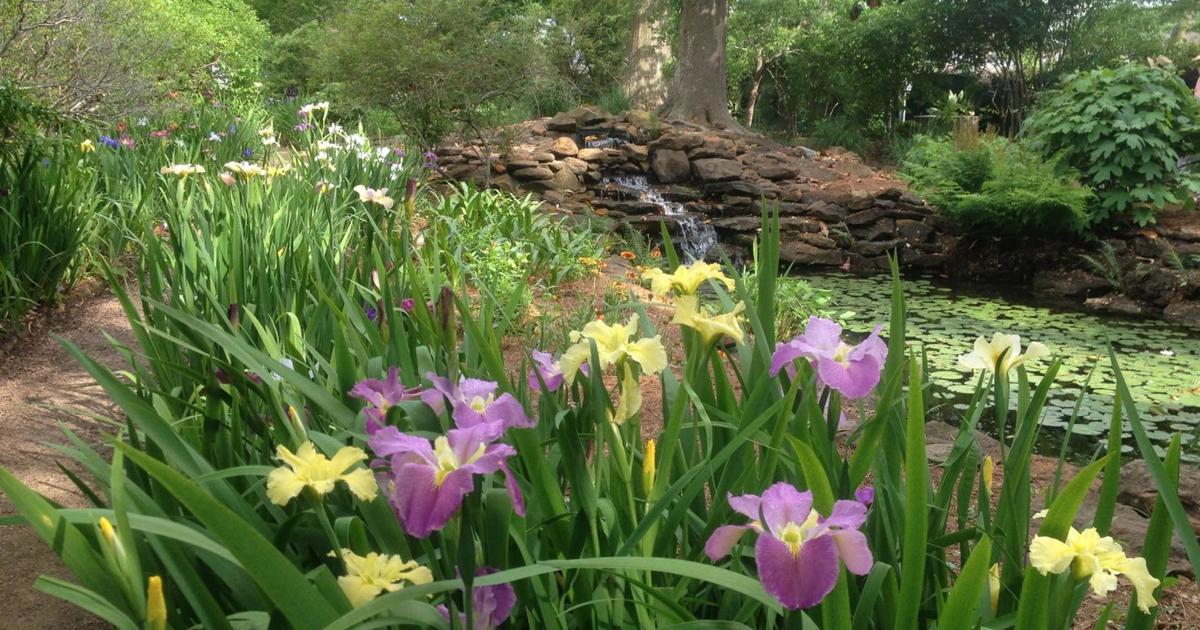
Louisiana iris is the name used worldwide for a unique group of Louisiana native iris species and, in particular, their hybrids. Their extraordinary beauty and reliability in the garden have made them increasingly popular, but they still deserve more recognition and use here in their home state.
Though several iris species are native to Louisiana, only five species, Iris brevicaulis, Iris fulva, Iris giganticaerulea, Iris hexagona and Iris nelsonii, are known as Louisiana irises. Only in south Louisiana do all five species occur together.
The crossing, or interbreeding, of these species has resulted in the modern hybrid varieties we grow today. Their large attractive flowers cover a broad range of colors including many shades of blue, purple, red, yellow, pink, gold, brown, lavender, burgundy and white. Varieties with bicolor flowers of contrasting colors, bright yellow signal markings or ruffled petals add to their beauty.

Louisiana Iris grows at the New Orleans Botanical Garden on Monday, March 21, 2016. (Photo by Chris Granger, Nola.com | The Times-Picayune)
CHRIS GRANGER
The best time to plant Louisiana irises is in August, September and October when they are dormant or just beginning their growing season. However, you can buy and plant them now while they are in bloom and pick out colors and types of flowers you like best.
When purchased and planted now, however, Louisiana irises need to be handled carefully to avoid damaging the foliage and flower buds.
Although in their native habitats the original species often grow in swampy or boggy conditions (Louisiana irises make outstanding additions to aquatic gardens), they can also be grown in ordinary garden beds with excellent results. Their culture is easy as long as you provide the right growing conditions and are familiar with their seasons of growth and dormancy.
Where to plant them
Louisiana irises should be grown with as much direct sun as possible. Although they will tolerate shade for part of the day, at least about six hours of direct sun are needed for good blooming. Avoid locating beds near large evergreen trees that create shade and extensive root systems that would compete with the irises.
When preparing a spot to plant Louisiana irises, incorporate a generous 3-inch layer of compost or rotted manure and a general-purpose fertilizer following label directions. They prefer a soil high in fertility and organic matter. They also generally prefer an acid soil, though here in New Orleans where our soils are slightly alkaline, they still do very well.
Aquatic culture is one of the easiest and most natural ways to grow these irises, and the foliage tends to stay more attractive in the summer. Simply place your potted iris into your aquatic garden so that the rim of the pot is a few inches below the water’s surface.
Every one to two years, divide and repot them in heavy garden soil. You can also simply plant them into the soil at the edge of a pond and they will grow along the edge and down into the shallow water.
How to plant them
When planting into beds, plant Louisiana irises at the same level they were growing in the container. The rhizome should be at the soil surface.
When planting irises from a container this time of year, they may be top heavy at first. If necessary, place a stake next to the plant and loosely tie it up. Established plants generally do not need to be staked.
The farther apart the irises are planted, the longer they may be left without dividing. If the plants become too crowded, they will not bloom as well. Crowding and insufficient sun are common reasons for poor bloom. If you are planting several plants in a bed, plant them in a group spacing them about 12 inches apart.
Providing adequate moisture is an important part of growing Louisiana irises. Keep newly planted irises well-watered and continue to water during dry weather until late June. After that, as the irises go dormant, watering is less important. Resume watering as needed in late September as the plants come out of dormancy.
Continuing care
Fertilize your irises in October and February with a general-purpose fertilizer following package directions. Irises growing in containers in aquatic gardens should be fertilized by lifting the pot out of the water and placing aquatic fertilizer tablets below the soil surface.
Always keep irises mulched when growing in beds. This is an essential part of good culture, especially in the summer. A two- to three-inch layer of leaves, pine straw or other mulching materials helps prevent sunscald of the rhizomes as well as reducing weeds and maintaining soil moisture.
Louisiana irises generally set seed pods after flowering. These seed pods grow to be large and heavy, and if left on the plant will tend to make them lean over and look less attractive. Also, the production of seeds uses up a lot of food and energy that could be better used by the plant.
So, remove the flower spike back to the point where it emerges from the foliage as soon as all the flowers have bloomed to prevent seed pod formation.
If you have never grown Louisiana irises, you will enjoy their easy care and amazingly beautiful flowers. If you already have some, consider adding some new colors to your collection.
SPRING GARDEN SHOW
Louisiana irises are among the vast selection of plants you will find for sale at the Spring Garden Show this weekend.
WHEN: 9 a.m. to 4 p.m. Saturday and Sunday
WHERE: New Orleans Botanical Garden, 5 Victory Ave. in City Park.
ALSO: Plant and garden product sales and exhibits, a Children’s Discovery tent, educational programs, live music, arts and crafts, cooking demonstrations and more.
TICKETS: $10 adults; $5.50 for ages 5-12; free for Friends of City Park members
Lawns are just waking up this time of the year. While they’re showing signs of becoming active, it’s a good time to consider strategies that w…
We can plant a wide variety of vegetables in the home garden this time of the year, but tomatoes are the most popular. If you want to grow fre…
I’m often asked for advice on how to have an attractive landscape that does not demand a lot of time and effort to maintain. While there are s…
Comments are closed.