
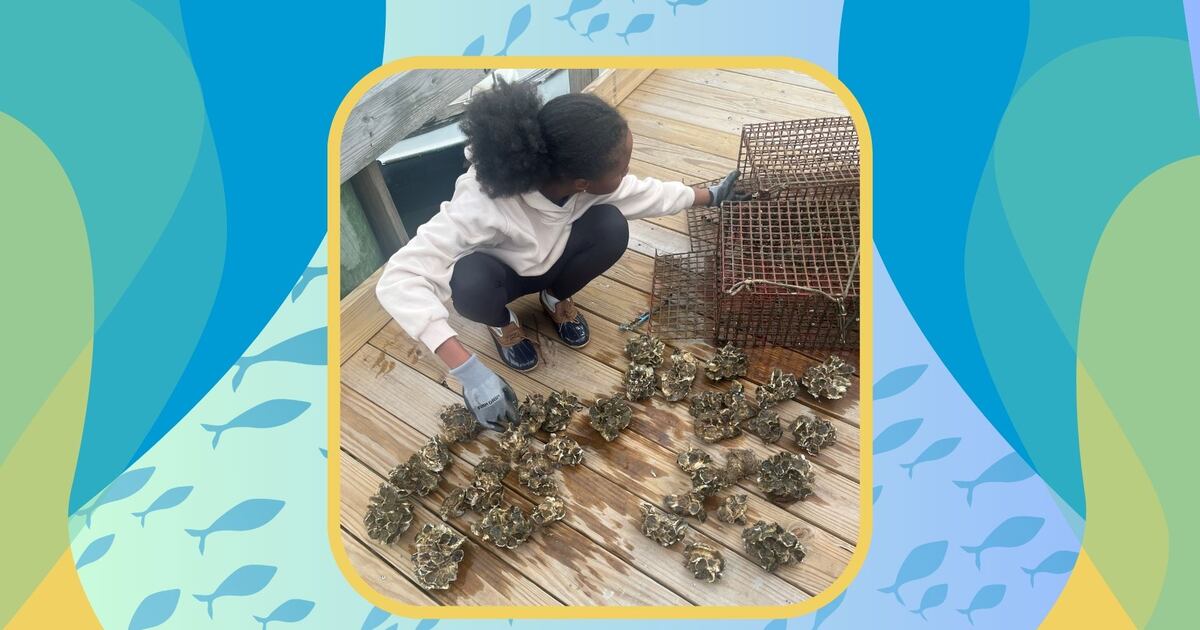
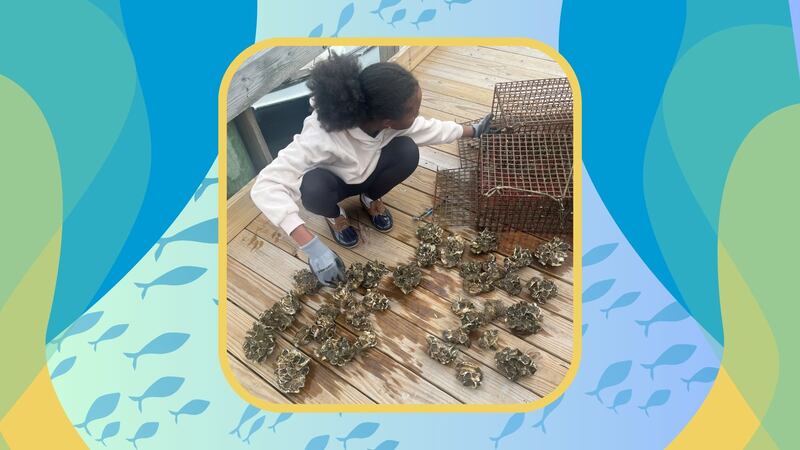
 Demi Johnson Demi Johnson checks on her oyster garden at Schooner Pier in Biloxi, Miss. (Shante Richardson , Jonece Starr Dunigan /Demi Johnson)
It’s Demi Johnson’s destiny to become a conservationist. The teen is doing her part to restore one of nature’s most vulnerable marine animals: oysters.
The incoming high school freshman has been in Girl Scouts since kindergarten, and her troop does many aquatic-related activities during camps. So when Johnson was in seventh grade and decided to go for the Silver Award, one of the highest honors in girl scouting, her troop leader suggested a project to save her area’s plummeting oyster population. Johnson jumped on the opportunity. When you’re being raised in the coastal city of Gulfport, Miss., beach trips are a common family getaway. Growing up near the water is more than just sand, sun and fun. Her upbringing taught her a thing or two about accountability.
“It’s everyone’s beach, basically. So I feel like everyone has to do their part in taking care of it,” Johnson said. “Even if you accidentally dropped trash, you still have to pick it up. So it’s kind of like taking responsibility.”
Johnson’s video “Off-Bottom Oysters” won an award and $1,000 grant during the National Geographic Society Slingshot Challenge, a global initiative celebrating teen changemakers solving the world’s environmental issues. Out of 2,100 submissions, Johnson was one of two projects from the United States selected for the 2024 Significant Achievement Award. Johnson has produced a total of 1,580 oysters through an aquaculture practice called oyster gardening. Her participation in the Mississippi Oyster Gardening program will help stabilize the ecosystem in her hometown.
Earlier this month, Johnson and her mother were flown out to the National Geographic Explorers Festival in Washington, D.C. Johnson was in awe of the knowledge and passions of other young environmental advocates, including a Ghanaian oyster gardener and a Pakistani teen who created eco-friendly menstrual products.
“It felt good knowing others cared about something that I also care about, and I was also able to learn a lot about other environmental issues, which I thought was really cool,” Johnson said.
Johnson’s project will make an impact on saving a species that contributed to her home state’s financial wealth, environmental health and Black history. Oyster reefs play multiple roles in the ecosystem, such as providing coastal erosion protection and a habitat for over 300 marine species. Since oysters are filter feeders, they can clean up to 50 gallons of water daily — when conditions are right.
Located a 30-minute drive away from Gulfport is Biloxi, Miss., which was known as the “Seafood Capital of the World” during the late 19th century when fishermen hauled millions of pounds of oysters and shrimp out the Mississippi Sound. After emancipation, Black people who were once enslaved in the shellfish industry were able to find financial freedom as oystermen who played a pivotal role in the industry’s success. Oysters were known as cheap, working-class food until Black restaurateur Thomas Downing became the “New York Oyster King” by opening an upscale cellar that served wealthier clientele. Black fishing towns began to thrive in the east coast and the South, and generations of families are trying to carry on the lineage to this day despite hardships.
Natural and man-made disasters have caused the oyster population to plummet. Hurricane Katrina destroyed and damaged 90 percent of the state’s reefs in 2005. Almost five years after the storm surge buried oyster reefs, BP’s Deepwater Horizon spill dumped more than 200 million gallons of oil into the Gulf of Mexico. Oysters thrive in salty or brackish water. In 2019 and 2020, the U.S. Corps of Engineers opened the Bonnet Carre spillway in Louisiana to relieve the Mississippi River. This poured freshwater along the Mississippi coastline, causing young oysters to die off.
Environmental advocates, including Johnson, from around the world are sounding the alarm on the decline of oyster reefs and the domino effect it has caused environmentally and economically.
“Oysters are a big part of the ocean and 85 percent of oysters worldwide have been lost,” she said. “So I feel like that’s a really big factor of why you should care. It’s just like how you would talk about animals going extinct.”
Conservation efforts such as the grant-funded Mississippi Oyster Gardening program give volunteer gardeners like Johnson the opportunity to help restore reefs for free. Wire boxes, called gardens, are filled with juvenile oysters known as spat from the Auburn University Shellfish Lab at Dauphin Island, Ala. The gardens are then distributed to the gardeners who submerge the boxes into the water at their local piers and docks. The oysters grow throughout the season, which starts around August and lasts until March of the following year in Mississippi. Volunteers are required to check on their boxes once per week to clean off any predators, algae or mud from the gardens. After six months, program staff members pick up the matured oysters at the end of the season. According to the program’s website, the 2023-2024 season was the most successful one of its eight year history. Over 93,000 oysters were collected at 48 sites across the Mississippi coast.
During the 2022-2023 oyster gardening season, Johnson cared for five boxes placed at a private pier which matured into 480 oysters. The following year, the teen placed five gardens at Schooner Pier in Biloxi and produced 1,100 oysters. She will be responsible for nine gardens when oyster gardening season starts back in a few months.
While Johnson is excited about handling additional boxes, she says she is staying focused on quality rather than quantity. Her curiosity, dedication and village of helpers have been the key to her success. When Johnson first started her project in 2022, she expanded her knowledge by connecting with Mississippi Oyster Gardening program coordinator Emily McKay during a convention in Gulfport. The two have been emailing each other ever since.
“Before, I was kind of like, ‘Oh, I don’t really know what to do,’” Johnson said. “ [McKay] taught me all the background information and she taught me what to do and what to expect. She gave me a lot of information that was needed.”
As news of Johnson’s success started circulating around town, the teen’s science teacher informed Johnson’s mother about a film camp at the Walter Anderson Museum of Art in Ocean Springs, Miss. The three-day workshop was part of the museum’s partnership with National Geographic that helps students with storytelling. Johnson joined the camp in December with a lack of filmmaking experience. She left with an expertise in camerawork and video editing after interviewing a local oyster farmer.
Museum Executive Director Julian Rankin praised Johnson for the way she leveraged her expertise in oyster conservation while doing additional research in the field.
“We are extremely proud of Demi for her creativity, leadership, and hard work,” Rankin said. “Her success in communicating her vision for a better world is indicative of the power of art to create dialogue and positive change.”
Johnson isn’t stopping with National Geographic. She’s taking an oyster gardening course this summer to get better at her craft and to inspire others to join in on the fun. There is no age limit to apply to be a gardener in Mississippi or any of the other oyster gardening programs at Mobile Bay and Little Lagoon in Alabama. Oyster gardens can also be adopted by people who want to help, but don’t have the time or the waterfront access to nurture a garden. P.J. Waters, an associate extension professor at Auburn University Marine Extension and Resource Center, said program staff works closely with all gardeners to guarantee success of their sites. Waters commended Johnson for being a wonderful ambassador for the program. “She’s a remarkable young lady and we’re thrilled to have her,” Waters said. “I look forward to seeing her in the future. I don’t know what she’s going to achieve, but it’s going to be amazing.”
Johnson is a couple years away from high school graduation. But saving the oysters has stirred up her interest in pursuing a career in environmental law. She said she wants to create and enforce policies that protect nature.
“The environment can’t speak for itself,” she said. “Obviously, it can’t go on the panel and tell everyone what happened. So I think that’s definitely interesting. It’s like standing up for something that can’t really speak for itself.”
Comments are closed.