
This month at work has been a fun one, as we are hosting the Garden Explorers summer 4-H camp for elementary school-age youngsters. Each day, we’ve taken the kids outdoors to explore and connect them to the plants, bugs and critters that populate our gardens here at the Pitt County Arboretum. It’s been especially fun to see which plants make an impression on the kids and which tidbits of information they respond to and remember.
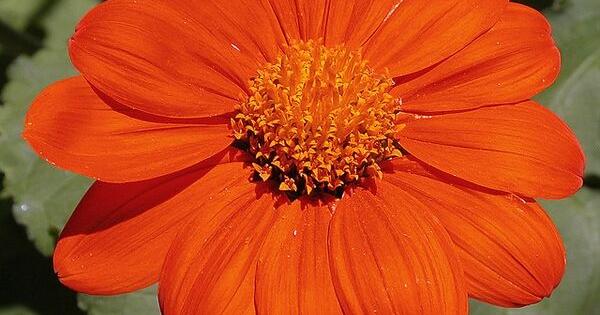
On our first day of camp, one of our activities was a scavenger hunt in which the kids had to collect plants of different shapes, sizes, flowers and other characteristics. One of the prompts was to find a “plant that looked like the sun.” Since we split the kids up into different areas of the garden, not all of them had a traditional sunflower nearby, so we helped them think about other types of flowers that might look similar. Many of the kids found Mexican sunflower (Tithonia rotundifolia) in the Children’s Garden. Two days later, when the kids set out to gather flowers to use in making suncatchers, I heard one of the kids excitedly exclaim, “I want to use Mexican sunflower!”
Like the common sunflower (Helianthus annuus), which is also native to Mexico and a few Southwestern states, the Mexican sunflower is a member of the Asteraceae (daisy) family. The blooms of Mexican sunflower do not rival its more famous cousin in terms of size; however, it does produce hundreds of 3-inch-wide orange flowers throughout the summer and fall. Each bloom has a prominent yellow-orange center, surrounded by seven to 20 blaze-orange petals. You may need to occasionally deadhead spent flowers to maximize bloom, but they will continue to produce new flowers up until the first fall frost.
Plants grow quickly to a height of 3-6 feet tall, with a spread of 2-3 feet. They are annual and may be started by seed or transplanted as young plants. The seed are plentiful and easy to save, so if you purchase one plant, you’ll be able to collect enough seed by the end of the year for a lifetime of plants.
Mexican sunflower is quite heat and drought tolerant, and almost seems to prefer growing in poor soil, so don’t worry about finding just the right spot for it. As long as it is in the sun, it will be happy. Larger plants may eventually flop over by late summer, however, so you may want to stake them or plant them next to a wall, fence or other structure that might help keep them upright. Relatively free of insect and disease pests, Mexican sunflower is also relatively unbothered by deer. Its brightly colored flowers not only attract young garden explorers, but also butterflies, bees, hummingbirds and other pollinators as well.
Matthew Stevens is the director and horticulture agent for N.C. Cooperative Extension’s Pitt County Center.
Comments are closed.