
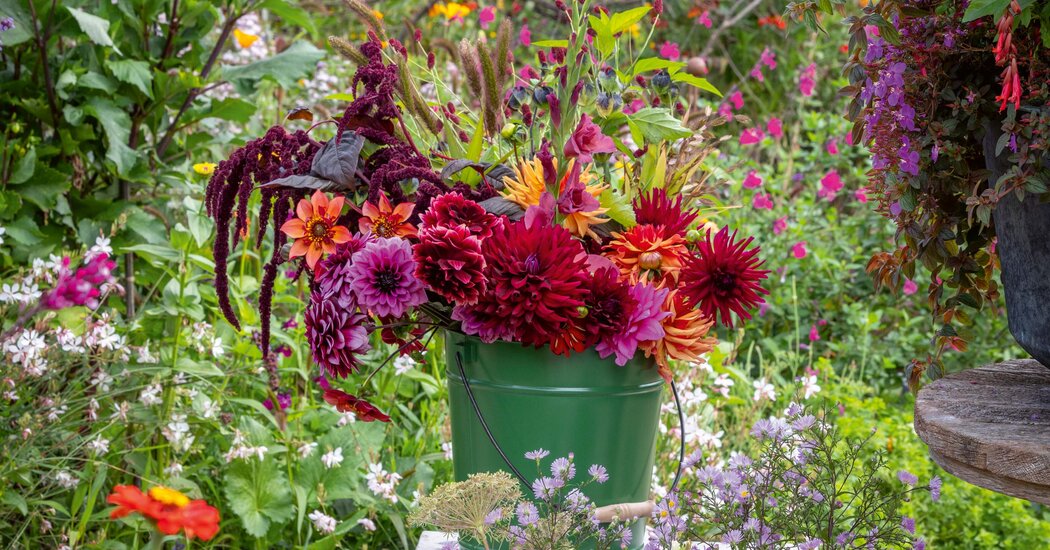
Sarah Raven had me at “Don’t pick and plonk,” her admonition not to cheat ourselves out of even a moment of delight a homegrown cut flower can give by hurrying it into the vase without some conscious aftercare.
Thanks to “A Year of Cut Flowers,” the 14th and latest book from the celebrated British gardener, nursery owner and podcaster, I will never again carelessly cut a stem straight across. The wrong cut risks it forming a seal on the bottom of the vase instead of remaining open to taking up water.
I won’t unthinkingly trim much lower on the stem than needed for the intended vase, either, because what’s squandered might contain buds representing another potential flush of bloom. Waste not.
Growing cut flowers, Ms. Raven writes, has been her “main gardening obsession” for more than 30 years, a pursuit she describes as “gardening for the optimist and the greedy flower lover.”
Added to that enthusiasm is the disciplined wisdom gleaned from records kept during years of methodical trials of thousands of varieties in the extensive, organically managed gardens at Perch Hill, her home in East Sussex, England.
Her analyses have divined which roses make top cutting-garden choices, for instance, but also helped her puzzle out other needed solutions — such as how to keep disfiguring fungal diseases like mildew and blackspot at bay without chemicals. Underplanting the roses with Salvia microphylla hybrids has proved effective, presumably thanks to compounds emitted from the sage leaves.
This fusion of sheer joy and hard data is a powerful combination, a formula so convincing on every level that it makes any gardener want to carve out space for a cutting garden.
Which Flowers Make the Cut?
Success begins by choosing plants capable of cut-and-come-again performance. These potential rebloomers are ones that make embryonic buds in the axil where leaf meets stem.
Some 70 percent of her cutting garden area is devoted to such candidates, most of them annuals, biennials or dahlias, as perennials are generally less likely to offer up quick repeat harvests, she said. (Of course space is also devoted to must-haves like tulips, Narcissus and other bulbs, despite their habit of pushing just one round of bloom.)
Even among the top 70 percent of performers, “there are superlatives and there are OKs,” she said. “And if you’ve got a small patch or a balcony or a window box, you want the superlatives.”
Ammi majus reblooms, for example, but is not as fast to recover between cuttings as Cosmos. Other top producers include annual clary sage (Salvia viridis), annual Scabiosa (S. atropurpurea), sweet peas (Lathyrus odoratus), amaranth (Amaranthus caudatus), zinnias and dahlias.
With many of the plants that “behave in this generous way,” she said, the gardener must still encourage a stocky plant from early on, by pinching out the top set of leaves once three pairs of true leaves have formed below. Salvias, sweet peas, cosmos, dahlias, calendula and zinnias are among those that respond bountifully.
Later, when we go to cut, we must do it strategically, too — typically above a pair of leaves, so axillary buds stay intact to power the next round of bloom.
Ms. Raven recommends harvesting in the morning (or last thing at night), armed with two buckets. Cut stems at an angle, strip off the leaves from the bottom two-thirds and toss them in the extra bucket, placing the cut flowers into the water-filled one.
In late winter and spring, perhaps three-quarters of what’s picked then gets seared, another treatment to extend vase life. In summer that drops to about one-quarter. The bottom 10 percent of each stem is dipped into a mug of boiling water fresh from the kettle — soft stems for a few seconds, and woody ones like roses or lilacs for perhaps 30. Among notable exceptions, tulips, daffodils and other spring bulbs don’t get seared; later on, sweet peas and dahlias don’t, either.
Before arranging, Ms. Raven suggests letting the flowers rest in tepid water for at least a few hours or even better overnight in a cool spot out of direct sun. When it’s time to arrange, she adds a little clear distilled vinegar or bleach to the vase water to slow bacterial reproduction that could hasten decay. In a 12-inch vase, she might add half a teaspoon of bleach or five tablespoons of vinegar.
A bonus to using bleach: It also neutralizes the “characteristic pong,” she said, that may offend some noses when bouquets include alliums, Cleome, or brassicas. And yes, the vegetable garden is fair game for red-leaf mizuna or kale or other arrangement elements, like dill and other herbs, vines of runner beans or purple-podded snap peas, or sprays of the smallest-fruited cherry tomatoes.
The Simplest of Arrangements
Her expertise notwithstanding, Ms. Raven resists pressuring us to become master arrangers. In fact she rather likes simpler routes for bringing bits of the outside into her own home. One way: as individual stems or small bunches of goodies, tucked into each of a row of small vessels along a mantle, or clustered on a pewter tray atop a table.
“A galaxy of mini bottles,” she calls it.
If an occasion begs for more formality, anyone who has been rattled by what-goes-with-what worries while wandering about the garden will be grateful for Ms. Raven’s charming conceit for making happy floral marriages.
The palette, she writes, usually includes three types of blooms (with foliar elements to come later). Identify a bride (“the star of the show,” and “the first thing to decide on”) and a bridesmaid (“smaller and a bit less demonstrative,” in the same color or very close “that backs up the bride but does not compete with her”). Finally select a gate-crasher to enliven the mix (a flower that contrasts in color, “like adding a squeeze of lemon to smoked salmon”).
Or free yourself entirely from design worry — and from using nonsustainable, petroleum-based floral foam — by constructing clever homemade grids that sit atop bowls or deep dishes to support flower heads. The grid keeps the blooms out of the water, encouraging longer life than if they were floated in the bowl.
To fashion a grid, cut twigs, ideally of hazel, dogwood or willow, to extend about an inch wider on each side than the vessel, and lay them out like a tic-tac-toe board. Connect each point of intersection by tying square knots in stretchy garden string (Flexi-Tie brand is recommended), first tying each knot loosely, then doubling back to tighten them all.
The grids are reusable, so when you cut and come again, and again, and again, they — like the most carefully chosen flowers — will be ever at the ready.
So go have a look at what’s blooming outside, shears and buckets in hand. Why wait till it’s time to deadhead when you can pre-emptively “live-head” (Ms. Raven’s word), enjoying the gift of cut flowers while also hinting to the plant to think about starting on another round.
Comments are closed.