
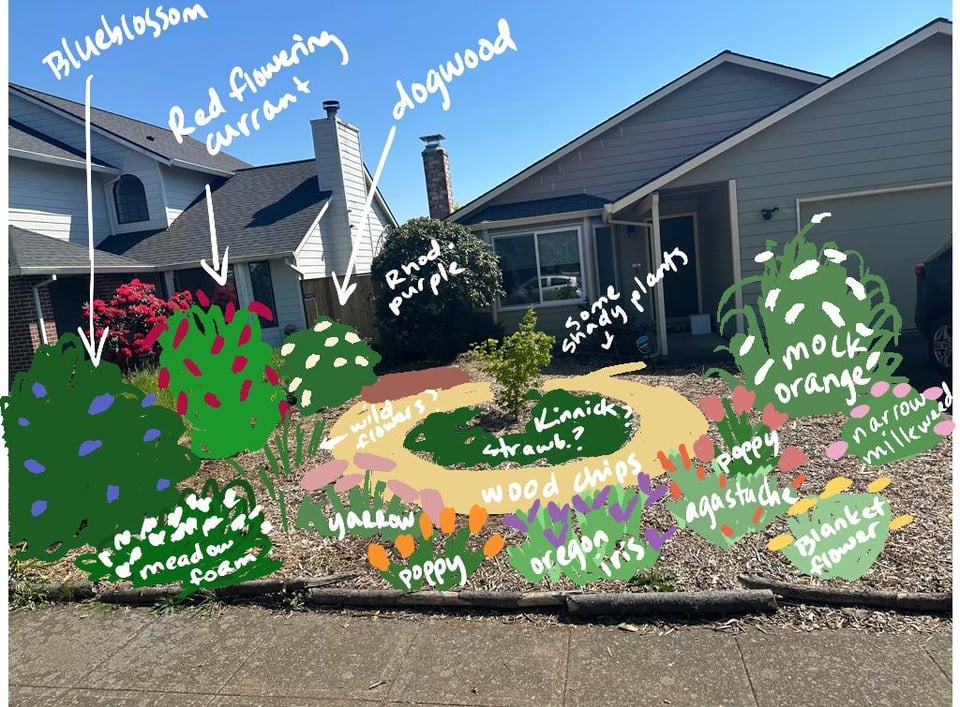
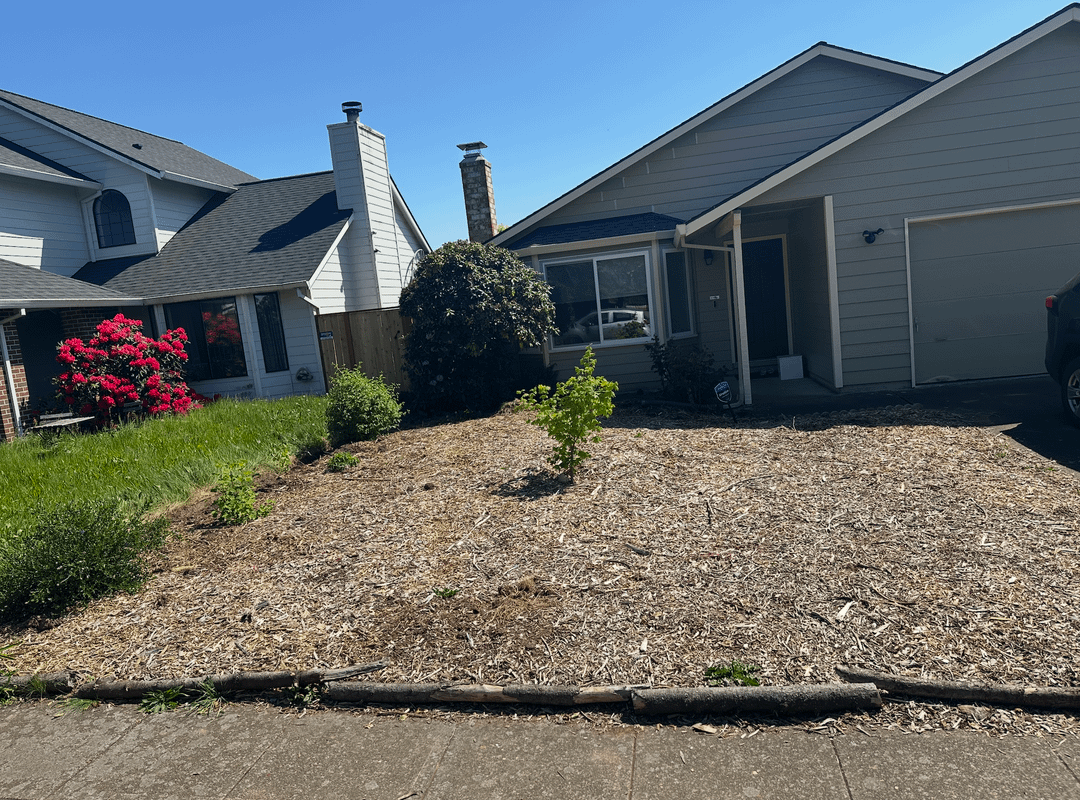
Hi! I'm feeling super overwhelmed with redoing my front yard. Before we moved in, it was a yard with what I think was Bermuda grass and a ton of weeds. We mowed 1-2 times and decided to nuke it with wood chips. But it's been sitting like that for a couple years now because I'm new to gardening and the overload of information was a lot. So, I finally put together a design and am looking for input/critiques because I don't know wtf I'm doing.
This is a north facing yard in zone 8b (Portland, OR). It gets full sun almost all day with one section that is more shaded by the house.
I've been slowly buying plants but I'm a little worried I may have bought too many plants that grow to be pretty large for the size of my yard.
What's planted now from front to back:
- Blueblossom ceonathus
- Red flowering currant
- Golden currant (not included in my design, probably gonna move that to the back or give it away)
- Dogwood
- Mock orange (Philadelphus)
- Vine maple in the center (I learned later this doesn't do well in full sun but we're gonna see what happens)
Most of the plants I bought and just put in the ground somewhere so they didn't die with the intention of moving them once I had a design. I heard this mock orange can get pretty big so curious if this might be a good placement for it. And is this too many different types of plants? I don't particularly care for the rhododendron but it's well established so I'm leaving it for now. Not super clear from the drawing but there is a short path from our porch area to the wood-chipped path around the vine maple.
Open to any suggestions or insights. Thank you!!
by Flaky_Revolution_996
17 Comments
The agastache may have trouble depending on your soil. It really likes to drain well. I would put it somewhere that gets very little water.
I would not recommend a big wood chip circle like you have. You can conceal access to make it look a lot more natural (no big wood chip circles in nature!).
Aim for at least 40% grasses to harmonize your forb plantings, which otherwise do not repeat and cover a lot of colors. Can’t help you on the species but I’d look for at least one type of cool season (like a sedge) and one warm season (like a bunchgrass). Buy deep plugs by the tray to save money and plant them in any gaps after you have your forbs laid out. This will help tremendously with weed suppression and aesthetics.
I can’t speak to species appropriateness or growth habits in your region, but I like your overall design. I would personally put the golden currant in between the blueblossom and red flowering currant so they make a small triangle to offset the line a little or offset near your rhododendron and dogwood if it gets enough light and that isn’t a path.
I think you’ve got a great plan here. One thought: you could replace the maple with a pacific dogwood and then transplant the maple to the side where the dogwood shrub is. The dogwood would help shade the maple from the afternoon sun. Kinnickinnick might get a bit leggy under a tree but the strawberries should do fine
I like your design. I do the same kind of thing over a photo, using my Apple Pen and Ipad.
Fringe Flower and Red Columbine might work well for your shady area by the house. I planted them for the first time and they are growing well in shade.
Im not too knowledgeable about White Pine Blister Rust it is hosted by the currant family that affects and kills white pine. I recently got a golden currant myself and i havent planted it in the fear of killing pines trees near by. If anyone more knowledgeable about the topic, please educate me if my fear is reasonable.
Assuming Philadelphus lewisii, put it in your hottest and driest spot, but the one you have will work. They prune with zero effort (literally a hedge trimmer) and if you feel they’re oversized at any point you can cut them to the ground if you’re willing to sacrifice a season of flowers, and they’ll grow right back. They ultimately grow into a sort of floppy slightly sprawling shrub even with some browse pressure or with shade/competition (which you don’t have) they can grow very tall (you’ll see them among stands of trees at forest edges sometimes).
Kinnikinnick + beach strawberries is a winning green mulch combo in part to full sun.
Note that the heat nearer to the the street is going to highest relative to everywhere else in the yard.
THANK YOU so much everyone! You’re all so helpful and knowledgeable and I’m already feeling less overwhelmed. ❤️
The mock orange is in a bad location, they can get absolutely massive over the years and you’ll have to constantly be trimming it to get to the front door. It would be good over on the side with the other hedge bushes.
On the flower design you are better planting in rows so that you get varying heights but also something in bloom along the sight lines. For example the Oregon iris with be a patch that will bloom early and then be done blooming all summer long so that area will be flower less.
If you planted the Oregon irises in a row you’d get the blooms and then as they fade you get the other blooms.
I’d check out sparrowhawk nursery, local to Portland, for native flower ideas if you are looking for more suggestions.
No comment on the design but before you start putting plants in the ground ensure any downspouts aren’t dumping right next to the house and any grading changes needing to be made for runoff purposes are done now.
What did you use to draw this out ?
Yarrow will be the entire garden within a few years. And your entire property shortly thereafter.
My front garden has a row of different bushes that are all too big for the space once they grow in. The side where the windows are 6 ft up have shrubs that… get 2 ft high.
So my feedback is consider how big things get, especially for shrubs you are unlikely to want to move. Also, with cottage garden type setups, repetition helps tie it together, so don’t be afraid to group 3 of something here, 3 of something there.
If stuff doesn’t do well, it’s ok to let it die and find something better – it’s not always easy to tell from labels.
Mock orange dies back completely in fall and winter so you will be left with a few straggly branches at best. I would not count on it for ‘structural’ presence.
I can’t speak to the specific types of plants for your region, but I personally would add more drifts of plants, and repetition. Especially for a front yard, and one with a more formal looking circular pathway like you have. That will give it a more intentionally landscaped feel. Otherwise it looks like a great start!
Kinnikinick is a full sun sandy rocky soil plant so that’s probably not a good spot for it under a tree. That’s all I can really comment on as it’s the only plant I have experience with shown.
FYI, CA poppies will not stay in a neat bunch. Their seed pods literally “pop” open and will scatter all around in the other stuff. There’s nothing inherently wrong with that (I love the random patches of neon orange in my garden), just an FYI for planning purposes. If you like neat and tidy, you may have to pull poppies like weeds.
What are your pink poppies?
Agastache is a totally new one to me, now I’m off to look it up!