
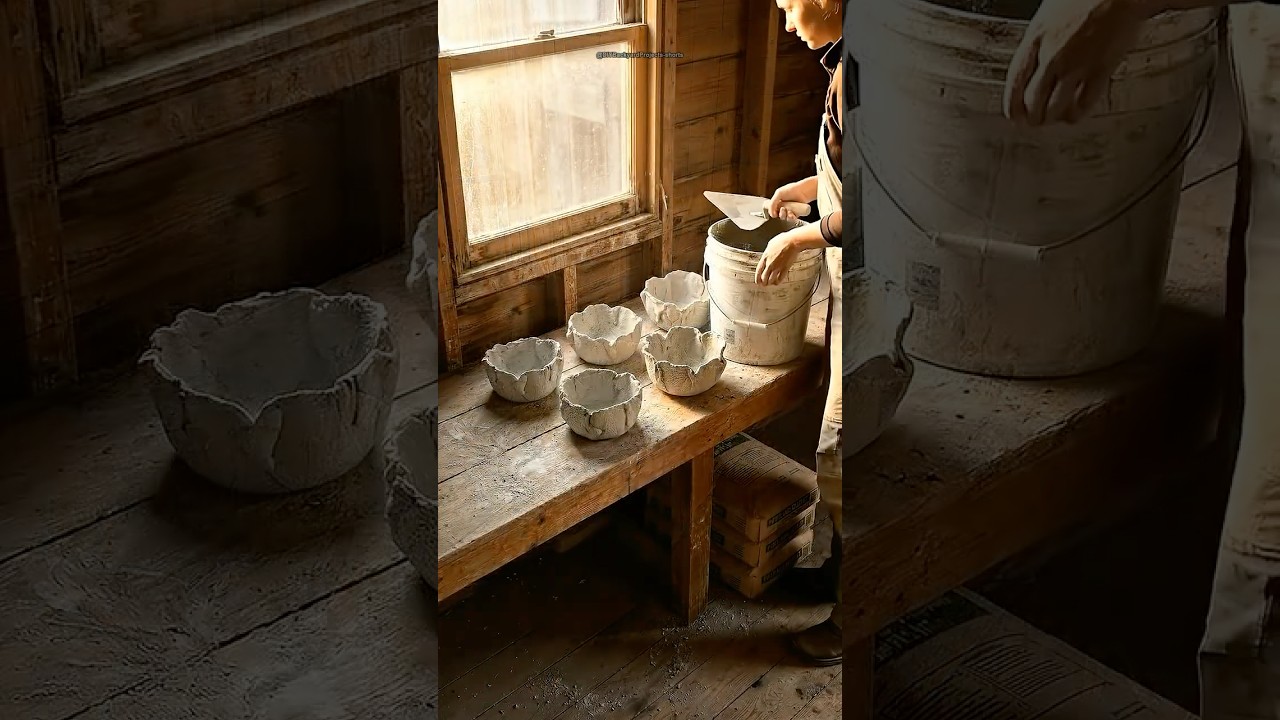
Fabric-cast cement works because the cotton weave holds the slurry while gravity shapes the drape. Upturned pot goes under, wet fabric goes over, fingertips press the folds into place, and the drips down the sides freeze exactly where they land. Every bowl ends up different because every fabric piece drapes differently.
One faded old cotton t-shirt torn into six irregular palm-sized pieces, each one dunked into a 5-gallon bucket of Portland cement slurry and then shaped by hand right on the workbench into a small organic bowl. No mold, no form — just a gloved palm pressing the center down and fingers pinching the rim upward. The wet cement dripped off the outside while the bowl took shape, and the drips hardened in place as solid streams running down each bowl’s outer wall. Because every piece was shaped by eye, no two rims are the same — some dip low, some rise high, all uneven like handmade pottery. Up on a rough wooden shelf beneath the workshop window they became a miniature succulent garden — zebra haworthia, a campfire crassula, a baby echeveria rosette, burro’s tail spilling over the rim, cobweb houseleek with its white threads still stretched across each rosette, and a tuft of creeping thyme with a few mauve flowers.
Drape fast, while the cement is still glossy wet. Once it starts to dull, it stiffens in place and cracks if you push on it. Center the fabric over the upturned pot, smooth it once against the sides, leave the bottom edge alone so it hangs where it wants. Don’t smooth the drips — those streams freeze and become the look.
Made with the assistance of VEO AI
—— AFFILIATE LINKS ——
—-
🌿 Tools & materials in this video:
Quikrete Portland Cement 47lb (the cement used in towel-dipping projects): https://www.amazon.com/dp/B00OZH7BII/?tag=backyardproje-20
Etsy shop: https://www.etsy.com/shop/BackyardProjec
Some links earn the channel a small commission at no extra cost to you.
2 Comments
Wonderful way to recyle an old tshirt!
🌿 Materials & tools in this video:
• Quikrete Portland Cement 47lb (the cement used in towel-dipping projects): https://www.amazon.com/dp/B00OZH7BII/?tag=backyardproje-20
(Some links earn the channel a small commission — at no extra cost to you.)