
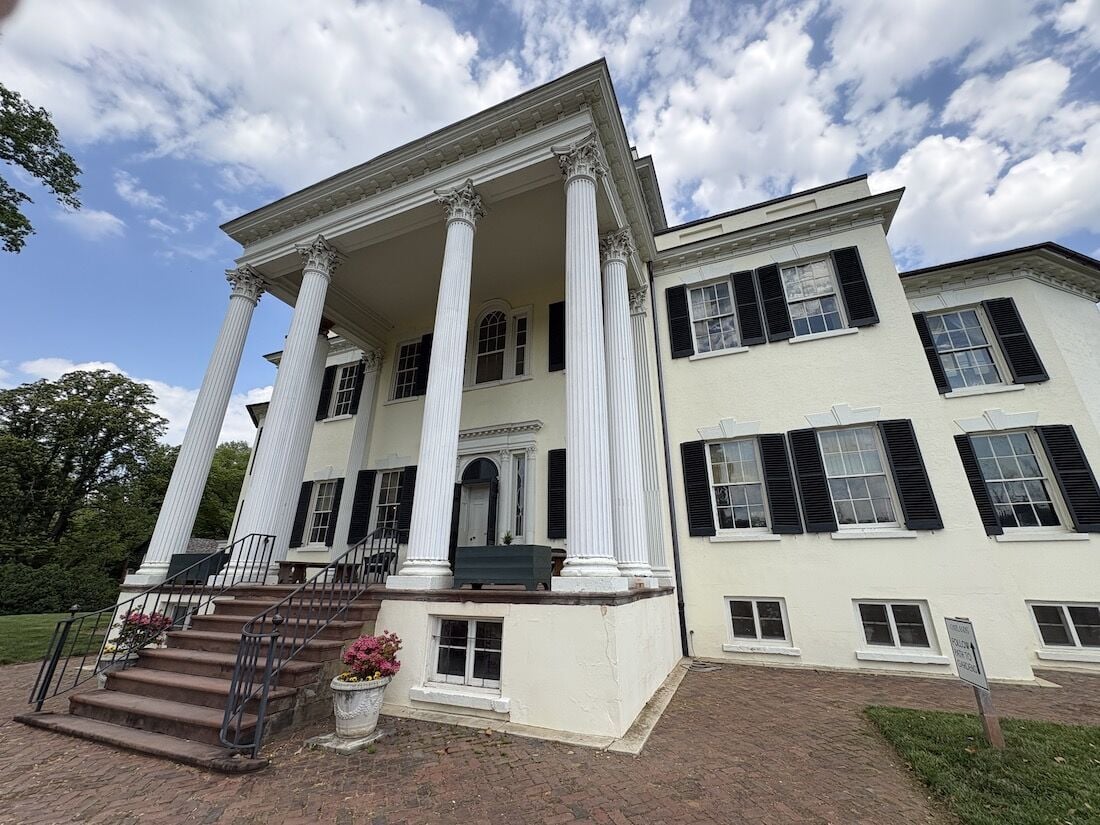
When visitors tour Oatlands this year, they’ll undoubtedly take in the grandeur of the estate’s iconic mansion and visit the historic greenhouse just down the lane.
While strolling through time into the world of Virginia’s landed gentry, they may not notice the recently completed repairs that have been executed on the structures—among several carefully crafted restoration projects happening around the property since the National Trust for Historic Preservation took over control of operations two years ago.
Executing the work is a team of old-school woodwrights from Shenandoah Planing Mill near Charles Town, WV.
The Trust first called in John Van Vliet and his team in 2024 to replace the rotting balustrade around the mansion’s front lawn and the Victorian fence around the terraced garden.
Over the winter, they’ve been busy with two other projects.

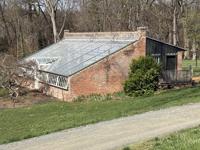
The greenhouse at Oatlands is believed to be the second oldest propagation greenhouse in the United States.
Norman K. Styer/Loudoun Now
The Greenhouse
The small brick and glass building is historic in its own right, believed to be the second oldest propagation greenhouse in the United States.
Lori Kimball, Oatland’s senior manager of programs and education, said the greenhouse was one of the first buildings constructed on the plantation by George Carter, with work likely starting around 1810. It was built along the entrance to the estate—not to be missed by visitors.
“During Carter’s time, it was a symbol of his wealth and status,” Kimball said. “But it also was a place during the winter months to be able to grow fruit. From some of the records that we have, he was buying what back then would have been called exotic plants and that was kind of a craze for rich people, mostly men, as a hobby.”
But after two centuries, deterioration, wood rot and broken pieces prompted a restoration project.
It wasn’t the first restoration for the greenhouse. It was badly damaged by a fire in the 1850s. And there was a renovation of some sort a few decades ago that introduced some non-historical alterations.
Van Vliet’s approach to the project started with a search for the original plans.
The restored door at Oatland’s historic propagation greenhouse features the starburst window that is a signature of Lord and Burnham designs.
Norman K. Styer/Loudoun Now
The greenhouse was a model from Lord & Burnham, known for building iconic, large-scale Victorian-era conservatories. The company’s records are housed in the New York Botanical Garden’s Mertz Library, but Van Vliet found the documentation for Oatland’s model was lost in a flood.
“I think it was Number 13 that was the project number for Lord & Burnham, which was an early one,” he said. The original details remain, including the sunburst window that was standard for the builder, and the venting system with hardware was part of the assembling package.
“There’d been a previous restoration, and it had just seen a lot of decay and rot—the window sashes and the bottom rails were rotted out from just time. They have an expected life, and it’s certainly been past that. But we did have enough detail to take them and replicate them exactly as they were built,” Van Vliet said.
The restoration started with research.
“That’s really our work. We call it a kind of a forensic deconstruction. What was there? How did it work? We do a little homework back with Lord & Burnham and having such a prominent name we find a lot of history, and we could find this same detail in their catalogs … and then replicate it to scale,” Van Vliet said.
They mostly craft pieces with sapele, a tropical wood that replicates the density of trees harvested from the slow-growth virgin forests of colonial times. “It grows to that type of density in its environment now, and it mills well, and it ages well,” he said.
The team also replicated the original joinery, using only bronze or brass hardware to avoid iron rot.
“That’s really our passion,” he said of the effort to revive the tradition of a pre-industrial age planing mill.
“You would have a local sawyer who might saw wood, and a carpenter might come out and take that sawn wood straight from the mill,” he said. “But back in the 1850s, at the beginning of what became the industrial age, the planing mill was a place to build a home. You would buy your two-by-fours, your windows, your trim, your lathe, and all of the kind of components of a home, and then it would be brought to the site and built.”
“As we got to the postwar era and the industrial age came on, you got more into the lumber yard-type of business model,” he said.
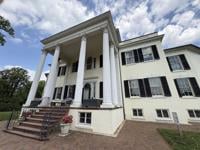
Six new Corinthian columns are in place on the portico of the Oatlands mansion following a months-long restoration process.
Norman K. Styer/Loudoun Now
The Columns
That craftsmanship was put to a greater test when Shenandoah was next contracted to replace the mansion’s six Corinthian portico columns, which had rotting bases.
The project started with the design and construction of a 30-foot lathe at the company’s Charles Town shop, which was already a woodworker’s Disney World filled with tools and machines used in the industry for more than a century.
“It takes a little ingenuity, a little faith, and some engineering,” Van Vliet said of building a new lathe to add into the mix.
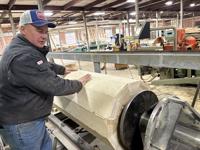
John Van Vliet stands next to the 60-foot lathe constructed at his Shenandoah Planing Mill to form new columns for the Oatland mansion portico.
Norman K. Styer/Loudoun Now
The original columns are virgin white oak logs clad in decorative trim and topped with Corinthian capitals made from 44 hand-carved pieces.
Shenandoah replicated that wood-core design.
“In today’s world, you would have a steel column encased with a fiberglass reinforced panel that was cast in a mold. But that doesn’t have the fluting and the emphasis, the details and everything else that is so unique to these,” Van Vliet said.
In the new columns, the wood core is encased in 12-sided staves, a barrel-like construction.
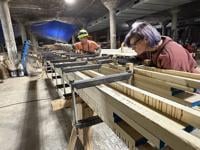
Craftsmen at Shenadoah Planing Mill glue the wood cores of new Oatlands portico columns.
Norman K. Styer/Loudoun Now
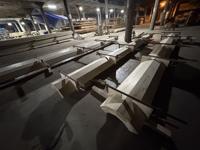
Staves for the new Oatlands mansion columns dry at in a warehouse at Shenandoah Planing Mill.
Norman K. Styer/Loudoun Now
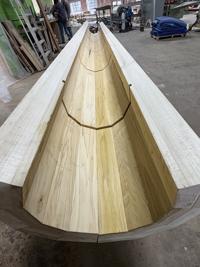
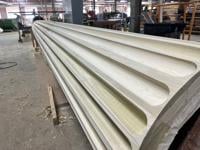
They were then turned—rotisserie-style—on the lathe to create the taper required for Roman columns. That’s another mathematical calculation to determine the transition points as the column narrows from its 22-inch base to its 18-inch top.
Over three days of slow turning on the lathe, each 2,000-pound assemblage was shaved down to about 1,700 pounds.
The columns were sealed with dolphinite, a flexible waterproof bedding compound used in shipmaking.
“That’s really where the care and the craft come in. It’s looking at that joinery and really thinking about water, not only migration, but condensation, accumulation, all of those things,” Van Vliet said.
It was a lack of attention to water that led to the column replacement, he said.
The columns had been repaired in the 1970s when rotting bases were cut off and new wood blocks were set in. At some point after that, the columns’ weep holes were painted over—trapping moisture inside.
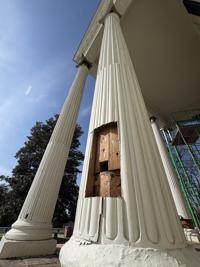
A cut in one of the original Oatlands columns reveals the tree trunk inside as well as repairs made to address wood rot in the 1970s.
Norman K. Styer/Loudoun Now
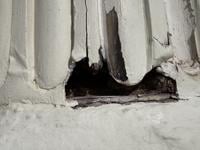
Deterioration in one of the original Oatlands columns was caused by trapped moisture causing wood rot.
Norman K. Styer/Loudoun Now
It wasn’t an obvious mistake, going unnoticed for decades and even during a dozen or more inspections by Van Vliet and his crew. One day, he poked around a bit more and pulled a chunk of caulk from a hole. Then a pattern of closed weep holes suddenly became obvious.
“You really have to look at all that stuff and just not just fix it, but really understand the good things and understand the bad things,” he said.
In the new columns, a short piece of rope at the base serves as wick to remove moisture from the interior of the columns. That solution will ably perform that critical function—as long as no one “fixes” it later. “That will be the trick—from here on out don’t paint that. Do not apply paint here,” Van Vliet said.
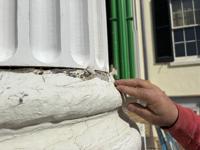
John Van Vliet points to the rope wicks on the newly installed Oatlands columns. The material will be important to preventing wood rot in the future.
Norman K. Styer/Loudoun Now
The work to remove the columns and put the new ones in place was completed in early April, just as the estate was reopening for tours after the winter break.
Kimball and Oatlands Executive Director Margaret Salazar-Porzio said that the Oatlands team is eager to spend time with the removed columns to see how they were constructed. Dating back to the 1820s or 1830s, they would have been constructed by enslaved labor from materials collected nearby.
“We’re taking down these 200-year-old columns, and we’ll be able to do some forensic studies on them, be able to see the marks and the handmade nails and the things that those who were enslaved on the property did, because this is their handiwork, and this is their expertise, and, their craftsmanship,” Salazar-Porzio said. “Obviously, we want to tell their stories more, and we want to be able to do that through this kind of evidence.”
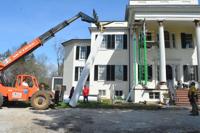
Crews lift a new column in place on the portico of the Oatlands mansion.
Norman K. Styer/Loudoun Now
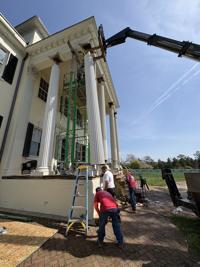
Crews lift a new column in place on the portico of the Oatlands mansion.
Norman K. Styer/Loudoun Now
For Van Vliet, completion of the columns project comes with a mixture of relief and pride.
“I love working with the Trust, because they are passionate. It’s very mission-focused,” he said.
“It’s an honor to be able to be part of it. It comes with a lot of responsibility to make sure it’s right. That’s why when we’re given things, we actually do a pretty deep dive,” he said, recalling the greenhouse research. “All we’re trying to do is to rejuvenate this historic place and keep it alive. It’s a nurturing process.”
Oatlands is located at 20850 Oatlands Planation Lane off Rt. 15 south of Leesburg. It is open for tours 10 a.m. to 5 p.m. Monday through Saturday and 1 to 5 p.m. Sundays. Learn more at oatlands.org.
John Van Vliet of Shenandoah Planing Mill discusses restoration projects at Oatlands, a Nation Trust for Historic Preservation property near Leesburg, Va. Recent projects include repairs to the historic greenhouse and the replacement of the column on the mansion portico.
Comments are closed.