
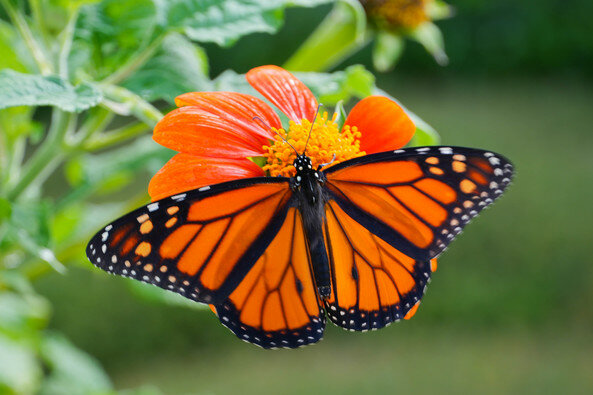
What started as a small beautification effort outside Riviera Utilities’ Foley office has taken root as a growing environmental initiative supporting pollinators, scientific research and community education across Baldwin County.
The Riviera Utilities Native Pollinator Garden, established in 2023, is now a registered Monarch Waystation and part of the Alabama Native Milkweed Project. The garden reflects a broader shift among utility companies nationwide to use available land for ecological benefits, particularly along rights of way.
Josh Roberts, Riviera Utilities’ vegetation management superintendent, said the idea emerged after learning how other utilities were creating habitats for pollinators.
“My primary role is managing utility rights of way to reduce conflicts between vegetation and Riviera Utilities’ electric, gas, water, and wastewater systems,” Roberts said. “A few years ago, I learned how other utility companies were creating habitats for pollinators. Given the widespread awareness of the importance of pollinators and the loss of their habitats, I began exploring ways for Riviera Utilities to create a pollinator garden.”
While vegetation management typically focuses on preventing interference with infrastructure, Roberts said the work naturally aligned with pollinator conservation.
“Most pollinator-friendly plants are compatible with our infrastructure, so they are left in place whenever possible,” he said. “When we decided to establish a pollinator habitat, we considered locations both along rights of way and at our office facilities. Ultimately, we chose a site at the office due to its accessibility, ease of monitoring and availability of irrigation.”
The project gained momentum through a partnership with Carmen Flammini, an Alabama Cooperative Extension agent in Baldwin County who leads regional efforts tied to native milkweed and monarch butterfly conservation.
Flammini said her work began years earlier while studying pollinators and monarch migration.
“I started working with native milkweed and monarch butterfly science in Georgia,” she said. “When I moved to Alabama, I noticed that there wasn’t too much information about native milkweed. I started to look for sources… and so I started to build the Alabama Native Milkweed Project.”
That project aims to restore native milkweed species — essential host plants for monarch butterflies — while helping communities establish pollinator gardens based on research and best practices.
The collaboration with Riviera Utilities began after a presentation, when utility staff realized their initial plantings included nonnative milkweed.
“They told me, ‘We bought the wrong one. They’re not native,'” Flammini said. “If you do what I say, pull those out, I promise you will help to build a very nice native garden, and we can partner.”
Since then, the garden has expanded significantly, both in size and scope. What began as a small plot now serves as a demonstration and research site, with multiple native milkweed species and ongoing scientific studies.
“At this moment we have seven,” Flammini said. “And my goal for next year is to have 14 native milkweeds there.”
The site is also being used to study how native milkweed adapts to the local environment and which pollinators are attracted to it. Flammini is leading several research efforts, including studies on propagation, bee interactions and seed collection, often in collaboration with Auburn University entomologists and local Master Gardeners.
“The Riviera Utilities garden has turned into more than a butterfly garden really — it has also turned into a demonstration and a study garden,” she said.
Roberts said the partnership reflects the utility’s broader mission.
“One of Riviera’s core missions is to serve as a thoughtful steward of our environment,” he said. “We feel this project perfectly aligns with Riviera’s core mission.”
The garden meets the criteria of a Monarch Waystation, which includes providing host plants, nectar sources and shelter for butterflies. Flammini emphasized that these elements are critical not only for monarchs but for broader ecosystem health.
“Having these gardens is extremely necessary to have a community ecosystem,” she said. “They provide pretty much everything they need. Without this garden, we would not have places where different kinds of insects and animals can live.”
She also highlighted the importance of using native milkweed species rather than tropical varieties, which can disrupt monarch migration.
“If the butterfly eats any other plant that doesn’t have the right quantity of chemicals, the butterfly will not develop the right shape,” Flammini said. “Most of the time… they will not be able to complete their migration.”
Beyond research, the garden has become a catalyst for community engagement. Riviera Utilities will mark the return of monarch butterflies with its first Welcome Back Monarch Day, a community event set for Saturday, May 9 from 9 to 10 a.m. in Foley. The event is designed to educate residents about the monarchs’ annual migration while encouraging efforts to protect native pollinators and plant species vital to the Gulf Coast ecosystem.
The initiative has also inspired additional gardens throughout the region.
“After this garden, actually we have five more gardens,” Flammini said. “I have seen a change… We have built another 12 gardens around.”
The Baldwin County Master Gardeners play a key role in maintaining the site, growing milkweed and supporting research efforts, while also helping educate the public.
Roberts said the garden continues to evolve, requiring seasonal maintenance such as mulching, irrigation and weed control, but increasingly relying on established native perennials.
“I’m proud that our garden is contributing to pollinator and Monarch research and that it can serve as an example for anyone interested in creating their own pollinator garden,” he said.
Looking ahead, Flammini hopes to expand access to native plants and continue building partnerships with schools, cities and conservation groups across Alabama.
“The more that we do the right way, we’re really contributing a little grain of sand in this big, giant mountain,” she said. “It’s bringing back the natural ecosystem.”
Gabriella Chavez is a Report for America corps member who writes about growth and development in Baldwin County and our natural spaces for Gulf Coast Media. Your donation to match our RFA grant helps keep her writing stories like this one; please consider making a tax-deductible gift of any amount today by visiting https://tinyurl.com/yaf8yf5n.
Comments are closed.