
Welcome to the T List, a newsletter from the editors of T Magazine. Each week, we share things we’re eating, wearing, listening to or coveting now. Sign up here to find us in your inbox every Wednesday, along with monthly travel and beauty guides, and the latest stories from our print issues. And you can always reach us at tmagazine@nytimes.com.
Gift This
A Gardening Wish List for the Start of Spring
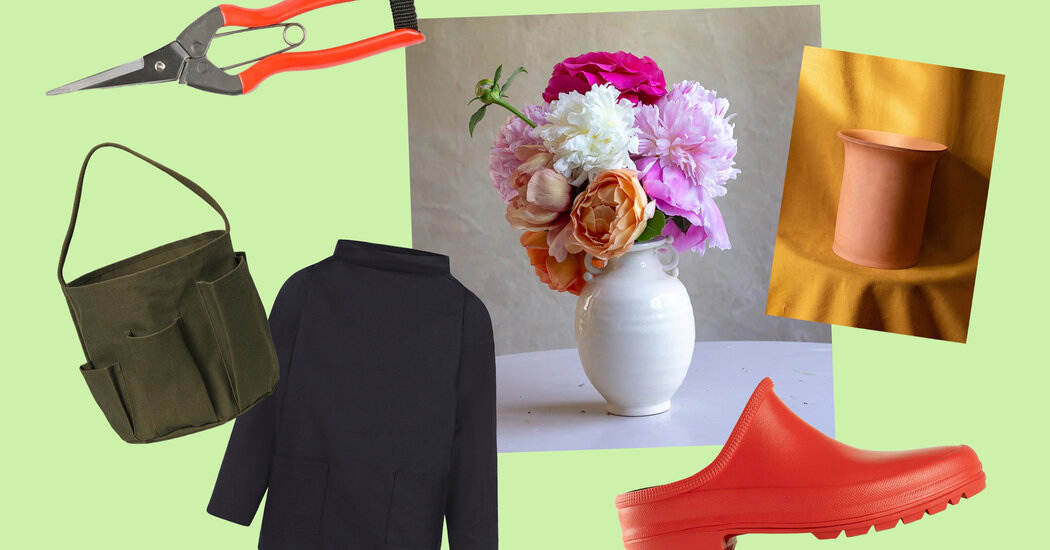
With spring comes the promise of longer days, and weekends pottering in the garden. Early April is an ideal time to consider equipment that will make that work easier. I’m rarely without my Niwaki snips, which are perfect for clipping daffodils to bring into the house and light enough to slip into the pocket of my smock. (I like these thick cotton versions, which have been made for sailors and fishermen in Great Yarmouth, England, since the 19th century.) The Connecticut-based ceramist Frances Palmer, a consummate gardener in her own right, creates vessels with homegrown arrangements in mind. I love this Putnam vase, which has hints of the classical and is perfect for delicate early flowers. For more sturdy tool carrying, this canvas bag has just the right amount of pockets and will stand on its own when you get distracted by new weeds. My favorite time in the garden is first thing, when the dew is heavy and the birds are singing: These tomato red clogs will keep early toes dry (and stylish) as you check on your budding bulbs. I wish I’d planted mine in these raw-edge planters, which are handmade in Vermont and would look sweet planted with grape hyacinth on a garden table.
— Elizabeth Tyler
This spring, T is celebrating everything related to the cultivation of plants and flowers, with guides, retrospectives and more:
– How to start a garden, from soil testing to planning to planting.
– Artists on the parks they’ll never forget.
– Ten films that feature fantastic flora.
– What gardening style suits you? Take our quiz.
– Perfect planters for any patio or sunlit room.
– A landscape designer’s favorite tools.
– The most covetable indoor gardens.
– Florals? For spring? When it came to these runway shows, the results were truly groundbreaking.
Eat Here
Inside Sotheby’s Breuer, a Patisserie Serves Architectural French Sweets
In 2017, Roman and Williams, the New York-based design studio founded by Robin and Stephen Alesch, opened La Mercerie, a SoHo restaurant that also sells embroidered tablecloths and tapered glassware. Now the couple, along with the chef Marie-Aude Rose, are expanding their culinary reach with a patisserie on the Upper East Side. There will be brioche feuilletée laminated in ribbonlike layers, and garden-inspired entremets of creamy mousses, crunchy pralines and glossy glazes. “I’ve always had a fascination with pastry as a delicious object, like jewelry or art,” says Robin. On April 16, the team will open La Mercerie Patisserie within and alongside the restaurant Marcel (which will serve French dishes such as duck confit and cod au gratin), at Sotheby’s in the Breuer Building on Madison Avenue, a few feet from vitrines of 20th-century jewelry. The pastry chefs Alexandra Puglisi (who previously worked at New York’s Le Coucou and Gabriel Kreuther) and Rae Gaylord (Casa Tua, the Butcher’s Daughter) are behind the menu, with madeleines at the center in seven colors and flavors, from jam-filled yuzu to a periwinkle number with a violet-infused white-chocolate shell. The classic version is baked in a scallop shell and dipped in honey, a nod to the fluted spongecake’s origins in 18th-century Lorraine, France, and all come packaged in pill-shaped boxes. Large-format cakes and tarts are available for takeaway with 48 hours’ notice, and the patisserie stays open late so Marcel diners can take home something sweet. lamerceriepatisserie.com.
— Emily Wilson
The designer and architect Philippe Starck has vacationed in Cap Ferret, the oyster-farming peninsula on France’s Atlantic coast, for over half his life, drawn to its natural beauty. “Cap Ferret is hyper-elegant simplicity,” he says. “It’s almost nothing: Just a sandbank about three-feet high with small villages of oyster cabanas between pine forests, and the wild beaches of the Atlantic on the other side.” This week, Starck is opening a hotel on the peninsula — his third in the area, after La Co(o)rniche and Ha(a)ïtza, on the other side of Arcachon Bay — with the restaurateur and hotelier Laurent Taïeb, his friend of 30 years. The architecture of Villa Colette, a newly built 28-room property on the town square, was inspired by the elaborate villas of Arcachon’s Ville d’Hiver, constructed in the second half of the 19th century as a retreat for wealthy families convalescing from tuberculosis. For the interiors, Starck and Taïeb imagined the souvenir-stuffed seaside escape of a midcentury actress like the French star Danielle Darrieux with a powder pink, acid yellow and Dior gray color palette. Downstairs, cocktails are served at a mirrored bar, while the restaurant’s dishes highlight the fresh fish from the bay. Guests can use the hotel’s electric bicycles to explore Cap Ferret’s nearly 30 miles of trails or head to the wide, sandy beaches on the Atlantic coast for a surf lesson. Villa Colette opens April 2; rooms from about $460; villacolette.com.
— Kate Maxwell
In 1954, seven Asian American artists in Hawaii rented a soon-to-be-demolished house in Honolulu to stage a joint exhibition of their experimental Abstract Expressionist works. Merging bold, gestural brushstrokes with landforms and seascapes inspired by the artists’ home islands, the work in the impromptu show caught the attention of a city museum director who went on to organize a formal exhibition at the Honolulu Museum of Art — which was then known as the Honolulu Academy of Arts — launching each member to local prominence. Collectively, they became known as the Metcalf Chateau, an ironic nod to the dilapidated property on Metcalf Street where it all began. Seventy-two years later, “Waves of Knowing,” an exhibition at Ryan Lee Gallery in Manhattan’s Chelsea neighborhood, revisits the group with rarely seen works by Satoru Abe, Bumpei Akaji, Tetsuo Ochikubo, Tadashi Sato and Harry Tsuchidana — all members of the tight-knit Chateau circle, most of whom haven’t exhibited on the U.S. mainland since the 1960s. Across 10 paintings, eight sculptures and 26 works on paper, the show highlights the artists’ individual styles, as well as their shared strain of Abstract Expressionism that reflects Hawaii’s natural beauty and cultural hybridity. As the gallery co-founder Jeffrey Lee puts it, the works have “a quiet power.” “Waves of Knowing” is on view from April 9 to May 9 at Ryan Lee Gallery, ryanleegallery.com.
— Matthew Dekneef
History Lesson
Tracing the Evolution of Design Through Cutlery
The design editor and publisher Dung Ngo bought his first set of vintage flatware at a shop in San Francisco around 2000. He’d just turned 30 and decided it was time to retire his college-era cutlery, and a stainless steel pattern caught his eye. The fork tines were truncated, the spoon heads had the grace of a still-closed tulip and the knife blade jutted out to a point. He didn’t know its story — only that the German brand Rosenthal had produced it — so he went to the library at the University of California, Berkeley, in search of the answer: It was a set called Composition (1962), by the Finnish designer Tapio Wirkkala. “I love the hunt,” says Ngo, whose now-expansive collection is the subject of a forthcoming exhibition, “Knife Fork Spoon,” at the Denver Art Museum, and a hefty book. (The title, also used for his eye candy Instagram account, pays homage to a 1951 show at the Walker Art Center in Minneapolis.) Ngo, who studied architecture, found that the seemingly narrow subject offered a window into 20th-century design movements. After World War II, amid a push to consider children’s developmental needs, kids’ cutlery began to fuse whimsy with ergonomics. The golden age of aviation called for in-flight pomp, as with Raymond Loewy’s sleek (and often filched) sets for the Air France Concorde. Architects of all stripes — Gio Ponti, Arne Jacobsen, Zaha Hadid, Richard Meier — brought their ideas to the table, while sets like the Haas Brothers’ Here, There cake service (2024), in glass and gold-plated steel, reflect the rise of collectible design. Lately, at home, Ngo’s flatware of choice is Form (1952) by the Bauhaus-trained designer Wilhelm Wagenfeld, who gave traditional shapes newfound refinement. “Subtle and beautiful,” Ngo says, “like a well-designed car.” “Knife Fork Spoon,” at the Denver Art Museum, is on view from May 17 through May 2028, denverartmuseum.org. “Knife Fork Spoon,” published by August Editions, is available Aug. 18, $85, artbook.com.
— Laura Regensdorf
When the artistic director Eole Peyron was overseeing construction of Hôtel Massé, the boutique property in Paris’s Pigalle neighborhood she co-owns with her brother, Corto, the bar next door went up for sale. “It was a no-brainer” says Peyron, who opened the hotel this past September. “Our family motto is to make a friend every day. We see our new bar as a place to facilitate that.” The new place, which they named Le Trente in reference to its street number, 30, has a decorative kinship to the hotel — they both feature ’70s furniture and contemporary art, though the bar has a moodier flair: There are red lacquered floors, and a weathered black leather sofa in the loft lounge. Original pieces of art, including a custom drawing of a chair by the French artist Alexandre Mussard, are hung alongside family photos, some depicting the expeditions of the siblings’ father, the French explorer Stéphane Peyron. In the bathroom is a playful nod to their great-grandfather the pastis-brand founder Paul Ricard: 1,800 mini-bottles of Ricard line the walls. Patrons can expect a tight menu of creative cocktails and wine; simple snacks, including a brioche bun with pulled pork; and a rotation of cross-genre vinyl spun nightly. hotelmasse.com/trente-paris.
— Lindsey Tramuta
From T’s Instagram
In Oslo, a Brutalist Villa Where Artists Come to Play
Comments are closed.