
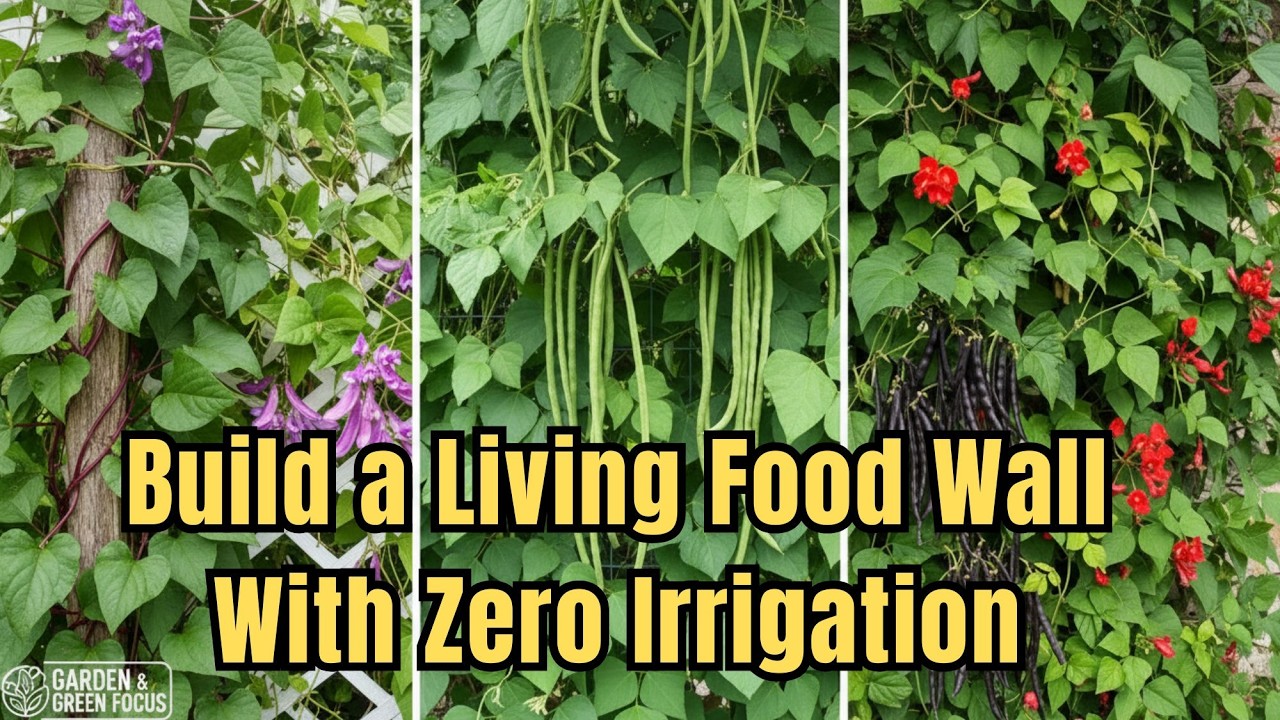
Most gardeners are fighting their soil, their water bills, and their climate — while the most productive growing space in their garden sits completely empty.
Vertical space. Fences, walls, trellises, and structures that could be producing more food per square foot than any raised bed, with less water, less weeding, and less work. These 11 climbing vegetables were feeding families for centuries before supermarket culture made us forget how to grow our own food. They grip a fence, climb a trellis, fix their own nitrogen, and once established, produce on rainfall alone.
Plant #4 was carried by the Cherokee Nation through one of the darkest chapters in American history — and it still outproduces modern hybrid beans in difficult conditions. Plant #7 yields up to 300 fruits from a single plant in one season. And Plant #9 has a taproot documented reaching 8 feet into the soil to find water — making it genuinely drought-proof in a way no irrigation system can replicate.
If you have a fence doing nothing, this video is going to change how you look at your garden.
🌿 WHAT’S IN THIS VIDEO
00:00 — The most productive growing space nobody is using
01:30 — #1 Malabar Spinach (the leafy green that loves summer heat)
03:00 — #2 Hyacinth Bean (4,000 years of cultivation, grown as ornamental today)
04:30 — #3 Yard Long Bean (18-inch pods, zero irrigation in humid climates)
06:00 — #4 Cherokee Trail of Tears Bean (1,000+ years of history, free seed every season)
07:45 — The most water-efficient climbers are coming — teaser
08:00 — #5 Scarlet Runner Bean (cold-tolerant, beautiful, forgotten as food)
09:30 — #6 Bitter Melon (staple across Asia, Africa, and the Caribbean)
10:45 — #7 Chayote / Mirliton (up to 300 fruits, one plant, one season)
12:00 — #8 Luffa (vegetable AND sponge — a zero-waste food plant)
13:15 — The 8-foot taproot — teaser
13:30 — #9 Cowpea / Black-Eyed Pea (grown in the Sahel for thousands of years)
14:30 — #10 Winged Bean (5 edible parts from a single plant)
15:30 — #11 Malabar Gourd (stores edible for up to 3 years — no refrigeration)
17:00 — What to plant first and how to use your vertical space
💬 Two questions for the comments: Which of these are you putting on your fence first — and what’s your USDA hardiness zone? Drop both below. Every comment gets read.
🔔 New video every week → Subscribe so you don’t miss it
20 Comments
Love and listening from Northeast Alabama, USA
Top video
Great video! Interesting and has good information and tips. I grow several of tgese but there's a couple I might add, assuming I can find seeds or plants. It's mid-April her in Zone 8 Oklahoma.
I don't like the slimy mouthfeel of Malabar Spinach! I'm zone 11. I am imterested in lablab & winged beans. I have fences, 2 trellises, & an above ground swimming pool ladder i salvaged from a trash pile to use as another trellis.🍀🍃🍀🍃
I'm in Zone 6b/7a in Southwest Idaho, and I've got a west-facing 2-story wall of my house that just bakes in the late afternoon. I built a trellis in front of it and I've tried growing cucumbers, pole beans, yard-long beans, scarlet runner beans, cowpeas, and hardy kiwis, but nothing has been able to take the heat. The hot sun reflecting off the wall just fried everything. Based on this video, this year I think I'll try luffa, hyacinth bean, and chayote if I can find it. I think I'll also plant tall sunflowers and towering amaranth to see if I can get some tall foliage there to shade the sun and cut down on the reflected heat and hopefully make a little cooler micro-climate.
5b eastern high plains of Colorado
1. Malabar Spinach
2. Hyacinth Bean
3. Yard Long Bean
4. Cherokee Trail of Tears Bean
5. Scarlet Runner Bean
6. Bitter Melon
7. Chayote / Mirliton
8. Luffa
9. Cowpea / Black-Eyed Pea
10. Winged Bean
11. Malabar Gourd
Zone 9B Houston, TX, I have fences but most pests get to my garden
Wish the narration can be short and to the point! No need for a leisurely chat?!
Ai slop… every fence i have is covered with muscadines… with a few cukes growing under them
How do you plant them
Nice work bro, I have been seeing malabar spinach in my garden and i have always treated it like a weed ,i am going to start taking care of it
Watching from the UK, South East England, to be more precise. Don't think we have any 'zones' like in the US.
Found the video informative. Most of the plants I've not heard of or seen before. We are currently planting lots of edible plants in our south facing garden. I grew up in Estern Germany during the cold war / reunification period. Nearly anyone who had a garden or balcony did use the space to grow fruit and veg…it became part of our culture due to limited varieties and supply since after WWII and during the cold war.
It's lovely to show our kids all the different plants, let them water and care for them, and then eating the harvest. Very special.
Wow 👌
Nice list, but a LOT of these are not suitable for cooler climates. Most of the vines are more suited for warmer climates than the northern part of the US; whenever it says 'indiginous to Africa or Latin America or South-East Asia' their production drops significantly when trying them in say northern PA or Maine for instance. In zone 5, most of these are not worth it unless inside a greenhouse and that usually that greenhouse space is needed for something else.
I must appreciate the clip you made. But i guess its done through AI and appears to be too good to be true. I really like the concept . I have space on terrace ..can something like this be donein India ?
I'm from the Philippines.
I enjoyed the information and beautiful video, but that flashing "subscribe " is irritated. People that wants to subscribe, will do so with out a flashing reminder. I left with out finishing the video.
Correction on the picture of chayote – the young leaves emerge from the bottom end not from where it is picked😊
You do not show real pictures of your own garden. Only AI generated artificial rubbish. Actually You do not have a garden. All rubbish !