
Breadcrumb Trail Links
OpinionColumn
Author of the article:
Cathy Dueck • Climate Chat
Published May 01, 2026 • 3 minute read
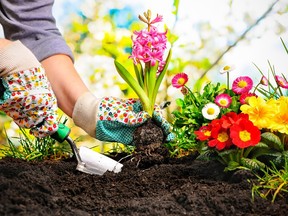 Gardening can be an important tool in tackling climate change. Your garden can not only combat stress, keep you fit, feed you, build biodiversity and take excess carbon out of the air, all at the same time. That’s some super-hero! jpg, BI, apsmcArticle content
May is the month of renewal—new growth bursting forth, people getting outside again, and yes, even chatting with each other in person! We feel a burst of fresh energy, and many of us get itchy fingers to start puttering in the garden.
Advertisement 2
This advertisement has not loaded yet, but your article continues below.
Article content
Did you know that gardening can be an important tool in tackling climate change? Your garden can not only combat stress, keep you fit, feed you, build biodiversity AND take excess carbon out of the air, all at the same time. That’s some super-hero!
Article content
Recommended Videos
Article content
As we learned in school, plants use sunlight to draw carbon out of the air and use it to build their tissues. Woody plants are especially good at that, and they can store carbon for many years in their bark and wood.
Have you ever thought of your yard as a carbon sink? How can you maximize the amount of plant material (biomass) produced in your yard this year as your own personal contribution to mitigating climate change?
A basic principle of good landscape design is “layering.” That is, creating a landscape with plants of many different heights. Ideally, that’s a mixture of tall and shorter trees, shrubs of various heights, and herbaceous (non-woody) plants of various heights too. This above-ground layering is pleasing to the eye, while doing a great job of reducing the carbon in the air. The carbon is not only in the above-ground parts we see, but in complex underground root masses to store even more carbon underground.
Advertisement 3
This advertisement has not loaded yet, but your article continues below.
Article content
This year, try helping your yard store more carbon. If your yard is entirely lawn, try adding some layers by planting a few shrubs or trees. One of my favourite small trees is serviceberry. It produces cheerful white blossoms in early spring, followed by blue berries in June that the birds love. Then, its leaves turn pink in fall—all-season interest!
If you have room for larger trees, so much the better. Trees that shade your house reduce the need for air conditioning, and street trees that shade the pavement help keep urban areas cooler in summer. I love Bur Oak trees – long-lived and tolerant of city life. They can store a lot of carbon in their lifetimes!
One of my favourite small shrubs is potentilla. It stays compact, with lovely yellow flowers throughout the summer that pollinators love. I also love weigela with its pink or red tubular flowers that attract hummingbirds. If you have more space available, common elderberry is a fast-growing shrub with lovely white blossoms and tiny blue berries that birds love too. Nannyberry is a large shrub that also has white blossoms and nutritious berries for birds.
Advertisement 4
This advertisement has not loaded yet, but your article continues below.
Article content
A personal favourite non-woody perennial is purple coneflower, growing to two or three feet tall and smothered with pink daisy-like blossoms in summer that will bring lots of butterflies to sip nectar. Bergamot is a fast-growing native plant that bees and hummingbirds will love too.
Even tiny yards can do a great job of providing beauty, biodiversity and carbon sequestration. If you only have a balcony, containers can hold a great variety of annual plants, including flowers and vegetables, as long as you have sufficient sunlight.
Local garden centers and horticultural clubs can be great sources of new ideas for plants to add variety, habitat and structure to your yard. But be forewarned – it can become an obsession!
Do you have questions or ideas to share about climate change? We’d love to hear from you. Contact us at climatechatcp@gmail.com
Article content
Share this article in your social network
Comments are closed.