
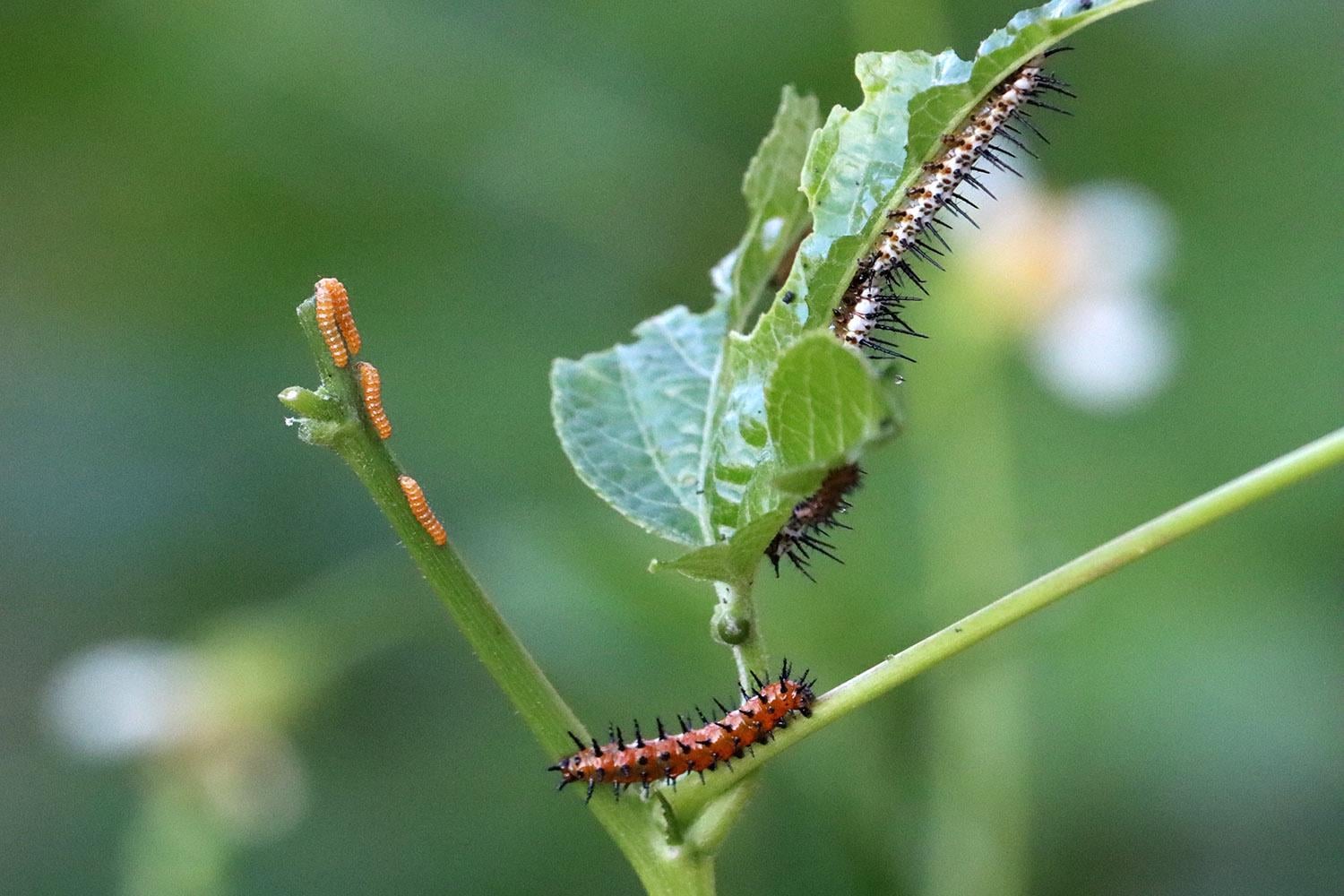
My house has five giant burning bushes that I’m giddy to replace. It’s a bed about 20 feet long and 6 feet wide with 5 hours of sun in Illinois, USA. My goal is to replace them with another shrub that birds love (they loved the burning bush), and support as many caterpillars as possible. Anything under 15 feet tall is fine.
I saw a fair amount of talk about spicebush, but it only supports 6 species of caterpillars. I’m not sure the hype (does well in shade?) Hazelnuts also seemed like a contender with nuts for many critters, but apparently blueberry species support close to 100 caterpillars and provide fruit for birds and people.
ETA: Source, https://blog.wfsu.org/blog-coastal-health/2023/10/bang-for-your-caterpillar-buck-which-plants-host-the-most/
What are the top Trees and Shrubs for caterpillars?
Oaks (Quercus): 395 species
Beach plum, cherry, chokecherry, peach, plum, sweet cherry, wild plum, almond (Prunus): 247 species
Hickory, pecan, pignut, butternut (Carya): 191 species
Willows (Salix): 190 species
Birch (Betula): 172 species
Crabapple, apple (Malus): 171 species
Maple, boxelder (Acer): 171 species
Pines (Pinus): 171 species
Aspen, cottonwood, poplar (Populus): 156 species
Blueberries (Vaccinium): 150 species
I’d have to amend the soil for acidity, but other than that, it seems a no brained. Am I missing something? why don’t blueberries have more hype? Is there a reason more people don’t grow them? What would you do instead with 5 hours of sun?
by Grouchy-Details
23 Comments
My take on native plants is that if you have to heavily amend the soil, grow something else.
My dad has been trying to grow blueberries in Central IL soil for years and they just aren’t right for the conditions.
Maybe consider serviceberry shrubs instead?
Serviceberry or blackberry?
What about a native Prunus species? Chokecherry (Prunus virginiana) supports a long list of Lepidoptera.
josta berry, goji berry, honey berry, raspberry, blackberry, nanking cherry
blueberries would rather have more sun, but may still produce. if you have a sunnier spot where they can have 7-8 hours, I’d put them there instead. tons of people grow blueberries, but because they’re primarily thought of as a food plant and can take a little extra effort if you don’t have the right ph already, most of those people are going to be talking about them over on permaculture or gardening or backyard fruit rather than here. gooseberries or currants (Ribes spp) may do better in your part shade area unless you really don’t care that much about getting fruit, and there are several native species to choose from. viburnums are another great for wildlife and birds especially choice for part shade, and a few species have edible berries as well.
Flowering raspberry (rubus odoratus) won’t require soil amendments and will host plenty of different caterpillar species while producing fruit for animals.
Hi, are you me? I’m planning to replace mine with winterberry, mountain laurel, and serviceberry.
I also considered Highbush blueberry and decided the soil amendment was too much work. I also considered spicebush, but my local nursery guy said they’re finicky. I may still throw one in there but just as a bonus plant.
>I’d have to amend the soil for acidity, but other than that, it seems a no brained
You might be underestimating this step. My soil test recommendation for blueberries literally just said “do not plant blueberries in this soil” and it was like…pH 7.2. Would have been so much elemental sulfur that I’m better off just getting a big pot and filling it with peat moss (which I may try this year! I want blueberries!)
Aside from the potted blueberry option, there are some other shrubs and small trees which support over 100 caterpillar species (in my zip code, according to[ this keystone plant finder tool](https://nativeplantfinder.nwf.org/)):
* American plum and the smaller native cherries
* Pussy willow (avoid planting near pipes and foundations)
* roses
* crabapple
* serviceberry
* blackberries/raspberries
* hazelnut
* dogwood
* viburnum (which, like blueberries, also has fall color rivaling the burning bush)
If you have to amend your soil, blueberries will not be happy, sorry. They also need extremely airy soil that is kept consistently moist, which is likely not the case unless you back onto a fairly mature forest with sandy soil.
Blueberries are a keystone species (some put it at 200+ caterpillar species) but they have a very narrow window of conditions they’ll tolerate. In Illinois for birds and caterpillars, I’d be thinking black elderberry. If it’s on a fence line your neighbors will hate you, but they form dense hedges that birds love to hang out in and often nest in. Over 100 species of birds eat the berries. I believe they support 30-40 species of caterpillars, including a few specialists that rely on them.
Don’t worry too much about numbers of species when you’re considering ecological value though. Specialists like spicebush are also very beneficial and small plantings help protect spicebush swallowtails that can only use spicebush, sassafras, and red bay. Large wild spicebush and sassafras populations are at risk of laurel wilt, which could cause spicebush swallowtail populations to collapse. Laurel wilt management is not going great in the SE.
If you choose blueberries, my frank advice is that you will need to constantly amend the soil for as long as you have them to get them to limp along. They will not be happy, they will not feed birds or caterpillars, and you will not be happy.
Edit: for clarity, I have been an extremely vocal advocate for blueberries on every project I’ve done where they would be well-suited. They are absolutely amazing in the right conditions!
Highbush Cranberry is the answer I think. Viburnum opulus var. americanum
Lots of great suggestions here, and I second American and beach plum, chokecherry, fire cherry and pussy willow. All fast-growing and hardy. But…highbush blueberry has been a smashing superstar in Central PA limestone clay. Fruit and fall color are unbeatable. I’d try some. : )
I bought blueberry bushes 5+ years ago thinking I could just add a bag of acidifier and be good. I was wrong. The bushes have barely grown in that time and only produced a couple of berries each year. One of them looks half dead. It’s really sad.
With the space you have maybe you could add 2-3 species for more impact. My top picks if I had the space would be Dwarf Chinkapin Oak and some variety of plum. I currently have Silky Dogwood and Northern Arrowwood. They’re gorgeous and the birds love them!
Besides low light, Blueberries have a two other special needs:
Different varieties have different cold requirements (vernalization). They have to be breed for your particular zone. Blueberries in zone 3 have different requirements than zone 8. You NEED to know which ones are good for your zone.
Acidic soil. This isn’t toss a bag of acidifier in and it’ll be fine. It’s a 4.5-5.5 ph. In New England, they grow under pine trees and the acid comes from broken down pine needles. The soil also tends to be clay. If you can duplicate those conditions it should be okay. Even dumping coffee grinds in there daily will help!
I would say that Service Berries have similar light requirements and are like high bush blueberries in June! If you can’t find the correct blueberry, they may be a great option.
Oh and as for the insects, every high bush blueberry I have ever picked from is loaded with spiders. It’s a predator magnet because it’s a pest magnet. I don’t mean this in a deterrent way, just that there are lots of insect populations that different bushes can support!!!
[It’s not quite a native to your area, but summersweet is fabulous and is a host plant to 11 different caterpillars.](https://extension.psu.edu/programs/master-gardener/counties/monroe/news/project-naturescape-whats-growing-in-the-garden-clethra)
The alternative to amending the soil is to build a raised bed with the soil ericaceous shrubs like. They are shallow rooted.
Go for a mixed hedge! Have them all! I too have 7 huge ancient burning bushes that are going to go in a year or two. This year I have 100 bareroot natives from the conservation district some of which are going in next to them. (American Hazelnut, Black Chokeberry, Nanny berry and Winterberry). Last year I popped in some elderberries in the same area. Here’s a link about the ecological benefits of a mixed native hedge [https://www.mofga.org/resources/land-use/native-hedgerows/](https://www.mofga.org/resources/land-use/native-hedgerows/)
As others have said, the soil amending will likely be an issue. But if you have 20ft x 6ft, you have room for a miniature hedgerow.
Hedgerows traditionally have a variety of shrubs and small trees interspersed, rather than a row of a single species. They provide diversity of habitat for caterpillars, birds, and small mammals, usually give food for wildlife and people, and look really nice because of the variety. And I’m thinking that if you plant several different types of shrubs/trees, you’ll end up hosting a bigger number of caterpillars than you would with a single species of something other than blueberry.
So basically what I’m saying is plant one of everything that people are suggesting here 😁
If you want to attract birds, plant something that attracts pollinators.
Native hydrangeas, ninebark, viburnum, or even the native burning bush.
People are really honing in on the soil amendment issue, but I’ll just put it out there and say I’ve been experimenting with growing highbush blueberries in containers on my city balcony, and I’ve had very few issues. My soil mix is peat-heavy, mulched with pine bark, and I use soil acidifier every year in addition to a 10-8-8 fertilizer. I had to make some adjustments last spring when I noticed some chlorosis on the leaves, but they recovered well and gave me a lovely yield.
I think there’s a case to be made that it’s a bit easier to control container soil conditions than if you’re planting in ground, so ymmv. But I love blueberries and I can’t wait until I have a home with space to give them a permanent in ground home. I wouldn’t count them out!
You could try a mixed shrub border – blackhaw viburnum, red twig dogwood, aronia melanocarpa (black chokeberry) and even pussy willow (salix discolor). I’m in Illinois too and have not been able to have success with blueberry shrubs
Have you guys ever seen caterpillars on your blueberry bushes? Maybe i haven’t paid close attention but i just cant recall a time
what does the title mean in this context
They’re one of the smartest plants you can plant.
They can produce substantial food. They’re beautiful with Fall color on some varieties and of course the flowers and fruit.
They’re big enough to make hedges and as long as you give them plenty of sunlight water and sawdust they can be incredibly rewarding.