

Harmer, S.L. Time after time: a quarter century of progress in plant circadian biology. npj Biol Timing Sleep 3, 16 (2026).
https://www.nature.com/articles/s44323-026-00076-2
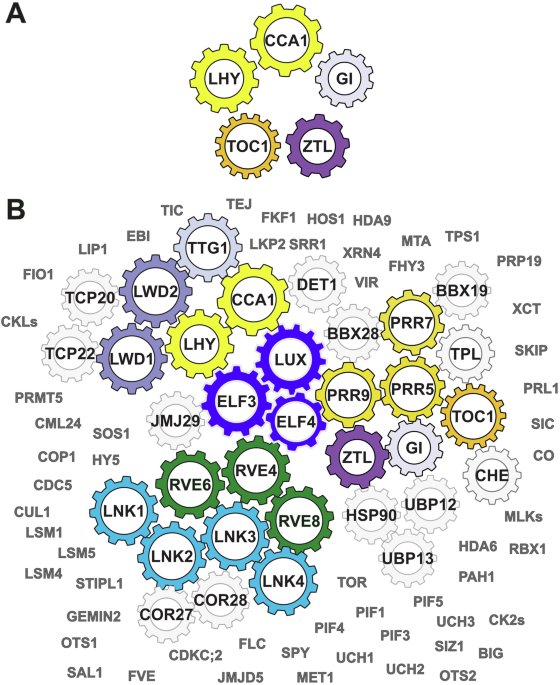
Twenty-five years later, this early promise has indeed been realized. While only a few plant clock genes had been identified by the year 2000 (Fig. 1A), we now have an embarrassment of riches (Fig. 1B). While most early molecular work on the plant clock assumed similar circadian function across the whole plant, we now realize there is considerable variation from tissue to tissue and even between cell types. We now know that much more of plant physiology and development are influenced by the circadian system than we suspected in those early days: while a few important physiological events were known to be circadian regulated twenty-five years ago (Fig. 2A), we now realize that many crucial processes are influenced by the clock (Fig. 2B). It is likely not too much of a stretch to say that all aspects of plant growth and development are modulated by the circadian system to some degree. Finally, while Arabidopsis thaliana was the favored clock model at the turn of the century, recent advances in genomics and genome editing have allowed circadian studies to be extended to a range of crop and wild species. In this perspective piece, I will highlight several milestone discoveries in the above areas from over the past 25 years. […]
As components of a highly-connected regulatory network, according to the gene balance hypothesis we would expect circadian clock genes to be preferentially retained after whole-genome duplications29. In an influential paper from the lab of Rob McClung, this was indeed shown to be the case for Brassica rapa after triploidization30. Intriguingly, most clock genes were retained in two or three copies after this ancestral polyploidization event. Angiosperm evolution is rife with whole genome duplication events followed by diploidization; the preferential retention of clock gene loci throughout this process may help explain the more complex circadian oscillator networks found in derived taxa such as crop species compared to the simpler networks found in basal plant taxa31.
Image: https://www.nature.com/articles/s44323-026-00076-2/figures/3
by jnpha
Comments are closed.