
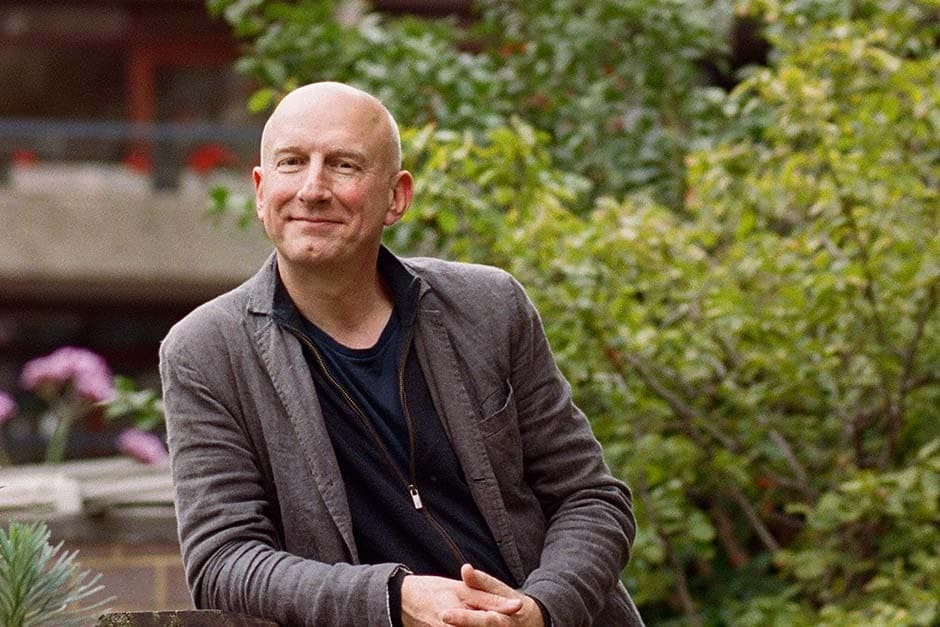
The internationally respected horticulturist, author and landscape designer, Professor Nigel Dunnett, has died at the age of 63.
His passing was confirmed today and has prompted an outpouring of tributes from across the gardening and design world. Widely regarded as one of the most influential figures in contemporary planting design, Dunnett’s work reshaped public landscapes across the UK and beyond, helping to bring biodiversity and sustainability to the forefront of urban design.
A professor of planting design and urban horticulture in the Department of Landscape at the University of Sheffield, he was considered one of the world’s leading voices on innovative approaches to planting design. A pioneer of ecological and sustainable practices, his work centred on integrating ecology and horticulture to create low-input, high-impact landscapes that were dynamic, diverse and closely attuned to natural systems. He was known for championing naturalistic planting schemes that combined scientific understanding with bold, visually striking aesthetics, an approach that redefined how planting could function in modern cities.
Author and garden designer Arit Anderson paid tribute, writing: “I’m too upset to say more. But for those that knew him well, you know we have just lost one of our dear, talented friends, and our beautiful world of plants and design will miss him sorely.”
Dunnett played a key role in the planting design for the London 2012 Olympic Games, particularly in the creation of Queen Elizabeth Olympic Park, where he served as co-principal planting design consultant from 2008 onwards. His innovative use of perennial meadows and long-season planting captured international attention, with the project widely viewed as a benchmark for environmentally conscious landscape architecture.
A gold medal winner at the Chelsea Flower Show, Dunnett designed six Main Avenue gardens between 2010 and 2025, including an invited Royal Horticultural Society garden. His wider portfolio of projects demonstrated both ambition and range, spanning major public and cultural landscapes. These included the Tower of London Superbloom (2022); the Barbican’s Beech Gardens and High Walk (Phase 1 in 2013, with Phase 2 commencing 2022–2024); Grey to Green in Sheffield (2015–2020); Grosvenor Square in London (2020 – ongoing); Battersea Power Station (2022); the Diamond Garden at Buckingham Palace (2013); Bergamo Green Square (2021); and the Hospitalfield Walled Garden in Arbroath (2020).
Throughout his career, he authored numerous books and academic papers, influencing both professional designers and home gardeners. His accessible, forward-thinking approach encouraged the widespread adoption of wildlife-friendly planting and more resilient green spaces in urban environments.
The Society of Garden Designers said: “We were deeply saddened to hear of the passing of Nigel Dunnett, a designer, plantsman, and academic whose influence on contemporary planting design has been profound. Nigel’s work combined ecological sensitivity with a bold, painterly approach to planting, helping to reshape how we think about public landscapes and urban green spaces. Through projects, teaching, and writing, he inspired a generation of designers to embrace naturalistic planting and to see beauty and biodiversity as intrinsically linked. His contribution to landscape and garden design will endure in the spaces he created, the ideas he championed, and the many people he taught and inspired.”
Colleagues and admirers have described Dunnett as a visionary whose work transformed how people think about planting in both public and private spaces. His legacy will endure in landscapes across the world, as well as in the many designers, students and gardeners he inspired.
Comments are closed.