
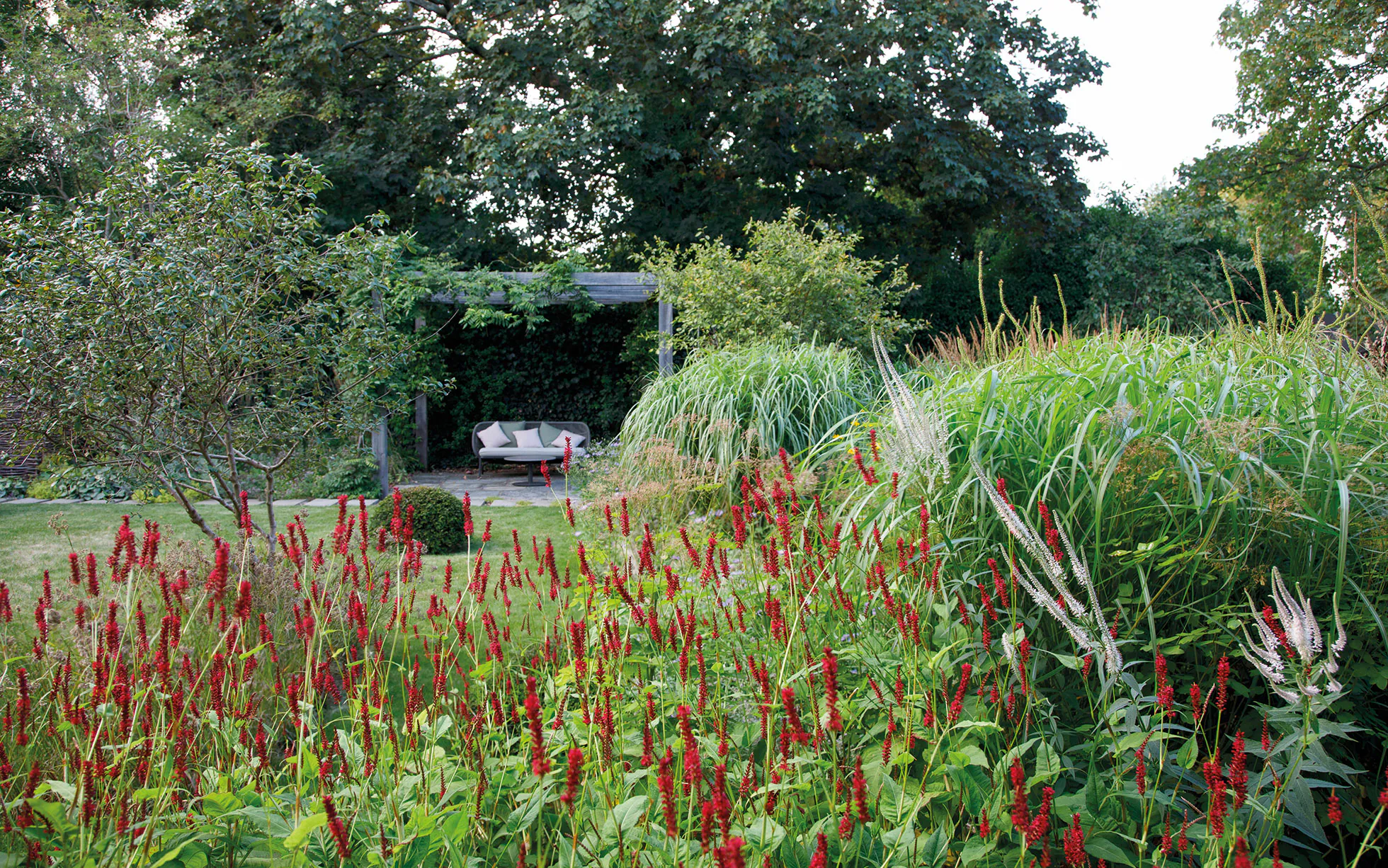
Having a garden in central London is both a blessing and a challenge. On the plus side, there’s the potential for a private oasis in the city, with no need to traipse to the nearest park to sit in the sun, or to pay for an outside table for lunch or supper. On the downside, well, that list can be long. London gardens can be too small, too long, too narrow, too awkward, too overlooked, too dark, too light, too damp, too hot, too difficult to access, too much effort…
All these obstacles, however, are juicy pickings for garden designers such as those who were winners and finalists at this year’s Society of Garden and Landscape Designers Awards. As the designs charted on these pages show, such professionals can help shape your outdoor spaces into places that are stylish, practical, wildlife- and climate-friendly.
1 Into the light zone
An expert-installed lighting scheme will make it easy to use the garden in the evenings. You want the overall effect to look and feel enticing, with a slightly different set of lighting, on a separate switch, to showcase key features, such as the dining and or seating areas.

Adolfo Harrison created an evening sanctuary with layered lighting in this terraced escape
Credit: Gonzalo Morillo
You could add a third, decorative layer – portable festoon lights, or solar-powered lamps, for instance – yourself. Most of the lighting in this terraced garden by Adolfo Harrison is provided by spike lights set into the planting and directed to cast a wash of light over the garden architecture at ground level. “Their job is not just to add definition but also rhythm and depth to the scheme,” says Adolfo, “and the benefit of spike lights is that as the planting grows, the locations and angles of the lights can be adjusted to adapt to the garden’s ever-changing dynamics.”
For a penthouse garden, meanwhile, Gonzalo Morillo of Locus Landscape, contrasts the urban horizon (in this case, Madrid) with dense, immersive Mediterranean planting to create a protected, almost wild oasis that sits above and looks out at the city. “At night,” says Gonzalo, “a combination of pendant and floor lanterns fitted with glare-free 2700k bulbs subtly highlight the stone kitchen, circular dining table, and pathways. Wall lights project soft geometric patterns that guide your movement, revealing the garden discreetly and fostering a sense of calm and intimacy.”
2 Say goodbye to fences and screens
In a small, overlooked town garden, how best to balance a wish for privacy with a desire for more space? Instead of fencing atop walls or solid screens, opt for ‘walls’ of tall ornamental grasses and ‘screens’ formed by pleached trees; they can distract prying eyes while still letting you see through.

Adolfo Harrison traded rigid fences for the soft, swaying privacy of ornamental grasses
Credit: Mischa Haller
Rug-shaped lawns and open-plan terraces separated by steps, raised beds, or a change in surface (from paving to gravel, for instance) can distinguish places for seating, dining, play, or entertaining. Each area has its own purpose without closing down views, making it feel reduced in size, or set in stone. “It’s important to have porous layers of planting at mid-height level, to give the illusion of more space and encourage curiosity,” says Adolfo Harrison, who designed this north London garden.
3 Planet-friendly and bespoke
The act of making a garden will inevitably present you with elements that you might think you no longer want. Instead of dumping old concrete or excavated soil in the tip, consider how they could be repurposed within the new garden.

Fi Boyle gave old concrete and oak sleepers a second life as a stylish retaining wall in this garden
Credit: Heather Edwards
The concrete can be crushed and used as a sub-base for a new terrace or path, while, depending on its quality, the soil, a precious resource, can be reused for new planting beds or landscape features. “This simple principle will reduce both waste and costs,” says Fi Boyle. “In this Bath garden, the stone we uncovered became drystone walls, while reclaimed oak sleepers and iron girders form the retaining wall, which we’ve planted with ferns and erigeron and other spillers. By reusing the soil and as many plants as possible, we kept waste to a minimum and allowed the garden to evolve with a greater sense of maturity.”
4 Double the benefits
Again, when space is at a premium, everything in a compact town garden needs to work extra hard to justify its presence.

Cassandra Crouch showcases multifunctional design with these wide benches, ideal for lounging, playing or connecting
Credit: Viktoria Dikareva
RHS Chelsea gold-medallist Ann-Marie Powell has used rocks or boulders in her designs as decorative features that children can clamber over, while tree trunks used as impromptu seating are a welcome additional habitat for wildlife. Cassandra Crouch also likes to include features that have a dual purpose in her designs. “The bespoke Douglas fir benches seen here make the heart of this London garden into a multi-purpose space that, with the addition of a folding table, becomes a dining room. I designed the benches to be extra wide, so the owners can lie on them too, and the children enjoy playing on them, while the solid, natural material connects with the wider natural feel of the garden.”
5 Water and wildlife
Small water features can add delightful sound and gentle movement to an enclosed space.

Sheila Jack created a sanctuary for all, from thirsty birds to night-loving hedgehogs
Credit: Alister Thorpe
A pond with sloping sides and planted with oxygenating plants and barley straw to help keep the water clean will be a boon for night-loving hedgehogs (an important habitat indicator species) and frogs, which help control plant pests; add a few large pebbles or a small rock so birds, bees and butterflies can perch and safely drink too. Alternatively, “A simple, shallow water bowl placed in the planting and visible from both outside and inside the house can be a valuable water resource for birds and wildlife and is safe around young children,” says Sheila Jack, designer of this leafy retreat in west London. “Filled by rainfall, the reflections in the surface of the water ‘bring the sky down’ into the garden and add an extra dimension.”
6 Make space to breathe
An artful combination of foliage, texture and pale materials will make small patio gardens feel fresh, calm, and inviting.

Pale stone and gravel meet lush foliage for a calm space in this garden by Charlotte Rowe
Credit: Jason Ingram
“In this small garden in Putney,” says Tomoko Kawauchi, of Charlotte Rowe Garden Design, “we worked with the idea of ma, meaning the intentional void or negative space, and have allowed pale-coloured stone and gravel and a planting palette of various green hues to create a sense of quiet breathing space. Texture comes through the foliage rather than colour, while carefully placed topiary subtly plays with perspective, guiding the eye and bringing a calm sense of balance to the terrace.”
7 Plan immersion therapy
Living in a city, it’s all too easy to remove oneself from nature and yet humans are part of the ecosystem, and we need it as much as it needs us.

Nilufer Davis brought nature right up to the windows in this stunning garden design
Forest bathing, plant immersion therapy, gardening, call it what you will but being close to plants is scientifically proven to slow your heart rate, reducing stress. It improves your breathing and therefore your lung health, and it calms a busy mind, making it easier to concentrate and remember.
Bringing the planting all the way up to the windows and walls of your home will settle you and a bonus benefit is that plant beds by the house will capture rainwater as it runs off your roof, helping to reduce flooding; it may even help reduce your water bill. “In this city garden,” says Nilufer Danis, “we’ve used ferns and ornamental grasses with sculptural and textural elements, and white-flowering astrantia for seasonal interest, to create a lush, layered effect. All are planted in enriched, well-drained soil beds, with low-maintenance care including mulching and seasonal pruning to keep the look vibrant all year round.”
8 Water runs through it
Sadly, many once beautifully planted London front gardens have been concreted over for car parking.

Nick Morton replaced concrete with crushed cockle-shells for a coastal feel
Hard surfaces are practical for many city dwellers, even in the rear garden, but increased flooding and a depletion of nature have been the damaging consequences. If plant beds are impractical, then replacing impermeable surfaces with those that allow water to percolate back down to the water table is essential. Laid properly, gravel allows water to drain away easily, reducing the chance of puddles and flooding in problem areas. For paved areas, leave the joints open and seed them with plants that will survive being trodden on, or sweep them with sand. “In this seaside townhouse garden, we used crushed cockle-shell gravel to unify the design,” says Nicholas Morton. “It’s a nod to its location, but also absorbs the rainwater well.”
9 Less is more
A careful curation of planting and materials used repeatedly throughout the design will make a bland or awkwardly shaped city garden feel cohesive and thus inviting and easy to use.

Cassandra Crouch used bold blocks of planting to build a seamless connection with the architecture
Credit: Viktoria Dikareva
“You can use the plants in bold blocks and broad swathes in one zone, then repeat it again elsewhere, so you build a connection. It looks simple but it works, particularly in a small space,” says Mandy Buckland, founder and managing director of Green Cube Design. “The material and planting palette for this garden were selected to complement the warm tones of the house,” says Cassandra Crouch. “Tall, airy grasses and flowering perennials are planted close to the house, creating a soft veil in front of the large windows that invites you to part it and walk out into the space. Plants with a naturalistic feel were selected to soften the scheme, while sculptural trees and evergreen shrubs provide year-round interest and privacy.”
10 Making connections
Using different densities and heights of planting to define zones and create a layered sense of privacy can turn a small space into a magical wonderland, for humans and wildlife.

Moss Studio used structural evergreens to create different zones in this stunning garden
Credit: Annaick Guitteny
“To create layers, depth and intrigue, as well as year-round and seasonal interest,” says Barbara Samitier, of Moss Studio, “we build our planting schemes from the bottom up, as well as from the front of the border to the back. We choose ground-cover plants such as epimediums, English geraniums, creeping thyme, and Pratia pedunculata before deciding on the structural plants that are going to hold the garden; these can be evergreens or shrubs and subshrubs with an elegant frame. They can also be grasses which have a strong presence throughout most of the year while being soft and providing food and habitat to birds and invertebrates during the winter months.”
The London Magazine celebrates prime property and luxury lifestyle in the world’s greatest city. Sign up to the newsletter

Comments are closed.