
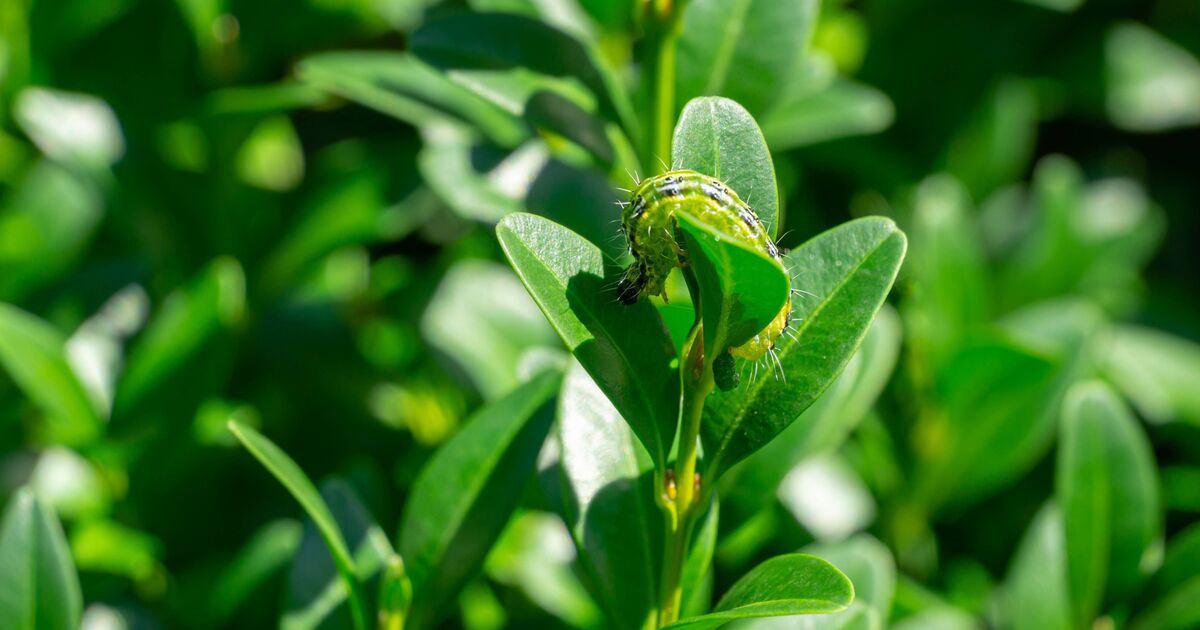
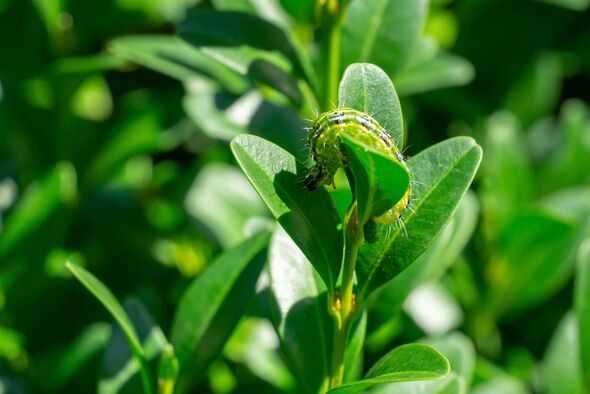
Caterpillars of Box tree moth (Cydalima perspectalis) on Boxwood (Buxus sempervirens destroying boxwood shrubs. (Image: Getty Images)
Gardeners throughout the nation are being warned about a major infestation threatening box trees this year. Numerous reports indicate cherished plants are succumbing to box tree caterpillars, with specialists calling for swift action to avoid permanent destruction.
Initially identified in 2007, box moth caterpillars are believed to have entered the UK from east Asia through imported plants. The moths were first discovered in private gardens across Britain in 2011, mainly in the south east, where they have subsequently become a substantial pest. They are now gradually spreading throughout the remainder of the UK.
Anyone with box hedges must monitor them carefully – and reports confirm they’ve already been sighted this year. One gardener said: “I’ve seen them for the first time today and they’ve killed lots of my plants before. I’m going to spray them immediately.”
These damaging pests become most active during warmer weather, and are presently at peak activity. Without prompt intervention, a box ‘ball’ can be entirely destroyed within merely a week. BBC Gardener’s World warned: “There have been reports of birds such as blue tits and jackdaws feeding on the caterpillars but it’s not yet known if this will have any serious affect on numbers.”
Celebrated gardening authority Monty Don has previously drawn attention to the gravity of the problem, suggesting it has become progressively harder to grow box tree plants anywhere across the UK. He commented: “Until 10 years ago Box hedges and topiary were almost ubiquitous in British gardens. But the combination of box blight and box moth caterpillar have made one of the stalwarts of the garden look very much under threat and it may be that fewer and fewer of us can successfully grow box at all.”
Kate Bradbury, garden writer and broadcaster specialising in wildlife gardening, who is an RHS ambassador supporting the charity’s Planet-Friendly Gardening Campaign, noted that caterpillars of this moth defoliate and can destroy box hedging, though she points out it remains a non-native species.
“What happens with new arrivals is that there are no natural predators to clear them up,” she says. “In the last 10,000 years, all of our native species have evolved together, and there are natural checks and balances that keep everything in in place.
“When you have something new coming in, it takes a few years for that to settle. “But I’ve seen robins eating the adults. There are various parasitic wasps that are keeping them in check as well. So I have hope that with box tree moths, we start to see populations go back down again.”” Box tree caterpillars are the larvae of a moth, Cydalima perspectalis, which lays its eggs on the undersides of box leaves. Once hatched, the caterpillars spin cobweb-like webbing across their feeding area, stripping the box leaves bare. BBC Gardeners’ World explained: “After around a month, the caterpillar forms a chrysalis which emerges as a box tree moth, which then mates, perpetuating the cycle. Box tree caterpillars can be a problem from spring to autumn, producing multiple generations. The caterpillars overwinter among box foliage, resuming feeding the following spring.”
Controlling box tree caterpillar
Organic control
Should the infestation be minor or limited to just a handful of plants, you can attempt to remove the caterpillars by hand – this will need to be carried out daily once signs of their presence have been detected, with thorough checks deep within the plant. Stems covered in webbing can also be pruned away using secateurs.
Should the caterpillars be taking a firm hold, a biological control containing the micro-organism Bacillus thuringiensis is considered to be effective. However, this is not licensed in the UK for domestic use and must only be applied by professionals. Treatment requires repeating several times throughout the season, when temperatures reach at least 15°C.
Insecticides Insecticides may be applied to combat box tree caterpillars, though they are generally considered less effective than biological controls and will additionally harm other insects. Several treatments are required. Avoid spraying insecticides near flowering plants to prevent damage to beneficial pollinators.
Preventing box tree caterpillar
Pheromone traps utilise a synthetic pheromone that replicates the one produced by the female box tree moth. Male moths are subsequently drawn to the pheromone and become trapped inside, interrupting the breeding cycle. The traps require regular replacement and are unlikely to capture every male moth within your garden. Nevertheless, they serve as a valuable indicator of box tree moth activity, enabling you to take swift action.
Comments are closed.