
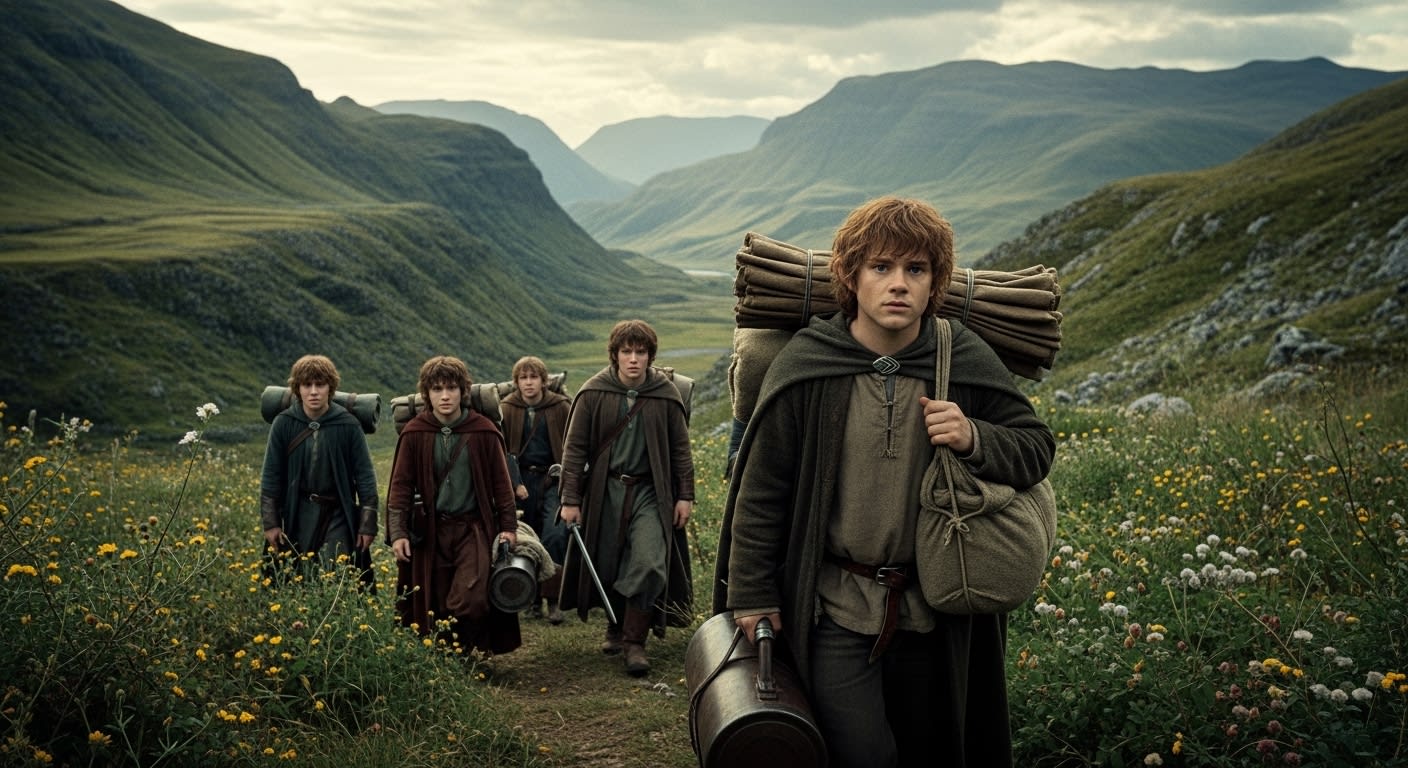
If you ask a casual fan who the hero of The Lord of the Rings is, they’ll likely point to Frodo Baggins, the burdened martyr, or Aragorn, the king returning to his throne. They might even suggest Gandalf, the celestial puppet master. But if you look closely at the mechanics of Tolkien’s epic—and if you listen to what J.R.R. Tolkien himself said in his letters—there is only one “chief hero.”
It isn’t the man with the broken sword or the hobbit with the glowing ring. It’s the gardener with the frying pan.
Samwise Gamgee is the actual hero of the story, and it’s time we stop treating him like a sidekick.
The Burden of the Ordinary
In high fantasy, heroes are usually born of prophecy or noble blood. They are “The Chosen One.” Frodo fits this trope; he inherits the Ring and the quest. But Sam? Sam is there because he was eavesdropping while trimming the hedges. He wasn’t chosen by destiny; he chose to stay out of loyalty.
This is the core of Sam’s heroism: it is entirely voluntary. Frodo is compelled by the weight of the Ring; Aragorn is compelled by his lineage. Sam is compelled by love. He is the only character in the entire trilogy who possesses the One Ring and gives it up willingly without a moment of hesitation or a struggle of will. Even Galadriel and Gandalf feared they would succumb to its power. Sam looked at the ultimate weapon of the Dark Lord and thought, “This is a bit heavy, and I’ve got a master to save.”
The “Samwise” Factor
Let’s look at the logistics. Without Sam, the quest ends at Cirith Ungol. Without Sam, Frodo starves in the Emyn Muil. Without Sam, the Ring never reaches the Cracks of Doom because Frodo’s will had finally, understandably, shattered.
When Sam utters the iconic line, “I can’t carry it for you, but I can carry you!” he isn’t just being a good friend. He is performing a feat of strength—both physical and spiritual—that surpasses anything done by the warriors of Gondor or Rohan. He is carrying the weight of the world’s salvation on his back, literally and figuratively, while his own stomach is empty and his home is a thousand miles away.
The Heroism of the “Small”
Tolkien, a veteran of the trenches in World War I, based the hobbits on the ordinary British soldiers he served with—men who didn’t have titles or grand ambitions, but who possessed an indestructible “plain” courage. Sam represents the “everyman” who survives the apocalypse not through magic or martial prowess, but through sheer, stubborn resilience.
While the “Great Men” of Middle-earth are busy debating the fate of nations, Sam is worried about whether they have enough salt for their meals. This isn’t comic relief; it’s a tether to reality. Sam is the reason there is a world worth saving. He represents the simple joys—gardening, food, family, and peace—that the Ring seeks to destroy. If Frodo is the soul of the quest, Sam is its heartbeat.
The True King of the Shire
At the end of the story, Aragorn is crowned King, but Sam is elected Mayor of the Shire seven times. He is the one who heals the land, planting the mallorn seed given to him by Galadriel. He is the one who ensures that the stories of the quest are told.
In the final pages of the book, the last words aren’t spoken by a king or a wizard. They are spoken by Sam, sitting in his home with his family: “Well, I’m back.”
It is the ultimate hero’s ending. Not a throne, but a hearth. Not a crown, but a child on his knee. Samwise Gamgee proved that you don’t need a magic sword to change the world; you just need to be the person who refuses to let go of the light, even when the shadows are at their darkest.
Is Sam the GOAT of fantasy sidekicks, or is he the true protagonist? Let’s settle this in the comments! If you’re a fellow Tolkien nerd, please leave a heart or a tip!
Comments are closed.