
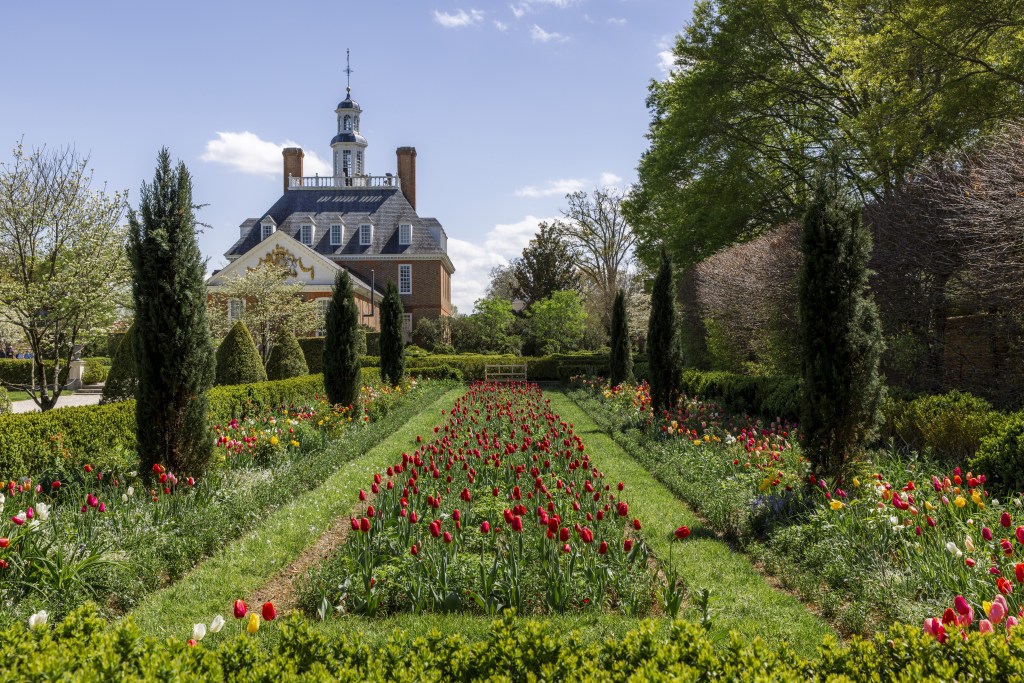
WILLIAMSBURG — Plans are in the works to revamp the gardens behind the Governor’s Palace at Colonial Williamsburg, thanks in part to a gift from the Garden Club of Virginia.
Details of the first phase of the project were shared with visitors on Tuesday during the Williamsburg leg of Historic Garden Week, an annual event offering tours of private homes and gardens across the state. The garden club is funding portions of the first phase, which includes restoration of the Governor’s Palace Bowling Green, located on the east side of the building. During the colonial era, the area was used as a recreational space primarily for lawn bowling, an outdoor sport similar to bocce.
Jack Gary, Colonial Williamsburg’s associate vice president of historic resources and archaeology director, shared evidence of a lawn bowling ball that was found near Shield’s Tavern, which proves that “we know for a fact unequivocally there was bowling in the 18th century in Williamsburg.”
Restoration of the Bowling Green and the overall Governor’s Palace gardens renovation project is part of a new, larger and “ambitious” 50-year master landscape plan at Colonial Williamsburg, Gary said.
“We are excited to be unveiling and implementing that soon,” he said.
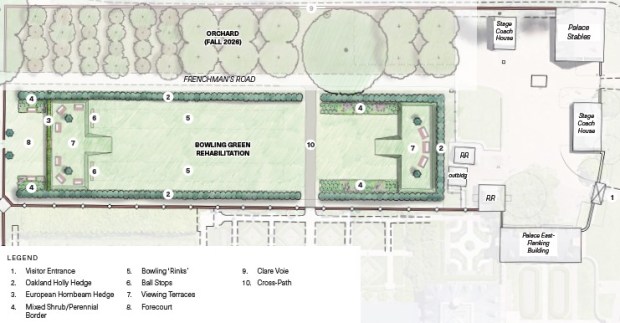 Rendering of the completed Bowling Green project at the Governor’s Palace. The palace is to the lower right of the picture. (Nelson Byrd Woltz Landscape Architects)
The decision to overhaul the grounds behind the Governor’s Palace comes as modern challenges pose a threat to the landscaping, most notably and devastatingly a disease called boxwood blight that forced the removal of all of the English boxwood shrubs.
“That was a hard decision for us to make,” Gary said.
Thomas Woltz, principal of Nelson Byrd Woltz Landscape Architects, has been tapped to work the Bowling Green project. He is being tasked with preserving and revitalizing the area that was originally designed by landscape architect Arthur Shurcliff back in 1932. At the time, Shurcliff made an educated guess as to how the long, rectilinear Bowling Green appeared and where it was located.
Thanks to archeological advances, Woltz said there is a “clearer picture” of what the area would have been like in the 18th century, which he plans to emulate.
“It is a step toward greater authenticity,” said Woltz, adding that he does not plan to redo what Shurcliff did, but rather create “the Shurcliff masterpiece that it was always intended to be.”
Once complete, the Bowling Green will be used to educate visitors about recreational practices at the time, including lawn bowling. Additionally, the space will be large enough to hold a tent for other events.
“We are trying to be clever about double uses,” Woltz said, so that the public can enjoy the green in a myriad of ways.
The new Bowling Green and surrounding space will also off the opportunity for landscapers to experiment with a new selection of shrubs and trees that are more resilient to contemporary challenges brought on by climate change, disease pressure and intensive public use. Renovations are expected to begin next month with an anticipated completion by late fall.
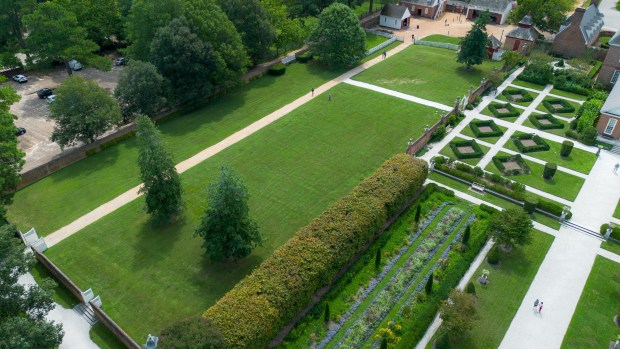 Aerial views of the Bowling Green next to the Governor’s Palace. (Brian Newson/The Colonial Williamsburg Foundation)
Phase II of the Governor’s Palace gardens renovations will include installation of an orchard and meadow.
Since its inception in 1920, The Garden Club of Virginia, a nonprofit organization that focuses on conserving natural resources and preserving Virginia’s historic public gardens, has funded 130 landscaping renovation projects through ticket sales from Historic Garden Week. The amount for the Bowling Green restoration project was not disclosed.
“We are excited about this new partnership with Colonial Williamsburg,” said Kris Carbone, president of The Garden Club of Virginia.
Brandy Centolanza, bcentolanza@cox.net
Comments are closed.