
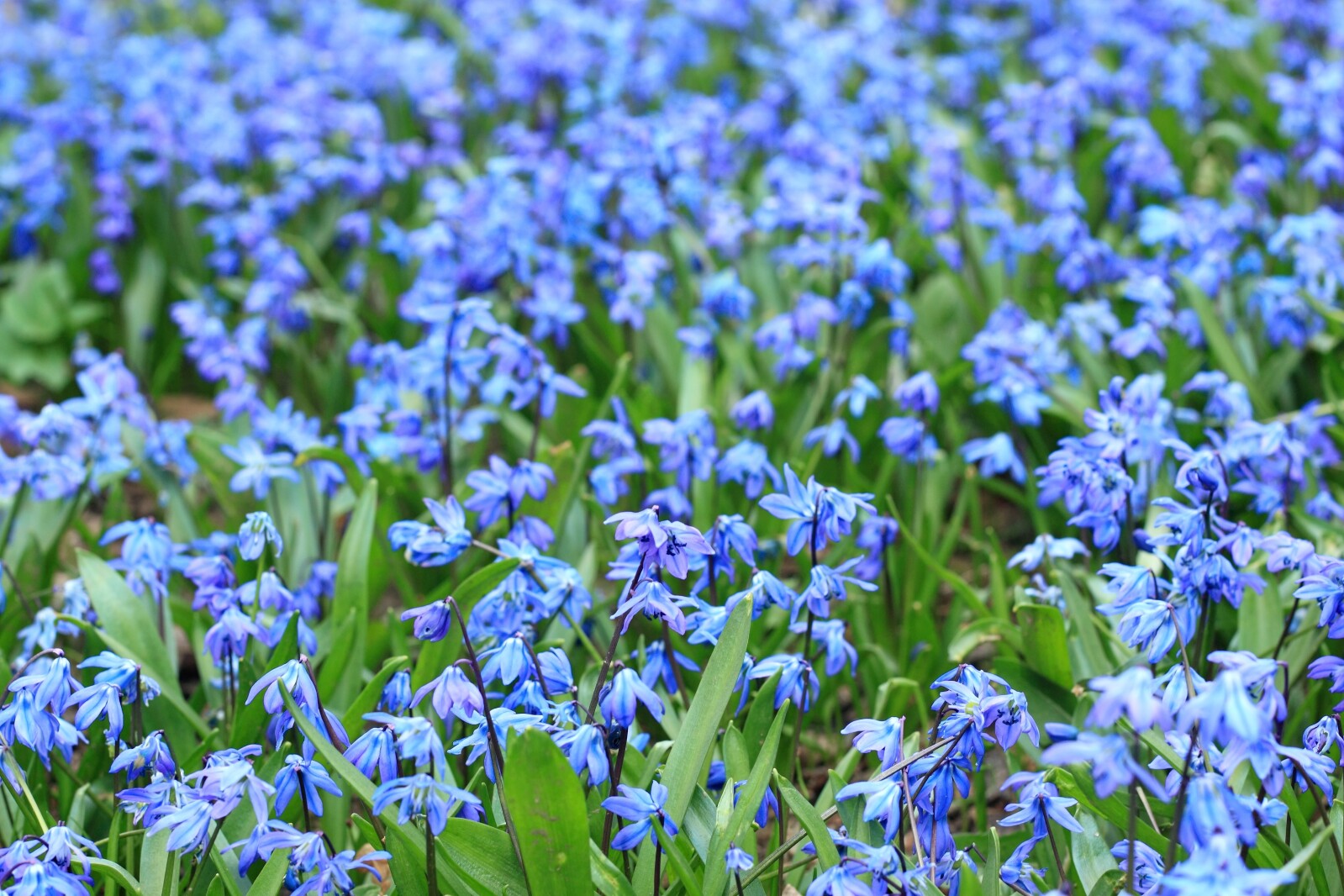
Dear Master Gardener: A few years ago, I planted 100 Siberian squill bulbs under a large pine tree. The large swath of blue is beautiful, but I noticed they are now growing in the lawn and have spread out in the yard. Did I plant an invasive species?
Answer: Siberian squill (Scilla siberica) was brought to the United States in the 1700s as an ornamental plant. It has been a popular bulb to plant in Minnesota because it is hardy to zone 2 (negative 50 degrees Fahrenheit) and has beautiful blue flowers. It emerges early and blooms right after the snow melts. Unfortunately, Siberian squill naturalizes easily and spreads quickly by self-seeding and bulb offshoots. In addition, rabbits, voles, and deer do not feed on squill to help manage the population. This non-native, fast-spreading species can choke out our native ephemerals, such as hepatica and trillium, and has become a major concern. It was planted at the Minnesota Landscape Arboretum in 1996 and has taken over natural areas and can be found in many of the gardens. There is a team at the Arboretum actively managing the invader. You (and many other gardeners, including me) planted an aggressive species that has not yet been listed by the Minnesota Department of Natural Resources as an invasive species. You may want to start management procedures this spring and start digging them out before they take over your landscape!
Dear Master Gardener: I haven’t heard much about emerald ash borer lately. Have they been found in Crow Wing County yet?
Answer: Sadly, the answer is yes. In January 2024, the Minnesota Department of Agriculture (MDA) confirmed emerald ash borer (EAB) in Crow Wing County for the first time. A suspected EAB infestation was discovered near Brainerd and EAB larvae was later found. Federal identification confirmed the samples as emerald ash borer. There are now 48 counties in the state with EAB. According to the Minnesota Department of Agriculture, the larvae kill ash trees by tunneling under the bark and feeding on the part of the tree that moves nutrients up and down the trunk. Often, the trees show several signs of infestation because of this. Woodpeckers like to feed on EAB larvae, and woodpecker holes may indicate the presence of EAB. In addition, EAB tunneling can cause the bark to split open, revealing characteristic S-shaped tunnels, called galleries, underneath. The MDA issues quarantines for all areas known to have EAB to limit the movement of firewood out of the area and reduce the risk of further spreading the insect.
Dear Master Gardener: I would like to put in an herb garden. What herbs are typically planted in an herb garden?
Answer: According to the Colorado State University Extension, a basic culinary garden contains garlic, chives, basil, oregano, parsley, sage, rosemary and thyme. A tea garden might have spearmint, peppermint, lemon balm, lemon verbena, chamomile and catnip. A garden for potpourri may have lavender, scented geranium, santolina and rosemary. Once established, most herbs require little water, but annual herbs and mints require a bit more water than perennial herbs. You may want to keep any mint plants in containers so they don’t take over the whole yard!
Dear Master Gardener: Is the burning bush really banned from being sold in Minnesota now? The shrub is so pretty in the fall.
Answer: In the mid-1800s, the winged burning bush (Euonymus alatus) was introduced to North America as an ornamental shrub. The bright red fall foliage has made it an attractive and popular landscape plant for years. According to the Minnesota Department of Agriculture, propagation and sale of this plant are prohibited in Minnesota. In 2020 it was declared a Restricted Noxious Weed. MDA states that although Restricted Noxious Weeds are not required to be controlled or eradicated by law, landowners are strongly encouraged to manage these invasive plants on their properties to reduce their spread into new areas.
Dear Master Gardener: Does watercress grow in Minnesota?
Answer: The USDA Natural Resources Conservation map shows that watercress occurs throughout all the continental United States, except for North Dakota. It is found in cool shallow water, muddy banks, streams, wet ditches and pond margins. Watercress (Nasturtium officinale) is a hardy, perennial herb that originated from Europe. It is the same watercress you can find at the local grocery store in the produce section. It is considered to be noxious and invasive in 46 states. In Minnesota it is considered a widespread and problematic invasive of clear streams, springs and brooks. It spreads out on the surface of the water, choking out native plants.
It is edible and can be harvested wild, but it is important to take it from clean (tested) water, as you run the risk of ingesting harmful parasites, pathogens, toxins or getting giardia. Harvest it before flower buds appear; otherwise, the flavor decreases in potency and it becomes inedible. Cut the stems at the waterline with a scissors or pull clumps out by the roots and cut the roots off later.
According to Utah State University you can grow watercress in your garden. Place potted plants in a bucket with 2 to 3 inches of water so the media stays wet and the roots are submerged under water — simulating the saturated conditions of a stream. They recommend changing the water once or twice a week. You can also plant watercress by an existing water feature in the yard, locating the plant where the soil stays saturated with water.
You may get your garden questions answered by calling the new Master Gardener Help Line at 218-824-1068 and leaving a message. A Master Gardener will return your call. Or, email me at
umnmastergardener@gmail.com
and I will answer you in the column if space allows.
University of Minnesota Extension Master Gardeners are trained and certified volunteers for the University of Minnesota Extension. Information given in this column is based on university research.
Comments are closed.