
Almost everyont that grows a garden puts in some lettuce for their salads. Lettuce likes it warm, but not hot. After about 25C (77F) it no longer grows at an optimum rate and if it gets too many hot summer days in a row it just shrivels up and dies. In the old days, farmers and gardeners in the south needed to worry about that. Canadian farmers rarely saw days that hot to begin with so they didn’t lose any sleep over it. Then the summers just kept getting hotter. Last summer, for example in the Province of Ontario the temperatures kept going up and it stunted a lot of lettuce growth. Luckily, agrivoltaics – the simultaneous use of land for clean electricity generation from solar photovoltaic technology and agricultural production – offers one viable and sustainable solution.
12 Agrivoltaics Climate – Which Will Work?
Climate destabilization endangers food security as crop productivity diminishes, nutritional quality is reduced, and unpredictability of growing seasons increases, Agrivoltaics is an emerging solution to this challenge. A new study investigates the performance of the heat sensitive crop of organic romaine lettuce under a broad range of agrivoltaic conditions outdoors alongside un-shaded controls. The study looked at twelve agrivoltaic configurations of varying type and opaqueness. The scientists varied between crystalline silicon wafer-based solar cells where they spaced out the cells and left blank glass to allow more light through. They also looked at thin-film solar modules, where they made the layers thinner – so they looked a lot like tinted glass windows. These experiments differed in magnitude and spectra of light transmittance, shading patterns, and spatial coverage.
When It is Hot, Agrivoltaics Comes Through
During high-temperature stress conditions, the results show agrivoltaic treatments increased lettuce fresh weight by over 400% compared to unshaded control plants and by over 200% relative to the national average yield. Notably, 60% transparent colored thin-film solar photovoltaic modules and 44% transparent crystalline silicon-based solar modules delivered the highest productivity gains, underscoring the critical role of optimized shading intensity and spectral quality in promoting plant growth.
You Don’t Have to Be A Scientist to See Agrivoltaics Works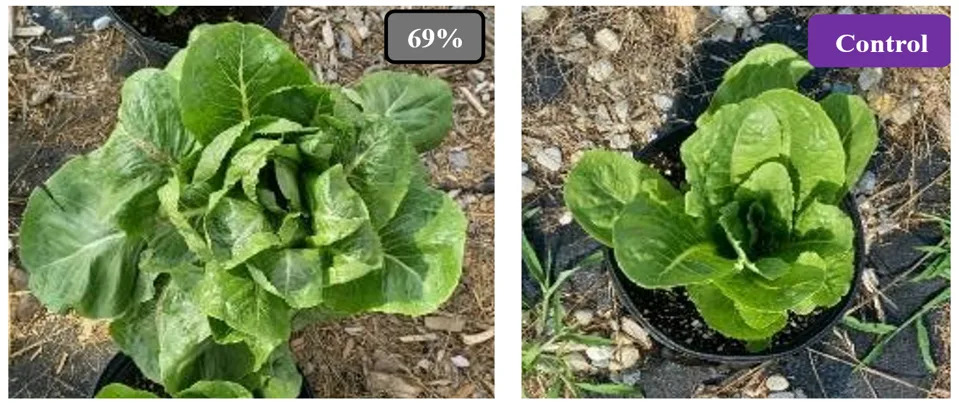
Control lettuce with no shading vs a lettuce protected by a 69% T solar panel in an agrivoltaic setup. From: Enhancing heat stress tolerance in organic romaine lettuce using crystalline silicon and red, blue & green-colored thin film agrivoltaic systems, Solar Energy, 305, 2026, 114215, ISSN 0038-092X, https://doi.org/10.1016/j.solener.2025.114215.
Uzair Jamil, Joshua M. Pearce
Morphological traits such as plant height and leaf number exhibited strong positive correlations with biomass accumulation, validating the physiological benefits of partial shading and spectral filtering.
Agrivoltaics Could Make Lettuce Farmers a Fortune
Agrivoltaics just makes economic sense – you get inexpensive power, agricultural jobs and perhaps most importantly more food. A study from a more than a decade ago in the US showed lettuce agrivoltaics would make money. Agrivoltaics has since exploded into a >$20 billion dollar market and is continuing to expand rapidly all over the world. The Vatican already is 100% powered by agrivoltaics. Now these new results show that Canadian farmers could benefit too. The economic value of lettuce is roughly four times the value of agrivoltaic-generated electricity on equivalent land area.
Overall, the results demonstrate that agrivoltaic systems can enhance romaine lettuce production during hot summers while simultaneously contributing to climate-smart agriculture and sustainable energy generation. If scaled to protect Canada’s entire lettuce crop, agrivoltaics would result in major emissions reductions as well as make farmers a lot more lettuce.
This article was originally published on Forbes.com
Comments are closed.