
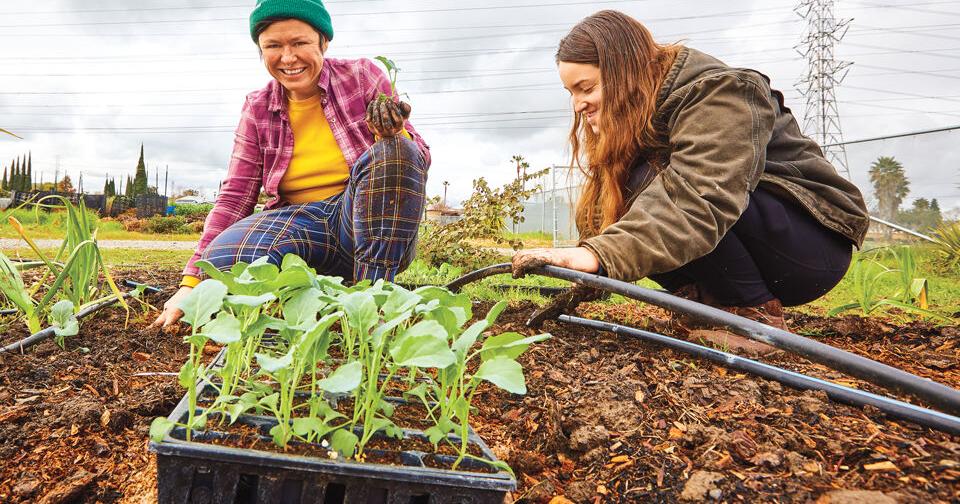

Family Harvest Farm participants gain job skills while providing food to those in need in the Pittsburg region.
Christopher Minor Ciardiello
Berkeley slow food advocate Alice Waters once said, “Good food should be a right and not a privilege, and it needs to be without pesticides and herbicides.” But ultra-processed food, not organic produce, makes up a majority of the American diet; an estimated 70 percent of the food supply in the United States is ultra-processed, and an overreliance on such fare can impact health.
Increasing access to fruits and vegetables is one way to promote healthier diets, with several nonprofit farms and gardens partnering with food assistance organizations in the East Bay to provide fresh fare, along with opportunities to learn more about agriculture.
“Our primary goal is to get good, healthy food into the hands of people who might not be able to afford organically grown produce,” says Brenda Kusler, executive director of Fertile GroundWorks. “Our mantra is teach, grow, give. We use education to empower individuals to sustainably grow food for themselves and others. We then take the harvest from those lessons, and we give it to our neighbors in need.”
The Livermore nonprofit began growing crops on land at Asbury United Methodist Church in 2010, providing fresh produce to food kitchens and pantries in the region. Last year, nearly 1,500 volunteers helped grow 32,116 pounds of food, which was then distributed to Fertile GroundWorks’ partners, including Open Heart Kitchen, Interfaith Sharing Food Pantry, Culinary Angels, and Tri-Valley Haven, among others. The garden also makes small donations to schools and programs like Meals on Wheels.
Livermore’s Fertile GroundWorks grows thousands of pounds of produce every year.
Courtesy of Fertile GroundWorks
The crops consist of “whatever is in season,” says Kusler, from chard and kale to pepper and eggplant to more subtropical plantings added in response to requests from their food distributors’ diverse clientele.
Fertile GroundWorks also has gardening programs at smaller community gardens and schools in Livermore, Pleasanton, Dublin, and San Ramon. “We had 5,600 kids make 32,000 visits to their gardens last year. It just makes my heart sing,” says Kusler. “You can just see the light bulb go off in their heads—I planted the seed that made this carrot.”
Along with providing education at their 2.5-acre garden site in Livermore, Fertile GroundWorks focuses on sustainable practices such as no-till farming, rainwater catchment, and composting. The garden is also a gathering space for their volunteers, many of whom are retirees, children, and teens, or people who want to get their hands in the earth but don’t have their own garden.
“If you ask people, they’ll say it’s just the good energy out here that keeps them coming back,” says Kusler. “It’s working together on a common task to give to our neighbors—to give back to our community.” fertilegroundworks.org.
Volunteers maintain Free Tomato Project gardens in Walnut Creek, Concord, and Clayton.
Courtesy of the Free Tomato Project
Fresh Vegetables for All
When Matt Davis retired in 2023 and moved from Danville to Concord, he noticed most of his neighbors were single mothers or seniors living on a fixed income. After learning food banks often aren’t equipped to distribute fresh produce before it goes bad, he came up with the idea of a food-pantry-adjacent garden where people can pick their own vegetables at no charge. He dubbed it the Free Tomato Project and partnered with several local churches to establish gardens on their vacant lots. “The basic principle is why don’t we just plant the vegetables where the people already are, and then they can take it from there,” says Davis.
A crew of about 100 volunteers help staff the gardens in Walnut Creek, Concord, and Clayton; Davis says the project will expand to 12 gardens this year with more to come. He encourages people to call him at 925-594-2052 if they are interested in establishing a garden in their neighborhood.
“My vision is that when you drive … around Concord, every few blocks there is a Free Tomato Project,” says Davis. “It generates awareness in the community but also generates awareness within the orbit of people that need assistance.”
Everyone, regardless of need, can pick from the gardens, however. “An important part is the sense of community that comes from people in the neighborhood who see [the garden], take ownership of it, [and] want to help their neighbors, but also want to get something good for dinner,” he adds.
The endeavor receives support from area residents, churches, and the local business community. Volunteers help with planting, maintenance, and propagating seeds for the next crop, while food assistance programs share information about the gardens with clients or pick the veggies themselves to distribute to those requiring aid. And despite its name, the Free Tomato Project offers a variety of produce including cucumbers, zucchini, peppers, and squash. “Our only litmus test is yield,” says Davis. “We don’t want to spend six months and end up with one cauliflower.” freetomatoproject.com.
Growing Strong
Pairing agrarian projects with societal issues is a natural fit, with many agricultural organizations in the East Bay promoting food equity, job training, sustainability, and/or social justice including Urban Tilth in Richmond and CoCo San Sustainable Farm in Martinez. Pittsburg’s Family Harvest Farm was established in 2020 and is a John Muir Land Trust program that encourages participation in our local food system, with a particular focus on youth who have experienced foster care.
Young adults learn regenerative farming practices and job skills on-site at the 3.5-acre farm. The resulting vegetables are donated to those in need.
“Family Harvest Farm is a true community resource. It grows healthy food for local families, offers workshops, and gives volunteers a place to get their hands dirty,” says Linus Eukel, executive director of the John Muir Land Trust. “Young adults acquire skills and learn lessons that can be life-changing. It’s so much more than just a farm!” jmlt.org/our-places/family-harvest-farm.
Comments are closed.