
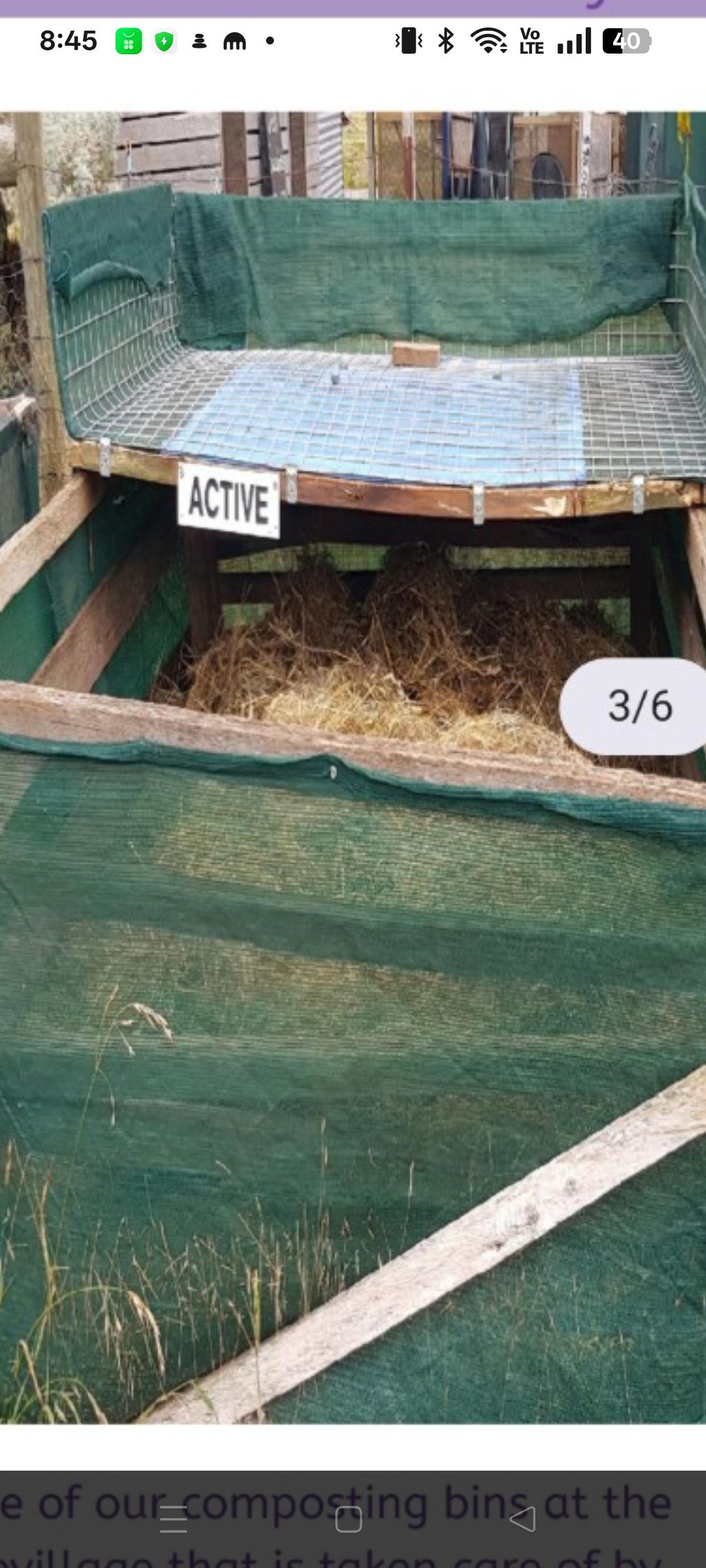
Here at the Ecovillage, for the past 6–7 years, I have successfully employed a system of thermophilic composting. I only deal with kitchen food waste.
This material often causes problems because, if not dealt with properly, it can become very smelly and breed flies. (Please note, there are numerous methods of composting, and each person can find the method which suits their particular circumstances. Once you find out which does suit you, stick with it—that is the one that will likely bring you greatest success.)
MY METHOD
The compost bin is ideally 1 metre square or larger
(Mine are 1.8m square with sides approx. 1 metre high.)
If the bin is too small, it may not reach higher temperatures.
Before use, a saucer-shaped depression is dug into the soil base (~30 cm deep).
This directs excess moisture into the pile rather than letting it leak outward.
A thick layer of hay or straw is spread over the soil.
Food waste is deposited into the middle of this hay, leaving at least 30 cm of hay/straw around the sides.
Why this works:
Keeps heat and smell inside
Deters flies
Allows plenty of airflow for aerobic composting
Important:
Always bury food waste into the middle, not on top
Always cover with more hay or straw
Never leave fresh waste exposed
AS THE HEAP GETS LARGER
The centre begins to warm due to fungal and bacterial activity
Temperatures can reach 55–65°C
If it becomes too dry:
Lightly moisten with water
Compost goes through stages:
Aerobic (less smelly)
Anaerobic (smelly, acidic)
Both are natural—no need to interfere
White fungal growth (“gossamer”) is a good sign
THE HEAP
The heap gradually settles as waste is added
When full:
Cover with a final layer of hay or straw
Leave to mature for 5–6 months
WITH THIS METHOD
The heap is never turned
Natural layered zones form
Organisms self-regulate based on their needs
👉Turning can disrupt this balance
Benefits:
Less work
Better compost
More nutrients retained
A WORD OF WARNING
Old hay can develop Aspergillus fungal species, seen as a powdery white coating.
When disturbed, it can release spores into the air
Some immunocompromised people may be susceptible
One of our composting bins at the
by Dry_Cheetah3725
1 Comment
I didn’t know how to edit but this is written by my friend who devised this system for around 50 people. After one year we get amazing compost to use in our gardens.
I wanted to post it as I love reading about anything compost! The way we do it here is there is smaller bins that people put their food waste in and then me or my friend put that in the system when there is enough. This is so the main compost gets hot enough (as you have to lift up the hay ‘lid’ to put the compost in, and so the hay lid stays in place. It’s a bit of work and could be easier but it’s beautiful compost at the end! The compost cage has a wall that comes down when it’s ready to harvest which is handy.
https://preview.redd.it/mgnlw9eiq1ug1.jpeg?width=3072&format=pjpg&auto=webp&s=5c89903c57d4b587dd173b26933215d938219533