
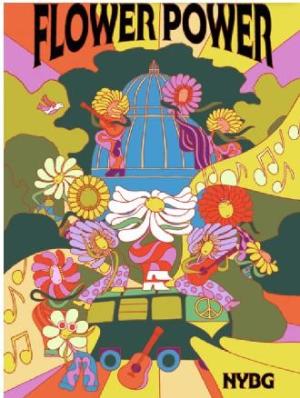
 A Multidisciplinary Exhibition Celebrating Flowers as a Cultural Symbol
Bronx, NY— This summer, the New York Botanical Garden (NYBG) presents Flower Power, a multidisciplinary exhibition celebrating flowers as a cultural symbol of peace and love that advances closer relationships with the natural world. The gallery show and gardens combine a vibrant flower show and monumental installations with paintings, photography, and posters from the 1960s and ‘70s, including three works by pop art icon Andy Warhol. Other pieces by Milton Glaser, Joe Brainard, and Carlos Irizarry highlight how flowers take on resonance as creative and enduring symbols spanning generations. Site-specific installations are on view in the Enid A. Haupt Conservatory and its lawn, while additional sculptures and artist-designed buses evoking the era can be found throughout the Garden. The exhibition invites visitors to “come together” and embrace flowers as meaningful symbols in our own lives.
Flower Power runs from May 23 through October 18, 2026. Tickets are on sale now for daytime viewing of the exhibition and can be reserved here at https://www.nybg.org/event/flower-power/. Tickets for Flower Power Nights, select evenings that celebrate the era with live music and Liquid Light Shows, will be on sale April 16, 2026. For more information about Flower Power and related programming, visit www.nybg.org/.
“Flower Power unites world-class art with our living plant collections and our historic landmark buildings and landscape,” said Jennifer Bernstein, CEO and The William C. Steere Sr. President of the New York Botanical Garden. “It’s an opportunity for us to present a cultural experience that can only happen at a botanical garden of this scale and scope, where art, history, and the natural world coexist.”
Visitors can step back in time in the Art Gallery of NYBG’s Mertz Library Building with an extraordinary display of paintings, photographs, screenprints, and collages by artists from the 1960s and ‘70s that depict flowers as symbols of peace and love. Andy Warhol’s Flowers (1964) will be on view alongside the image used as source material for the work, a photograph taken by nature photographer and environmental activist Patricia Caulfield. Other highlights within the gallery include artworks by Joe Brainard, Milton Glaser, Carlos Irizarry, Corita Kent, and many others, as well as original fashion from the period, posters, and first editions of critical feminist and environmental texts including Betty Friedan’s The Feminine Mystique and Rachel Carson’s Silent Spring. Together with reproductions of photographs by Bernie Boston, Bob Edelman, and other photojournalists, archival audio, and news footage, these displays will exemplify the era’s social movements and culture. By placing these works in conversation with each other, Flower Power explores how flowers took on resonance as creative and enduring symbols in the social movements of the 1960s, including the early environmental movement, as well as art, music, and fashion to champion a closer relationship with the natural world.
A fifteen-foot diameter peace sign filled with live plants welcomes everyone at the Leon Levy Visitor Center. In various locations, colorful buses inspired by the festively-adorned hippie buses that conveyed the crowds to Woodstock in 1969 are on display, designed by New York-based artists Snoeman, Blanka Amezkua, and Carlos Wilfredo Encarnación-Vazquez. The Conservatory Lawn features large, hand-painted fabric canopies created by Mushuman, known for vibrant, light-reactive, and dreamlike designs. Nearby, an interactive art fence, inspired by one at the original Woodstock Festival, allows visitors to participate in an ever-growing textile artwork, accompanied by reproductions of archival photos and graphics.
Inside the Enid A. Haupt Conservatory, monumental sculptures by artist Amie Jacobsen dazzle in a rainbow of colors and daisy shapes amid horticultural delights. Outside in the Conservatory’s Hardy Pool Courtyard, water lilies and lotuses create a meditative, peaceful space for visitors to connect to the 1960s-era interest in spirituality and enlightenment.
“We are proud to present an exhibition that celebrates how flowers have been used as enduring symbols of peace and creative possibility, from the transformative movements of the 1960s to today,” said Joanna L. Groarke, Vice President of Exhibitions and Programming at the New York Botanical Garden. “Flower Power reminds us that plants have always been a shared language, one that artists return to again and again to express hope, harmony, and connection.”
Flower Power Nights
On select evenings starting May 30, 2026, Flower Power Nights offer visitors the opportunity to experience the free-spirited creativity and communal joy of the era that shaped the exhibition, through live performance, a Liquid Light Show, and a maker’s market offering crafts and food and beverages for purchase. Featured bands include Ghost Funk Orchestra on May 30 and Habibi on June 13.
Each Flower Power Night features a vibrant 40-minute concert by a featured band whose work brings a fresh, modern edge to the late 1960s’ iconic and free-spirited sound.
Liquid Light Shows are a multimedia performance art that uses colored oils, dyes, glass, and light to create dynamic real-time visuals projected on the center of the Mertz Library Building to accompany live music. The art form began in early 1960s San Francisco and evolved through the psychedelic ballroom scene, providing an immersive backdrop for musicians such as the Grateful Dead, Jimi Hendrix, Janis Joplin, and Pink Floyd. Artists originally used overhead projectors, slide projectors, film projectors, and modified devices such as color wheels to achieve their effects. Today’s Liquid Light Shows may incorporate the same tools, along with modern upgrades such as high-definition camera feeds, LED light tables, RGB color wheels, digital projectors, and powerful VJ software. Liquid Light Shows during Flower Power Nights are presented by Liquid Light Lab, the work of Steve Pavlovsky, a multi-dimensional light artist from New York City.
Arts at the New York Botanical Garden
Gardening throughout the ages has been closely related to scientific exploration and innovation, the visual arts, architecture, and cultural and aesthetic movements. Through pioneering interdisciplinary exhibitions that bring together plants, rare books and manuscripts, and works of art, NYBG illuminates the deep and enduring relationships between plants and people. These exhibitions, along with their accompanying public programs, highlight the powerful connections among gardening, the arts and humanities, and human well-being.
For more information about Flower Power, go to www.nybg.org/.
About The New York Botanical Garden
The New York Botanical Garden (NYBG) has been a connective hub among people, plants, and the shared planet since 1891. For nearly 135 years, NYBG has been rooted in the cultural fabric of New York City, in the heart of the Bronx, its greenest borough. NYBG has invited millions of visitors to make the Garden a part of their lives, exploring the joy, beauty, and respite of nature. NYBG’s 250 acres are home to renowned exhibitions, immersive botanical experiences, art and music, and events with some of the most influential figures in plant and fungal science, horticulture, and the humanities. NYBG is also a steward of globally significant research collections, from the LuEsther T. Mertz Library collection to the plant and fungal specimens in the William and Lynda Steere Herbarium, the largest such collection in the Western Hemisphere.
The plant people of NYBG—dedicated horticulturists, enthusiastic educators, and scientific adventurers—are committed to helping nature thrive so that humanity can thrive. They believe in their ability to make things better, teaching tens of thousands of kids and families each year about the importance of safeguarding the environment and healthy eating. Expert scientists work across the city, the nation, and the globe to document the plants and fungi of the world—and find actionable, nature-based solutions to the planet’s dual climate and biodiversity crises. With eyes always looking forward, they train the next generation of botanists, gardeners, landscape designers, and environmental stewards, ensuring a green future for all. At NYBG, it’s nature—or nowhere.
###
Flower Power is sponsored by:
Delta
Major support provided by Janet M. Montag and Caroline A. Wamsler Ph.D. & DeWayne N. Phillips
Additional support is provided by Christie’s.
Flower Power is made possible by the New York State Council on the Arts
with the support of the Office of the Governor and the New York State Legislature.
Exhibitions in the Enid A. Haupt Conservatory are made possible by the Estate of Enid A. Haupt.
The New York Botanical Garden is located at 2900 Southern Boulevard, Bronx, New York 10458. For more information, visit nybg.org.
The New York Botanical Garden is located on property owned in full by the City of New York, and its operation is made possible in part by public funds provided through the New York City Department of Cultural Affairs. A portion of the Garden’s general operating funds is provided by The New York City Council and The New York State Office of Parks, Recreation, and Historic Preservation. The Bronx Borough President and Bronx elected representatives in the City Council and State Legislature provide leadership funding.
Comments are closed.