
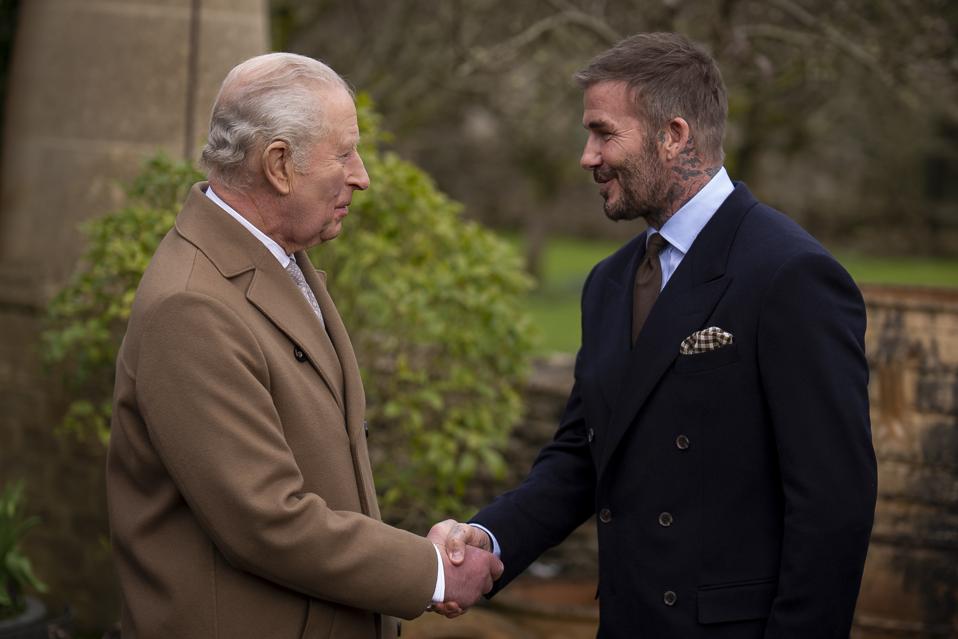
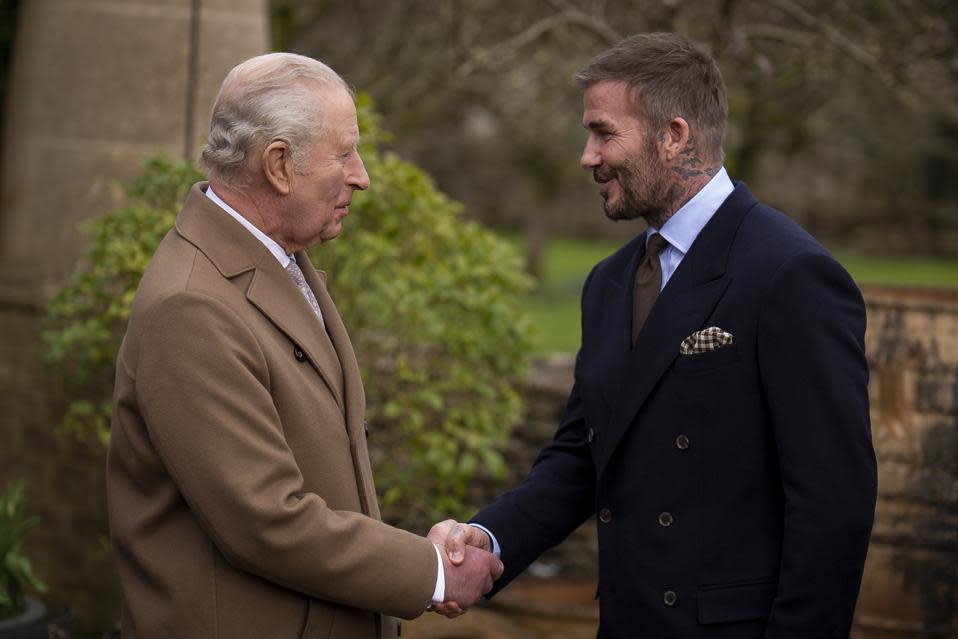
King Charles III and Sir David Beckham shake hands on departure, as part of the team behind The RHS and The King’s Foundation Curious Garden gather at Highgrove, Gloucestershire, to look over the designs for the RHS Chelsea Flower Show garden looking to celebrate and encourage the public’s curiosity in gardening and spending time in nature. Picture date: Friday March 27, 2026. (Photo by Aaron Chown/PA Images via Getty Images)
PA Images via Getty Images
In just a few weeks, more than 140,000 people will pass through the gates of the RHS Chelsea Flower Show, with millions more engaging globally across broadcast and digital platforms. Tickets move quickly, demand builds early, and the atmosphere carries a level of anticipation that would once have been reserved for a very different kind of event.
Organised by the Royal Horticultural Society, Chelsea has long been influential within horticulture. What it now reflects is something far broader. The involvement of King Charles III and David Beckham in a garden centred on beekeeping and biodiversity places gardening firmly within a wider cultural conversation. It sits alongside discussions around food, sustainability, and health, rather than quietly within lifestyle.

The Ravello zinc water feature from Burford Garden Company introduces a quieter layer to outdoor space. Its low, circular form and gentle circulating flow create a sense of movement and sound that shifts how the garden is experienced, not just how it looks.
A Place In the Garden / Burford Garden
The global gardening market is now valued at over $120 billion, with projections to reach closer to $150 billion by the end of the decade, growing at approximately 5% annually. The United States remains the largest single market at $50 billion+, while Europe continues to show strong and sustained participation, particularly across the UK, Germany, and the Netherlands. Growth across Asia-Pacific is being driven by urbanisation, with smaller-format gardening becoming increasingly relevant.
In the UK, the category is forecast to grow at around 1.7% annually through 2029, yet participation tells the more meaningful story. Around 36% of consumers are now growing some form of edible produce, and younger demographics are expanding the category into spaces that would not traditionally have been considered viable for gardening.
This trajectory has been building for some time, with my earlier analysis already pointing to the category’s resilience and commercial potential, as explored in “Growing Profits: Gardening Surge Shows No Signs of Slowing” and later in the evolution of digital-first platforms and a partnership with Kew Gardens.
Bullrush outdoor spike lights by Pooky Lights bring structure and atmosphere in equal measure. Crafted in solid brass with glass tubes and IP67-rated for year-round use, they are designed to be hardwired and lived with, extending the garden well beyond daylight hours
Pooky Lights
Functions that were once contained within four walls have moved outside. Cooking does not stop at the back door; outdoor kitchens, pizza ovens and prep spaces have moved firmly into the mainstream, supported by a UK outdoor cooking market that has grown steadily since 2020, with BBQ and outdoor kitchen spend remaining elevated well beyond lockdown peaks. In the United States, outdoor kitchen installations alone are now estimated to represent a multi-billion-dollar segment, reflecting a broader shift toward at-home entertaining.
Story continues
Exercise has followed the same path. During the pandemic, global home fitness equipment sales surged by over 170%, and while that spike has normalised, the behaviour has not disappeared. Instead, it has settled into more permanent, flexible formats, with gardens increasingly accommodating weights, reformer equipment, and open-air training.
Recovery has also moved into the space. Cold-water immersion, outdoor bathing, and heat-based recovery have shifted from niche wellness practices into visible consumer behaviours, particularly among higher-income households. The global cold plunge and recovery market is now valued in the hundreds of millions and growing, driven by a wider focus on physical and mental resilience.
Sarah Raven’s Claverton Garden Hose proves the practical can still be beautiful — a functional essential with a distinctly elegant edge for the garden.
Sarah Raven: Claverton Garden Hose
There is a practical explanation for the rise in edible gardening, particularly in the context of food pricing and supply chain awareness. What is more interesting is how widely it has been adopted, and how consistently it appears across different markets.
Growing food introduces a level of clarity that is otherwise difficult to access. It changes the relationship between consumer and product, even at a small scale. That shift carries weight because it restores a sense of influence in an environment where much of consumption is removed from its source.
At the same time, there has been a noticeable change in how people seek out activities that support wellbeing. Gardening offers continuity and visible progress without needing to be framed as wellness. It sits comfortably within daily life, providing structure without pressure.
On platforms such as TikTok and Instagram, a new generation of “gardenfluencers” has reframed gardening entirely. Under tags such as #gardencore, what was once positioned as practical or seasonal is now presented as aesthetic, expressive, and shareable.
Younger consumers are no longer entering the category through tradition or inheritance. They are encountering it through content – balcony herb gardens, indoor plant styling, small-space growing, and visually-led transformations that make participation feel accessible rather than specialist.
The effect is not superficial. It lowers the barrier to entry and normalises gardening as part of everyday life, particularly in urban environments where space is limited but intent is high.
The Verdandi Day Bed from OKA reflects the shift toward fully realised outdoor living. With its adjustable frame, integrated blinds and signature Areca print, it positions the garden as a place to spend time, not simply pass through.
OKA
Burford Garden Company: Ravello Zinc Water Feature
Pooky Lights: Bullrush Solar lights
Sarah Raven: Claverton Garden Hose
OKA: Verdandi Day Bed
Blue Diamond: Crucible Table/Pool Table
The Crucible 6-seat set blends elegant outdoor dining with built-in play, transforming seamlessly from table to pool table for effortless entertaining.
Blue Diamond Garden Centres
Outdoor space now plays a fuller role in home life. It is tied to how people want to eat, entertain, unwind and make better use of what they already have. That is why interest in the sector has deepened beyond gardening alone and why the products succeeding within it often do more than one thing well. A dining table that turns into a pool table is part of that wider picture: outdoor living has become more layered, more purposeful and more central to the way people live.
This article was originally published on Forbes.com
Comments are closed.