
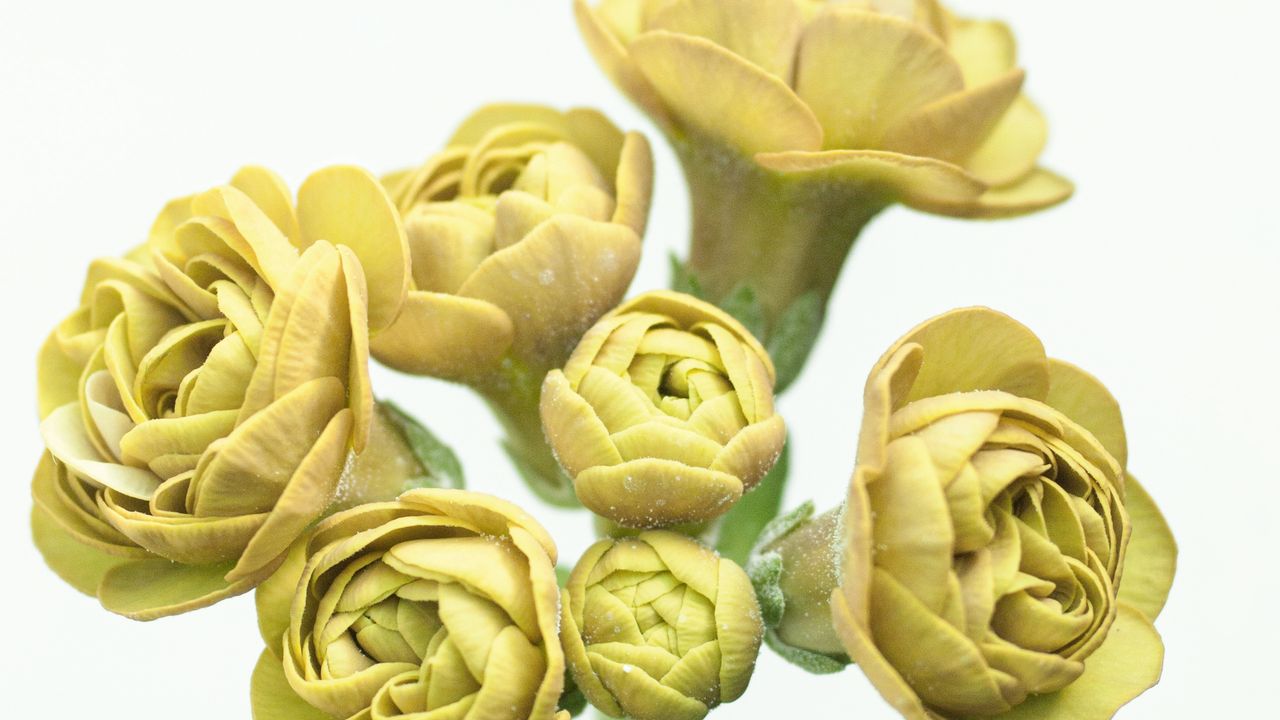
From this point on, auriculas became a sought-after treasure in the plant world and were soon adopted by 17th-century florists’ societies. These groups were devoted to the growing and exhibiting of particular flowers for their beauty alone, with members meeting several times a year at Florists’ Feasts, where they would all show off their prize plants. New hybrids emerged all the time, with ever more outlandish colours and markings, including striped and double blooms. In the 18th century, edged auriculas were introduced, each petal of which had a delicate rim of green, grey or white around a band of base colour. Known at the time as English auriculas, the edged versions quickly became all the rage and wealthy gardeners built special wooden theatres to display their specimens – a tradition that is still upheld today.
Modern auriculas come in an extraordinary range of colours and forms. For the purpose of exhibiting, they are grouped into four recognised categories: show, alpine, double and border. Show auriculas, including edged and striped varieties, are the most tricky to grow. Slow to bulk up and produce offsets (baby plants), they have leaves and flowers that are often covered in a white, mealy substance known as farina. This is easily marked by rain, so they need to be under protection, ideally in a theatre. However, when you see varieties such as the striped ‘Königin der Nacht’ or the edged ‘Grey Lag’ in flower, it is hard to resist their curious, beguiling beauty.

‘Jeff Scruton’
Sabina Rüber
Flowering in mid-spring, alpine auriculas, with gold or cream centres and bright flat, round blooms, are easier, tougher and less time-consuming than the show varieties. They come in an array of rich colours, such as purple ‘Vera Hill’ and gingery ‘Jeff Scruton’, a variety only found at specialist shows. The doubles look like miniature posies, with flowers in colours that range from pale cinnamon ‘Trouble’ to vibrant ‘Purple Heart’, and are very attractive. Border auriculas are more akin to native primroses, forming larger, bushier plants – not as refined as some auriculas, but generally easier to grow.
A great way to increase your collection is to join the National Auricula & Primula Society and visit one of the shows it holds round the UK. There, you’ll find rare varieties grown by specialists and enthusiasts, who will also be on hand to share the secrets to getting the most out of your plants.
Comments are closed.