
Recently, one of my followers asked me how to style his Prunus mume var. tortuosa ‘Yudie Longyou’, commonly known as Dragon Plum.
After carefully studying the photos he shared, I found that this tree has very strong potential, especially because of its powerful base and naturally expressive trunk movement. Based on my observations, I proposed two possible design directions, each reflecting different artistic goals and technical challenges.
⸻
🌳 Step 1 — Overall Analysis of the Material
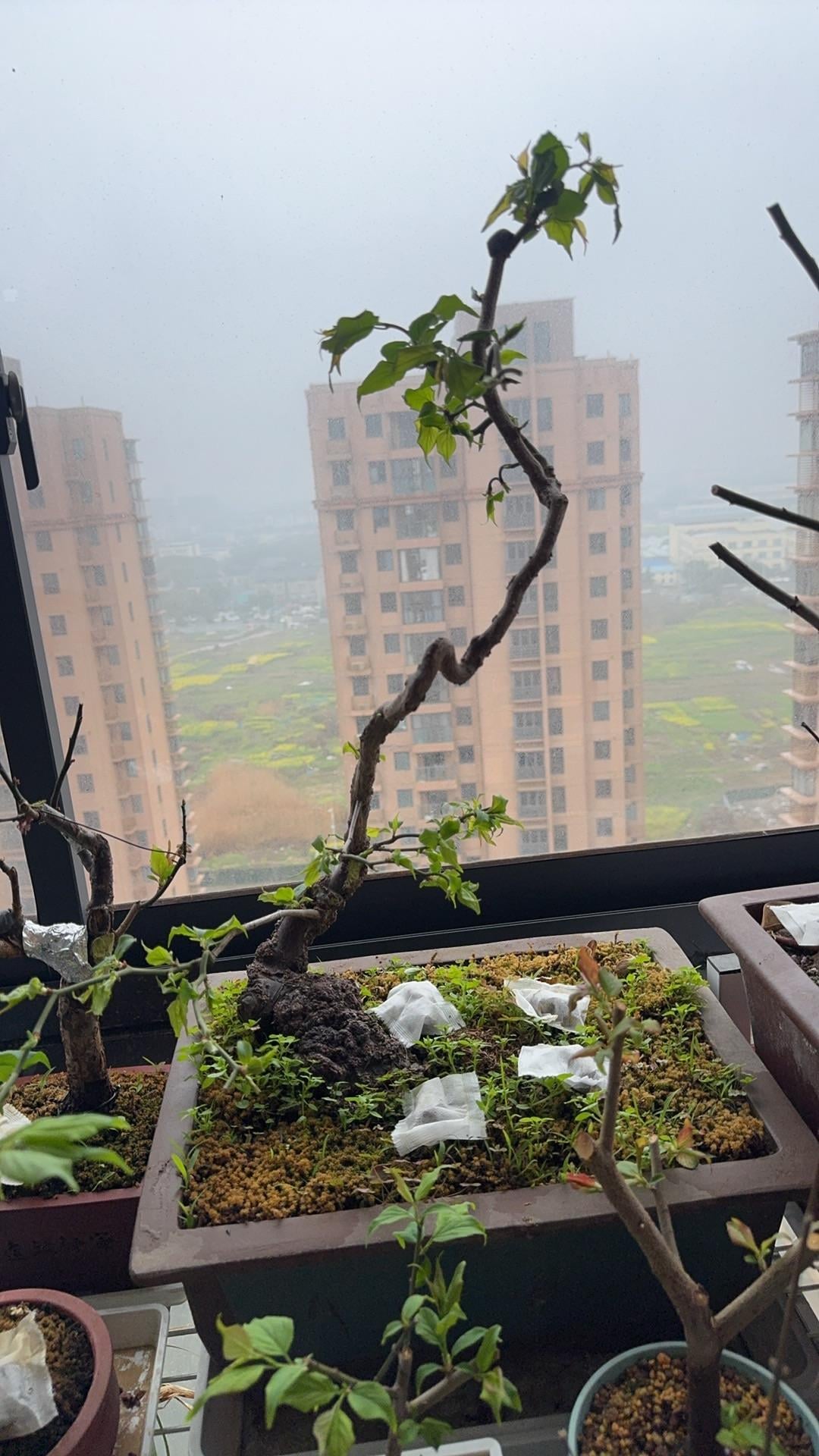
First, looking at the trunk base, this Dragon Plum shows a very old-looking and powerful head, giving the tree strong character and age.
Second, the trunk displays natural curves and directional movement, with the overall flow leaning toward the right side, shifting the visual weight to the right.
Third, the natural growth habit of Dragon Plum is to produce twisting, dragon-like branches, which is one of its most distinctive characteristics.
Based on these three observations, two design concepts were developed.
⸻
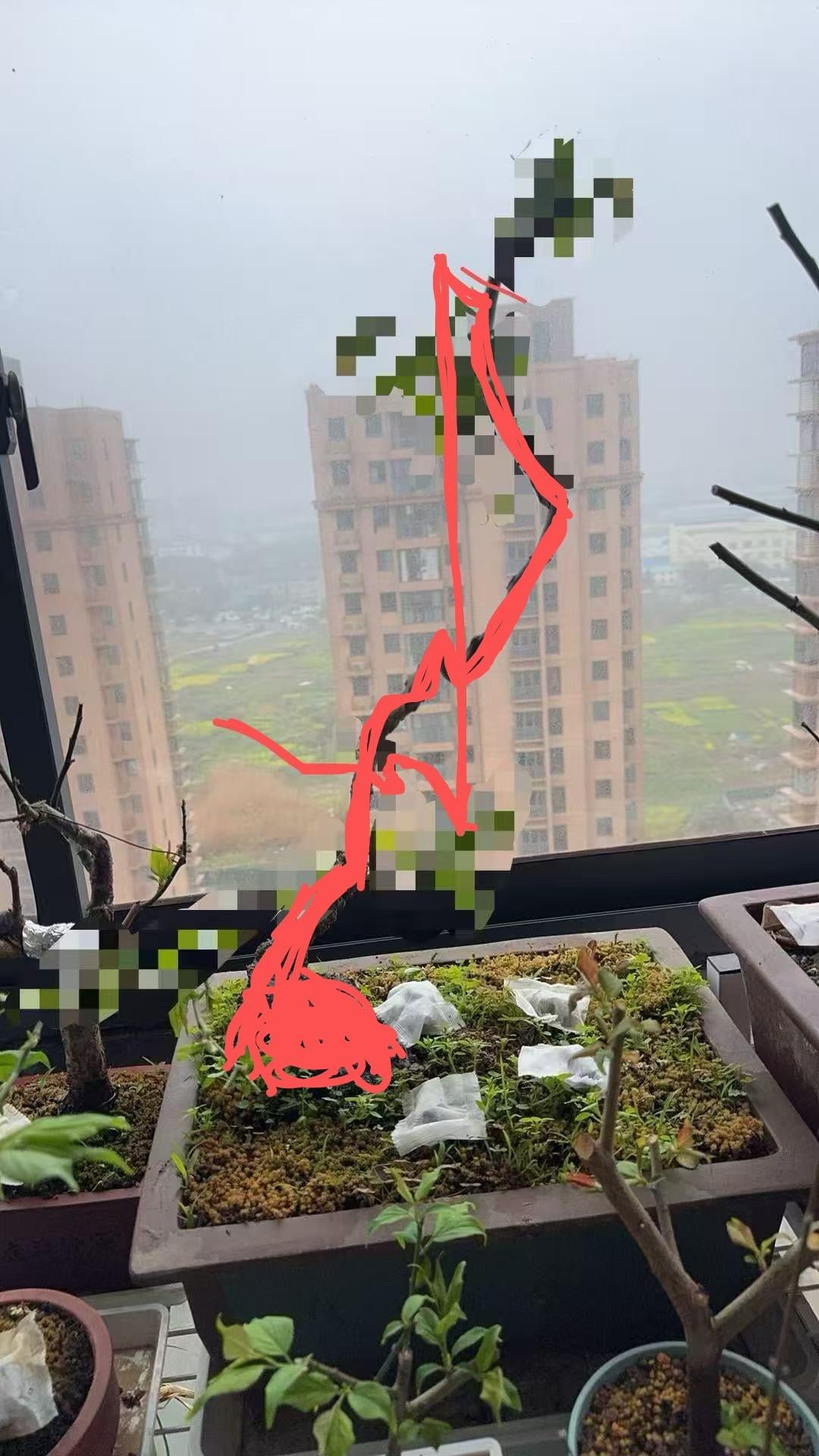
✏️ Option 1 — Tall Literati Style with a Dramatic Dropping Branch
This design follows a tall literati-style composition, emphasizing simplicity and strong directional movement.
The plan is to:
• Select one bud at the top to develop into the next trunk section

• Remove all other competing shoots

• Develop a very straight downward branch from the upper section

• Maintain a clean vertical dropping line

• At approximately one-third of the trunk height, create a leftward drifting branch to restore visual balance
⸻
The Key Feature — The Dropping Branch
The core of this design is the vertical dropping branch, which is technically demanding.
There are two major challenges:
• Overcoming the natural twisting tendency of Dragon Plum

• Overcoming gravity and the plant’s natural upward growth habit
However, if successfully achieved, this design could result in:
👉 a highly original bonsai with strong artistic value
⸻
Artistic Principle Behind This Design
In Lingnan bonsai art, there is an important design principle:
“Seeking straightness within curves.”
A tree composed only of curves may lack strength.
A tree composed only of straight lines may feel rigid.
True beauty lies in:
👉 the balance between curves and straight lines
👉 the harmony between yin and yang
This is also a common mistake beginners make — focusing only on twisting branches while overlooking the importance of overall structure and composition.
⸻
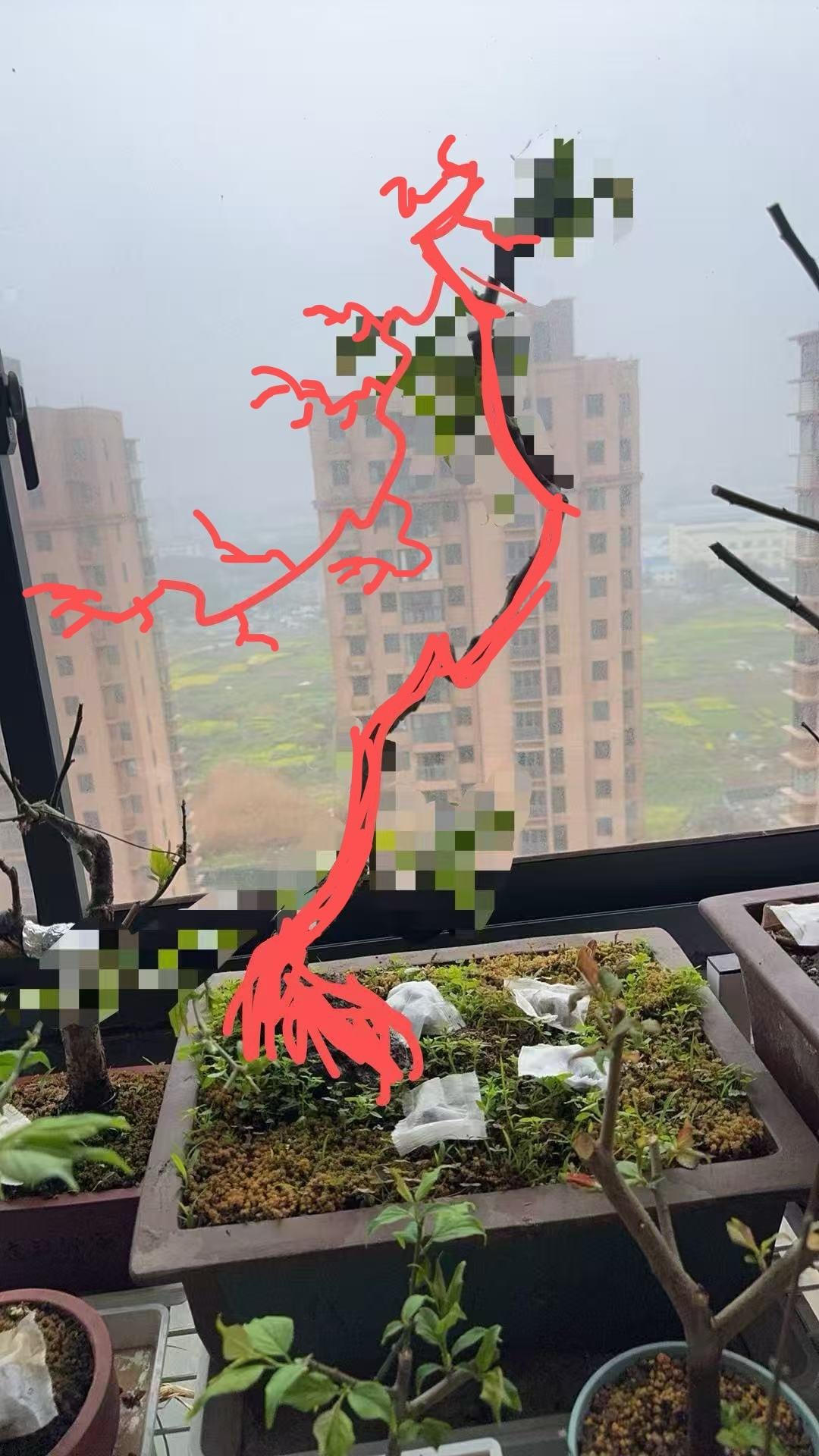
🌿 Option 2 — Tall Tree Style with a Large Sweeping Branch
The second design follows a more traditional structure.
Like the first option, it begins by selecting one bud to develop into the next trunk section.
However, instead of a straight vertical dropping branch, this design focuses on:
👉 a large sweeping branch
👉 extending diagonally at about 45 degrees downward toward the left
This movement helps restore balance to the tree and creates a strong visual flow.
⸻
Difficulty Level
Compared to Option 1, this design is:
👉 technically easier
👉 more traditional in appearance
However, it still requires patience and careful practice, especially for those learning Lingnan branch-building techniques.
⸻
📸 Supporting Materials
This case study includes:
• The original tree photo

• Two design sketches showing different styling possibilities

• A close-up photo of the trunk base
These references help explain the reasoning behind each proposed design.
⸻
🌱 Closing
This case demonstrates how careful observation and structured thinking can reveal the hidden potential of a bonsai material.
If you’re interested in Lingnan bonsai techniques and design philosophy, feel free to follow —
let’s discuss ideas, exchange knowledge, and grow together.
by Ejohn-Shin
3 Comments
There is no point whatsoever discussing design options when
A) it’s inside
B) it’s in a tiny pot
Both are not conducive to development. It won’t grow strongly enough to develop…..
Please dont put an AI slop essay as your description, no one wants to see or read that
No one wants to read your AI slop.