




Okay, here goes my first Reddit post:
Heyho, beautiful people of r/succulents and greetings from Germany!
In autumn 2024, I got a single-head cutting of Aeonium “Mary Anne Kunkel,” and during 2025 it grew into a beautiful, little cone-shaped bushlet with many rosettes. That year, it spent a lot of time on my south-facing balcony, and for the last few months, it overwintered at a south-facing window. I had been away for a couple of months (leaving my plants in the care of friends), and when I returned at the end of January, it still looked pretty good (P1).
As the days became longer and warmer, she resorbed a lot of leaves, which I chalked up to her coming out of dormancy. In the first days of March, I gave her a good soak and some fertilizer before visiting family for two weeks. When I returned, she looked rough, dropping older leaves without properly resorbing them, and new growth appeared tiny, swollen, and cramped. I noticed some pimples that I thought were edema and assumed I had over-watered or over-fertilized.
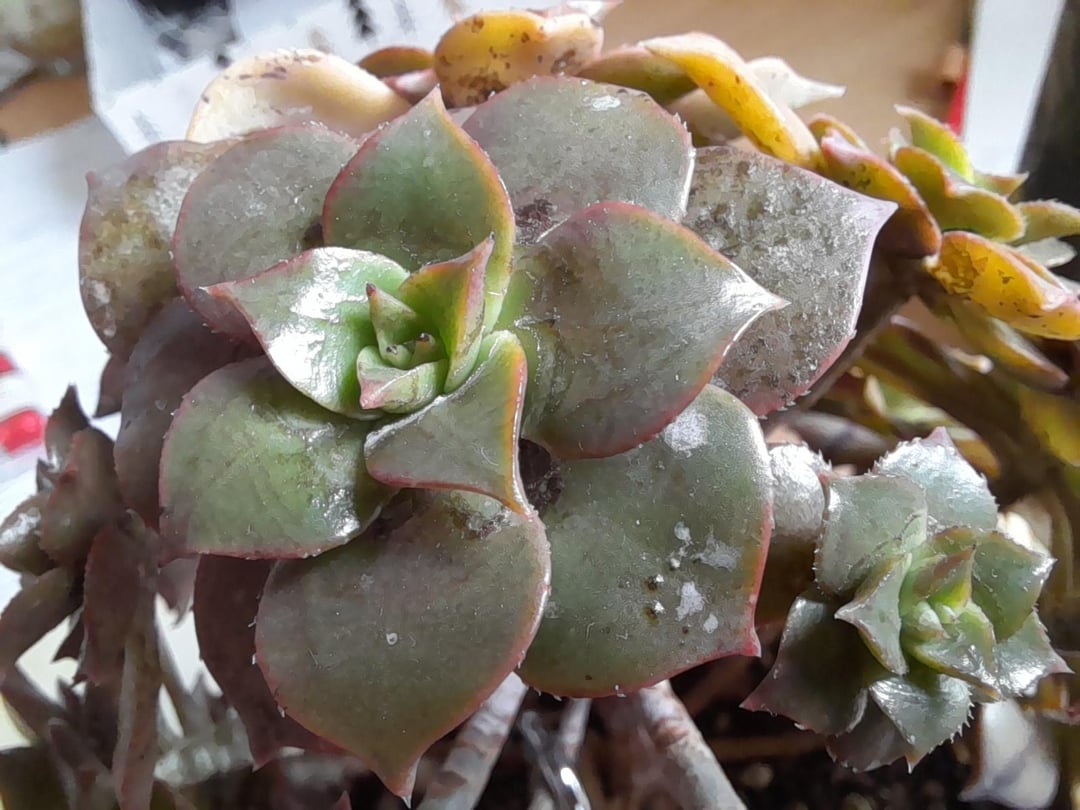
However, over the next few days, the damage worsened. The dark lesions (of which she had always had a few, mostly on the undersides of leaves) rapidly increased in number and size and began appearing on the upper sides as well. By this time, most mature leaves on the shaded side of the plant were gone, while the sun-exposed side still looked almost healthy. I also noticed some dark deposits in the leaf axils (P2, P3, P4).
During my search for answers, I came across this excellently informative post on flat mites from two years ago: https://www.reddit.com/r/succulents/comments/18nc7bi/im_here_to_talk_to_you_about_flat_mites/. So, I got myself a pocket microscope to confirm my suspicion. However, as you can see (P5), the culprits were not flat mites but what I believe to be a mass infestation of rust mites, though identification to species level is beyond my pay grade.
It seems some rust mite species are known agricultural pests, attacking apple trees or tomato plants, but I couldn’t find any information about them feeding on Aeonium or succulents in general. When examining my other plants, I found a few individuals on two asymptomatic Aeonium of different cultivars that had been in close proximity and, at times, direct physical contact.
Last weekend, I began treatment with wettable sulfur, wrapping the pot and substrate in a plastic bag and dunking the plant head-first into the solution, swirling it around a bit. I let it dry for about 15 minutes and repeated the process three times. Afterwards, I cleaned of most of the solution by spraying with water. I also misted the substrate surface thoroughly with the sulfur solution. The next day, I couldn’t find a single living mite. I plan to repeat this treatment weekly at least twice more to catch any survivors or eggs that might hatch later. Wish me luck!
I’m posting this to raise awareness about uncommon or undescribed parasitic relationships our thicc little buddies might have to endure. Has anyone here ever heard of, or experienced, a (presumed) rust mite infestation?
by Disastrous-Pirate450
3 Comments
First off, excellent post.
Secondly, I am SO sorry about your beautiful plant!!
But thirdly I am so happy to hear the treatment is going well!! Way to go and thank you for raising awareness!
This is such a quality post awesome job! I’m glad to hear about the success, I found sulphur really effective for mites in my collection as well, hoping it works on rust mites for you too! My big aeonium also isn’t doing great, I find they’re finicky for me to keep indoors.
I possibly might have found rust mites on one of my plants a while ago. I treated it the same way that I’ve treated flat mites in the past (multiple different kinds of mite treatments in quick succession and then persistently every week or so over a few months) and that seemed to take care of it. It was definitely startling to see an unfamiliar mite under the microscope though, since I had to deal with flat mites a lot when I was first getting going with succs and was used to seeing those. Agriculture (especially the marijuana industry) is really seeing a lot of mites on their crops and because there’s so much money associated with growing food/weed, there’s a lot more research available into how to treat them. Good luck!