
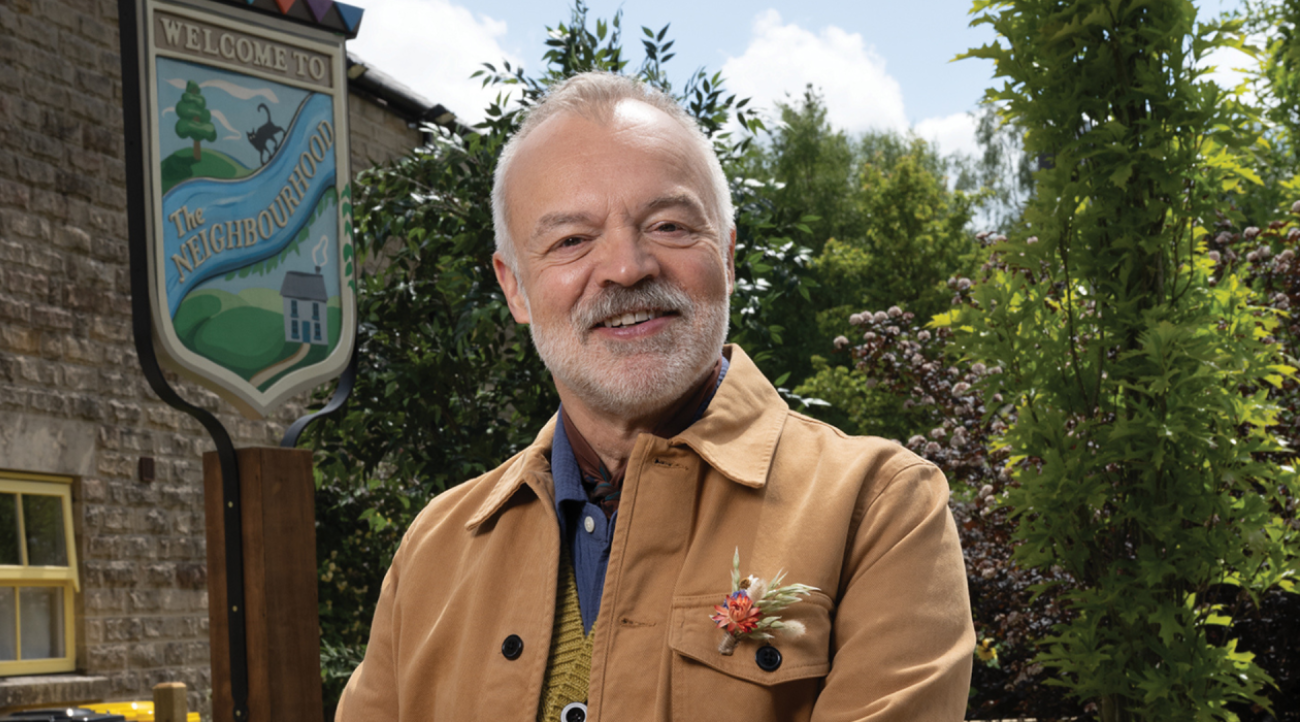
We have trekked the jungle in I’m a Celebrity…, lounged in Mallorca in Love Island and wallowed in Grenada for The Fortune Hotel – all in the name of ITV reality contests. But what if the most tantalising drama is on our doorstep? That’s the premise of The Neighbourhood, ITV’s new gameshow, in which six households move into one street and battle it out to win a £250,000 prize.
On Keepyourenemies Close, where the neighbours live, and nearby Goa Way, contestants join community challenges, aiming to put their household’s interests first. But they must also stay popular on the street because contestants vote each other out by pitching a “For Sale” sign on the target’s doorstep. It’s brutal, and very public.
The idea originated with Lifted Entertainment, responsible for I’m a Celebrity… and Love Island. Kat Hebden, Director of Development and New Business, explains: “We loved the scale of having a whole street. And the fact that entire families could come to our made-for-TV street with their own furniture – and their own dynamics.”
To help work out the gameplay, the indie asked a specialist company to create a board game. In an unconventional move, Lifted then approached its ITV Studios cousin The Garden, known for its fly-on-the-wall documentaries 24 Hours in A&E and 24 Hours in Police Custody, and for Squid Game: The Challenge, which it produced with Studio Lambert. Michael Philo, Director of Development at The Garden, says: “Kat and I had been talking about how we could bring together the powers of The Garden and Lifted. After a brainstorming session, we asked if they had anything in development that they wanted looked at from a sideways angle. That’s when they brought out The Neighbourhood board game.”
The Garden’s interest was piqued by what each household would say about their neighbours once their front doors were shut. So the format shifted to focus on a fly-on-the-wall aspect, too. “Our joint process then became about robust gameplay where, whatever happened in the game, you had those delicious conversations afterwards in each house, that would then play out in the game the next day. That’s the secret sauce,” says Philo.
That dual focus helped make it an easy “yes” for ITV Entertainment Commissioning Editor Louise Major. “We went straight to commission, which is a big risk. It’s not often you see a format without any proof of concept get the level of spend and quick action that’s required,” she says.
“All the basic foundations are there for a global smash format”
Graham Norton, the presenter of ITV’s Wheel of Fortune, quickly agreed to bring his tongue-in-cheek humour to the show. As he has explained, “Like everyone, I’m intrigued by what goes on behind closed doors. Add to that some dastardly challenges and a life-changing prize, and I’m hooked.”
“He doesn’t say yes to a lot, so that felt like a win for us,” says Major. “He saw its relatability and the fun he could have on the way.”
The show was commissioned last spring, and the production team had six weeks to bring it to life in order to meet a summer production slot. “There used to be a world where we could use studios endlessly. Now we want to film everything outside, and in this country we are restricted by the weather,” explains Major.
The first piece of the production puzzle was finding the right location. A group of six empty TV-friendly houses isn’t easy to come by. The team, including executive producer Ros Coward (who has since joined Lifted as Creative Director), looked into renting from private owners or developers, “but that felt too risky, in case they pulled out at the last minute”.
Eventually, Coward found a holiday village in the Peak District: “That was a blessing because it gave us more space than we realised we needed at the time. And it dictated the look of the show. We considered something more modern but this beautiful village worked for the format because it was so English and quaint.”
The six households were found via adverts, targeted locations and a call-out on Norton’s social media. The key criteria was that they all had to be existing households “so that they knew each other inside out”, says Coward. The producers also wanted to reflect all walks of society, so we see blended and multi-generational families, and even a household of university mates.
Some reality gameshows, such as The Traitors, have been accused of exhibiting unconscious bias when it comes to voting people out. While it’s tricky to minimise this without stepping in, Hebden says that the premise of The Neighbourhood was to shine a light on people’s gameplay rather than their personalities. “You want drama and competitiveness but also warmth and humour. We never wanted to create a format that feels too mean.”
The three-and-a-half-week shoot was a huge undertaking, with 172 rigged and 15 portable single cameras, “which far exceeds any of the shows I’ve done”, says Coward. “It was essentially a 360° set and we had to hide ourselves, which meant it became the contestants’ own world.”
With the first series in the can, the team is pleased with how it unfolded. What response is ITV hoping for? “All shows of this size need to drive cultural conversation,” says Major. “They need to be cross-generational in appeal. We need every demographic sharing memes and being prolific on socials. That’s success for us.” She adds that “all the basic foundations are there for a global smash format”.
Already, international visitors have been to the set to investigate. “Our vision is so distinct to the UK; the Americans would have to look at a Desperate Housewives setting or whatever they felt was complementary to their world,” says Major.
Hebden adds: “The foundations we’ve designed can be taken anywhere and made relatable to the territory. Everyone has a neighbourhood.”
So let the scheming, gossip and curtain-twitching commence.
The Neighbourhood starts on 24 April at 9pm on ITV1 and ITVX
Comments are closed.