
Breadcrumb Trail Links
HomesNew Homes and Condos
Like all living things, houseplants sometimes contract diseases. But it doesn’t have to be terminal.
Published Apr 02, 2026 • 3 minute read
You can save this article by registering for free here. Or sign-in if you have an account.
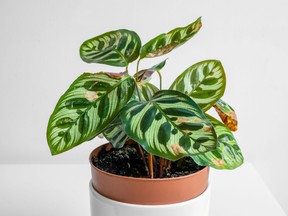 Leaf spot, as seen on this prayer plant, is rarely fatal, but spoils the look of the plant. Overwatering and excessive humidity are common causes.Article content
Reviews and recommendations are unbiased and products are independently selected. Postmedia may earn an affiliate commission from purchases made through links on this page.
Houseplants are susceptible to a number of diseases and infections, ranging from mild to serious. But depending on how advanced the case is, with a bit of TLC, you can usually return your plant to health.
Advertisement 2
This advertisement has not loaded yet, but your article continues below.

THIS CONTENT IS RESERVED FOR SUBSCRIBERS ONLY
Subscribe now to read the latest news in your city and across Canada.
Unlimited online access to articles from across Canada with one account.Get exclusive access to the Toronto Sun ePaper, an electronic replica of the print edition that you can share, download and comment on.Enjoy insights and behind-the-scenes analysis from our award-winning journalists.Support local journalists and the next generation of journalists.Daily puzzles including the New York Times Crossword.
SUBSCRIBE TO UNLOCK MORE ARTICLES
Subscribe now to read the latest news in your city and across Canada.
Unlimited online access to articles from across Canada with one account.Get exclusive access to the Toronto Sun ePaper, an electronic replica of the print edition that you can share, download and comment on.Enjoy insights and behind-the-scenes analysis from our award-winning journalists.Support local journalists and the next generation of journalists.Daily puzzles including the New York Times Crossword.
REGISTER / SIGN IN TO UNLOCK MORE ARTICLES
Create an account or sign in to continue with your reading experience.
Access articles from across Canada with one account.Share your thoughts and join the conversation in the comments.Enjoy additional articles per month.Get email updates from your favourite authors.
THIS ARTICLE IS FREE TO READ REGISTER TO UNLOCK.
Create an account or sign in to continue with your reading experience.
Access articles from across Canada with one accountShare your thoughts and join the conversation in the commentsEnjoy additional articles per monthGet email updates from your favourite authors
Article content
For advice, I turned again to fellow plant parent Tara Soloway to ask about diagnosing and treating some common houseplant diseases. Tara is the founder of Plantd Life (plantdlife.com), a company that specializes in indoor plant design, installation and care, and a consultant in biophilia.
Article content
Recommended Videos
Article content
According to Tara, there are two main types of plant diseases: fungal and bacterial. In both cases, overwatering and excess humidity, combined with poor air circulation, usually turn out to be the real culprit (more on this in a moment).
Fungus disease infections, including powdery mildew, rust and their cousins, are quite common and quite infectious: look for a white or grey powdery substance or rust-coloured tiny bumps on the leaves or soil surface.

Your Midday Sun
Thanks for signing up!
Article content
Advertisement 3
This advertisement has not loaded yet, but your article continues below.
Article content
If you spot a fungus infection, immediately isolate the plant to prevent the disease spreading to healthy plants. Cut away any damaged leaves. You can purchase fungicide to dust on the infected parts of the plant, but the real problem is likely in your soil, so that’s where you should turn your attention next.
Remove the plant from its pot and examine the root ball. If there are any rotted, mushy roots, cut them away with a clean sharp knife, leaving only healthy, white roots. Remove rotten, sour-smelling soil as well, washing it away if necessary.
If the root ball is very soggy, leave it to dry out of direct sunlight on a few sheets of newspaper for a few days, before repotting the plant in fresh, slightly damp new soil. With luck, and if you got it all, the plant should recover.
Advertisement 4
This advertisement has not loaded yet, but your article continues below.
Article content
The most common bacterial disease is leaf spot. As the name suggests, you can identify it by round holes or papery brown spots on leaves, sometimes with a yellow ring around the edges.
The spots are actually caused by a bacterium in the soil, and can spread from leaf to leaf; the only solution is to remove the damaged leaf.
Whether the problem is fungal or bacterial in origin, says Tara, the key to preventing diseases, along with a host of other problems, is to improve air circulation and humidity in your plants’ environment.
Crowding plants so close together that they pile over each other not only reduces air flow but can spread both disease and insect infestation. Ideally, plants should not (or should barely) touch each other. Also, maintain good air flow in the room where they grow, with a fan or air conditioner if needed. (This is healthier for you as well.)
Advertisement 5
This advertisement has not loaded yet, but your article continues below.
Article content
Overwatering is significantly more harmful to plants than underwatering, especially if your plant lives in a pot that doesn’t have drainage holes at the bottom.
Almost all of us tend to water our plants more than they need – especially in winter when they are dormant. A $20 moisture meter is a great investment, especially if you have a number of plants.
Many houseplants love a daily spritzing from a spray bottle, but not all do. Plants with furry leaves, like African violets, or any plant that originates in dry or desert climates such as cactus, should never be sprayed. But even some tropicals, like certain ficus species, simply don’t like getting wet.
If you do spray your plants, never let direct sunlight fall on the wet leaves; the effect can be like training a magnifying glass on an ant, and lead to sunburn or even holes, similar to leaf spot.
Article content
Share this article in your social network
Comments are closed.