
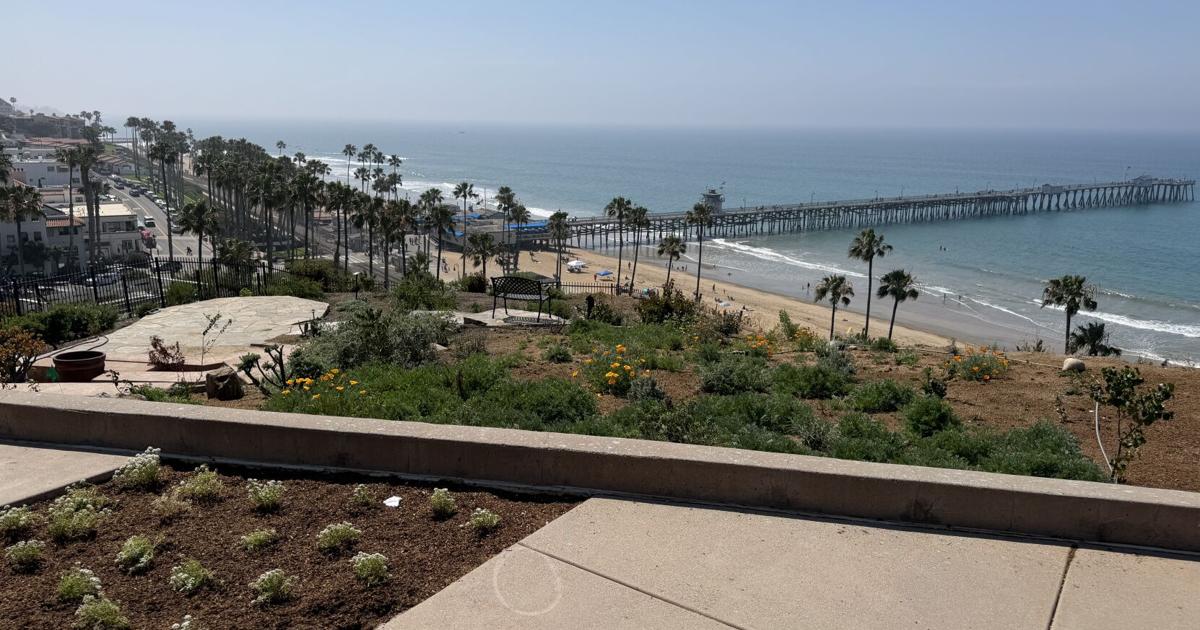
Music drifted across the bluff as guests stepped onto the grounds of Casa Romantica on Saturday morning, March 28, coffee in hand, moving between courtyard, gallery and garden paths as the cultural center unveiled a preview of its spring programming.
The event unfolded as a guided, immersive experience through the historic home and its surrounding gardens, with each stop revealing a different layer of how the nearly century-old property functions today.
“This house was built in 1927, so if you’re really good at math, that puts it at 99 years old this year,” Co-Executive Director Kylie Travis told attendees.
Originally the home of San Clemente founder Ole Hanson, the property has since been preserved and reimagined as a public cultural space.
“And so, since then, we’ve been a place that operates in kind of three different branches,” Travis said. “We’re open six days a week as a museum … we also are a cultural center … and we also are a private-events venue.”
She noted the organization is still recovering from a 2023 landslide that “took out a whole half acre of our property,” adding that while the site is stabilized, portions of the grounds remain under restoration.
The morning began with movement, as instructors from Atomic Ballroom led a salsa dance lesson in the courtyard, guiding attendees through posture, rhythm and partner connection.
“In salsa, there’s never going to be straight knees,” an instructor said. “We’re always going to have our knees nice and bent.”
Participants practiced stepping patterns and weight shifts before moving into partner work.
“You want to make sure you commit to your weight every step,” the instructor added as couples rotated and practiced basic turns.
The lesson progressed into partner technique, with instructors emphasizing hand placement and connection.
“The connection will be between the palm and the fingers,” the instructor said while demonstrating how to guide a partner through turns without losing frame.
From there, guests moved into Casa Romantica’s gallery space, where a curated exhibition from the California Art Club’s Orange County chapter is on display.
“It’s really special for me to be a part of this, because I live in San Clemente,” artist Fay Wyles said.
Wyles explained that the California Art Club, founded in 1909, was created as a way for artists to “exhibit together, learn from one another and just share camaraderie.”
Describing her own work, she said she aimed to capture a more personal and layered view of the city.
“This is not your typical postcard view of San Clemente,” Wyles said. “I wanted to kind of give it that moody feeling … and almost a way of capturing the soul of San Clemente.”
She added that the painting reflects “that timeless kind of sunset golden-hour glow,” focusing on everyday alleyways and architecture rather than traditional coastal scenes.
As the tour continued through the home, Travis highlighted how the building’s original layout has been adapted for programming, pointing out that former bedrooms now serve as multipurpose spaces.
“Pretty much anything we use the space for,” Travis said, noting that rooms now host weekly ballet classes, meditation and yoga sessions.
She added that the same space is also used for performances, including “jazz concerts, classical concerts,” and seasonal programming such as annual holiday showings.
Guests were then led into the studio for the newly introduced “Greenhouse” exhibition, a rotating floral installation designed to give artists creative freedom.
“We asked that they’d be interested in doing florals as an art form,” Travis said, describing how the concept allows florists to move beyond traditional client-directed work.
Florist and artist Adrienne Moore, the first featured participant, said the installation draws from her experience working across life events.
“For the last 15 years, I have built a business that does weddings, retail, pretty much any occasion that you can flower for,” Moore said.
She explained that the exhibition reflects on why people use flowers in different moments.
“With this exhibition, I was really curious to explore the different underlying emotions that drive us to seek flowers,” Moore said.
Each arrangement represents a distinct emotional theme.
“We might use flowers to express desire … devotion … celebration … gratitude … loss … and connection,” she said, adding that the work ultimately centers on “the emotion of love.”
The experience then shifted outdoors into Casa Romantica’s gardens, where staff highlighted both ecological education and restoration efforts.
“This is our butterfly garden,” Travis said, noting that the property serves as a Monarch waystation.
Garden manager Kim Neal emphasized the importance of pollinators during the tour.
“Without pollinators, which pollinate 80% of our food, we’re going to lose a lot of our food,” Neal said.
She pointed to specific butterfly species present on the grounds, including Monarchs and gulf fritillaries, as well as the plants that support them.
“The most important thing to know about this garden … we have to plant host plants, nectar plants, and we need to provide shelter and water,” Neal said.
She also explained the importance of avoiding pesticides.
“If you’re putting pesticides in your garden, you’re killing your caterpillars,” Neal said, noting that companion planting can help protect the ecosystem.
The tour continued through restored areas, including a children’s garden and a cultural fusion garden featuring plants from coastal Mediterranean climates.
In the edible garden, guests participated in a hands-on activity, potting vegetables while learning about sustainable gardening practices.
“This garden is used for educational purposes,” Neal said.
She added that even small spaces can support growing food.
“You can do something this small, and you can have an edible garden at your house,” Neal said, gesturing to compact planters filled with herbs and greens.
The session also introduced seasonal planting strategies and techniques for maintaining small-scale gardens.
The event concluded inside the main house with a live performance by musician Bei Bei.
“I will be playing traditional Chinese music, some original repertoire,” she said before beginning her set.
Introducing one of her pieces, she invited the audience to imagine a scene from southern China.
“Just imagine yourself going to southern China … the lotus in the park … super elegant and beautiful,” she said.
The performance served as the final element of the morning, bringing the event full circle by combining music, art and cultural programming within the historic setting.
Comments are closed.