
Tori James/Calaveras Enterprise
Hardly a secret garden, a Calaveras County treasure trove of knowledge, free resources and well-priced locally propagated plants seems to be hiding in plain sight awaiting discovery.
Located in the adjacent parking lot next to the government center and across from The Red Barn Museum in San Andreas, the Calaveras County Master Gardeners Demonstration Garden is exactly that. While it might attract more interest with a fancier name or a Jack and the Beanstalk-sized specimen plant emanating from one of its experimental garden beds, its charms begin with a friendly greeting at the Open Garden Gate entrance during its open-to-the-public hours every Thursday. Summer hours beginning this week through fall will run from 9 a.m. until 1 p.m.
Every week 10 to 15 Master Gardeners, all local volunteers who have at the very least graduated from the 15-week UC Davis Master Gardener program, are on hand to provide advice, give tours and work on gardening projects. The actual demonstration garden areas provide visitors a bevy of best practices gardening examples mixed in with an array of expected and unusual plantings and even some edgy experiments.
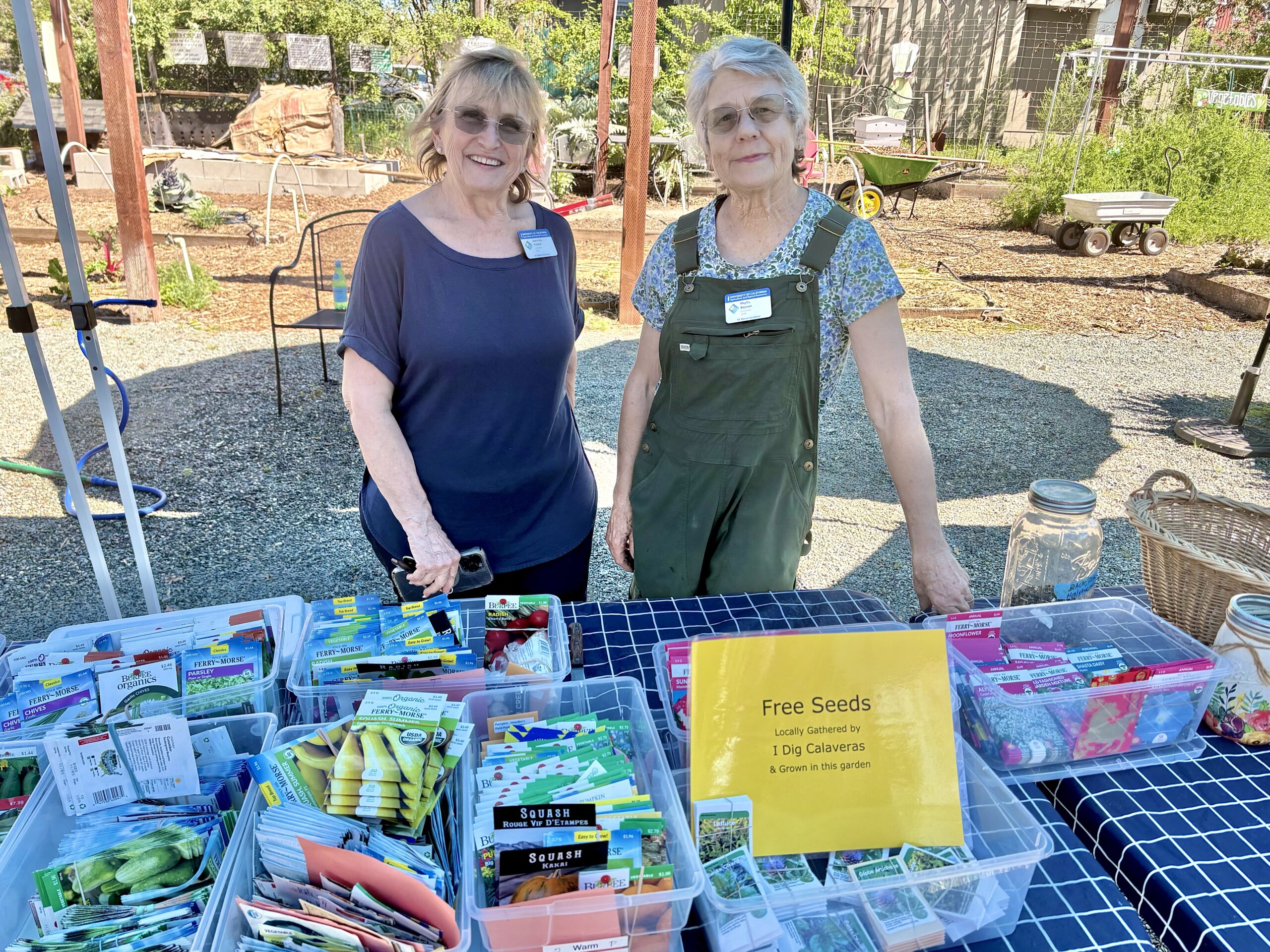
Upon entering, visitors are greeted at the check-in table by volunteers dispensing freshly picked produce, which varies from week to week depending on what is in season. Last week, lettuces and kumquats were among the offerings. There is generally also a free seed exchange although you do not have to bring any seeds to avail yourself of free seeds locally gathered, grown and packaged onsite.
Among the packets being handed out this past week were Globe artichokes, Swiss Chard and various lettuces. The Master Gardeners’ latest newsletter, event information and a selection of educational gardening handouts were also available to peruse and pick up.
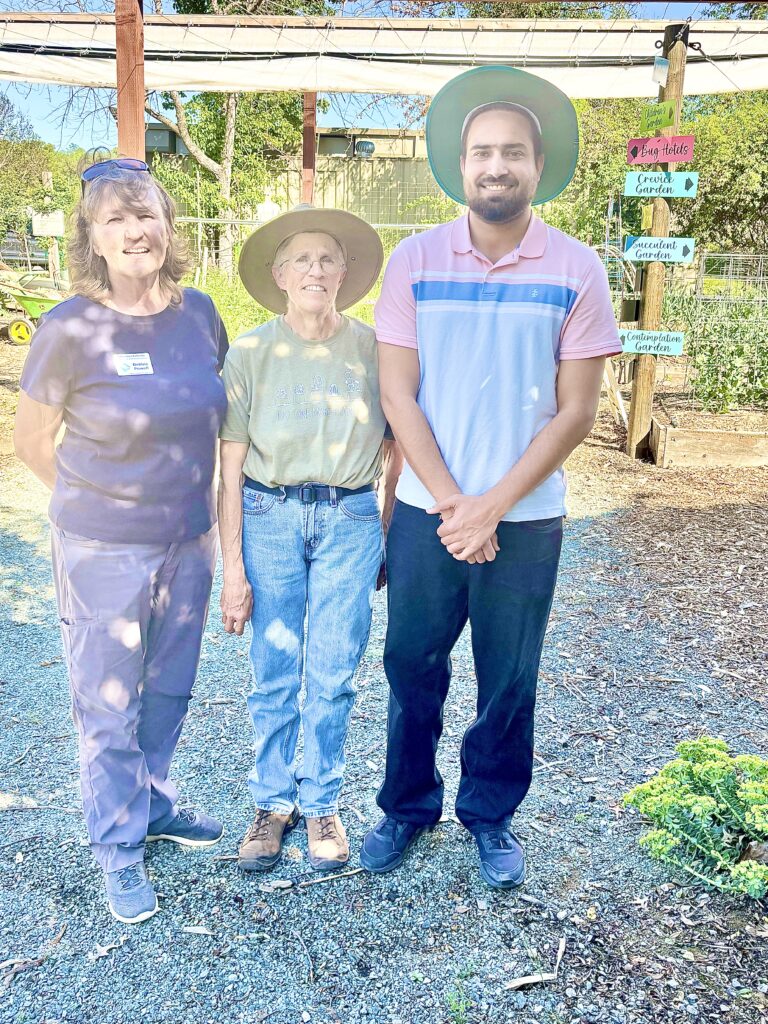
This reporter was fortunate enough to be squired about the gardens by Erin Harper, the president of the group. A retired engineer with a friendly, low-key manner and nearly comprehensive
Tori James/Calaveras Enterprise
knowledge of the various growing projects and plantings across the property, she has lately been specializing in caring for the orchard.
“We try to have something in bloom all the time and right now the trees are,” Harper explained. “Some have leaves, some have blooms. Having different pear trees coming into bloom at different times spreads the amount of time we have good fruit in production.”
She pointed to a series of pollinator circle gardening beds spread throughout the orchard to attract bees throughout the growing season. “We have borage and calendula in bloom now,” she said. “Catnip will come into heavy bloom in one and a half to two months and white sage, when it goes into bloom, comes in with big spheres in July or August.
Nearly nonstop blooms
“We try to do this so there is always food for the bees, who tend to like to have about four and a half to five feet of color. Along fencelines we planted ‘Keep California Beautiful’ native plants that go into bloom in late summer and early fall.” Smiling, she added, “The only month we don’t have anything in bloom is maybe in January.”
Tori James/Calaveras Enterprise
Sharing some orchard learning, Harper shared it was the perfect time to “get your grade” on the previous year’s efforts to keep fruit trees producing. “You can easily see where the blossoms are, and whether the blossoms are on branches that will support the fruit load.” Pointing out fresh blooms sprouting directly out of one pear tree’s lower branches, she admitted. “I have been struggling with this 20-year-old one to try and get as many fruiting branches as possible and trying to create some lower down because the others are higher up; so you have to open the tree out and get sun into them.”
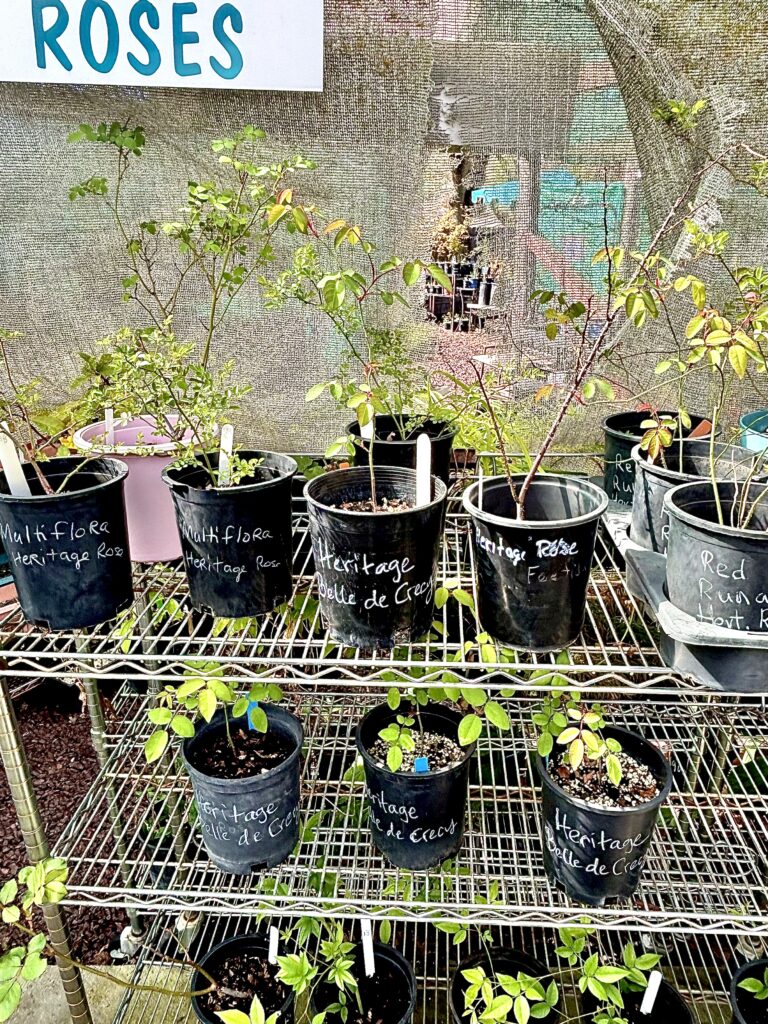
According to Harper, one of the unique things about the Demonstration Garden is that it has taken the time to recover and propagate historical roses. Diana Perkins-Sillivan, who joined the discussion, shared her knowledge of that focus area.
“We have 53 heritage roses in the garden,” she said with noticeable pride. “Most of them were gathered from homesteads and cemeteries in the county. A lot of them came from the Angels Camp Cemetery. Many were planted in 2007 when the Master Gardeners went out and ‘wrestled’ the roses, took cuttings, propagated and got them big enough so they could put them in the ground.”
Harper added, “Once they bloom they were named from wherever they came from, such as San Andreas Car Wash! If you follow how (a rose plant) blooms and the style, you can chase them down to the strains of what they are. But we really don’t know how old they are.
“So many Italian immigrants brought roses with them in the 1800s and they were brought into the county,” she continued. “We began to lose them because so many people were changing the cemeteries and such. Several kinds are really prickly. Heritage roses only bloom once (per season) so there’s no rebloom like the hybrids that you can deadhead.”
Spreading high and wide like a gargantuan fairytale tree, a white heritage rose called the Lady Banks has grown so much since it was planted in the early 2000s that it now nearly encompasses the roof of a central pavilion. Perkins-Sillivan said it came from a non-locally wrestled cutting obtained in Arizona from one of the country’s largest rose bushes. “It’ll bloom once for maybe a week and a half and then the blooms are done,” Harper noted, adding that the rose plant in Arizona, which was planted in the 1850s, now covers nearly a square mile and is still growing.
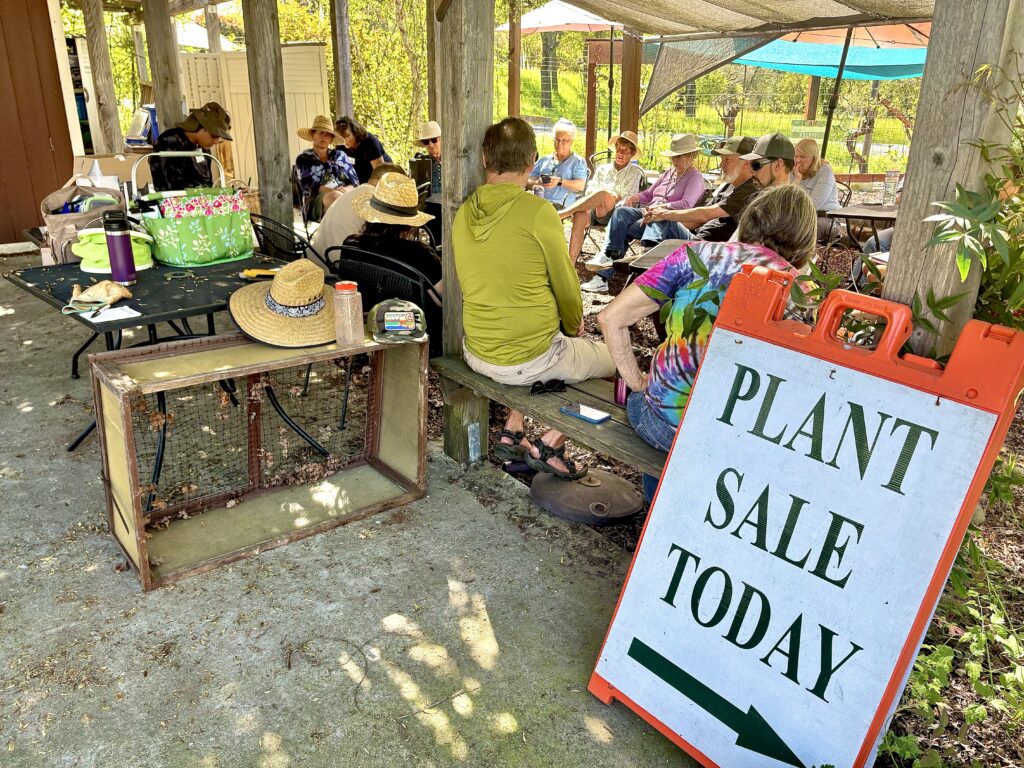
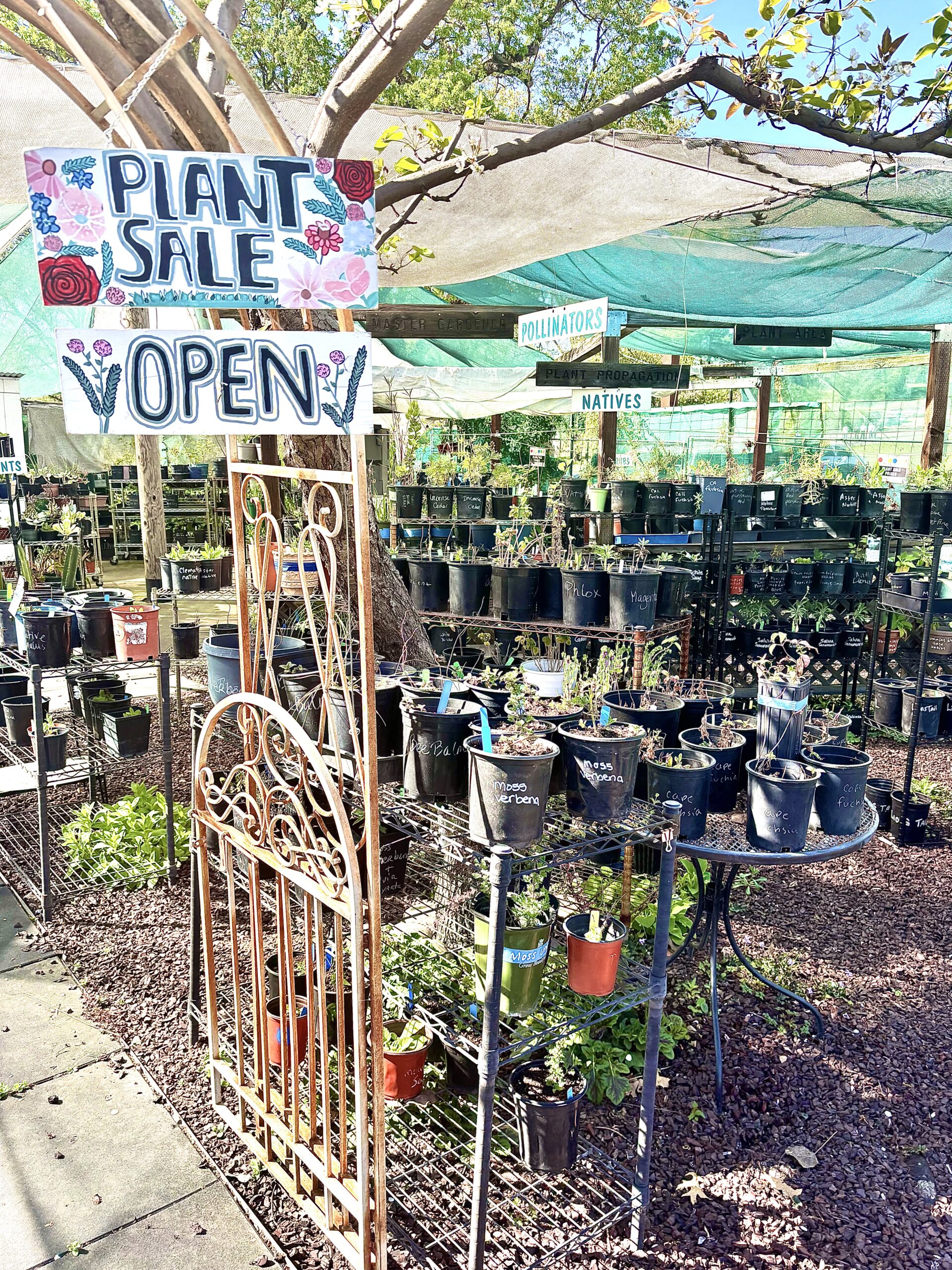
Among the most popular attractions in the Demonstration Garden, the Propagated Plants For Sale area brings a pretty good draw, according to Harper. “We don’t specialize in but grow a lot of natives that grow in the county. This is where we replant, split, divide and grow plants for sales,” she explained. “There is also a collectibles area of small decor, including vases, dishes and jewelry.” The area, overseen by Master Gardener Dolores Ransom, is where most of the fundraising for the largely self-funding group occurs.
Local plants for sale
Because the heritage roses are unique, they are included in the propagation area. There are even Lady Banks roses for those who think they have enough room for one. Potted plants run from $1 to $6 although some of the larger plants might run as high as $25. Among the plant selections spotted during a quick, sweeping glance were day lilies, rock garden plants, irises, peonies, and an assortment of cacti and succulents.
Tori James/Calaveras Enterprise
Asked for suggestions of what might not be attractive to deer, Harper smiled with amusement. “There’s no such thing as a completely deer-proof plant. Maybe some cactus–they even eat succulents and tips of agaves and the gophers get those, too!
“We try to carry (different kinds of) plants that can grow in various parts of the county,” she continued. “We hold a nursery license and go through the annual inspection. We support school gardens–go in and coordinate and help teachers usually around third and fourth grade and also provide any of the plants from here that they want. School garden projects need to have a teacher and some parents to help it,” she emphasized. “We barely keep enough money to keep and maintain our gardens so we do what we can but school gardens need (their own financial) support.”
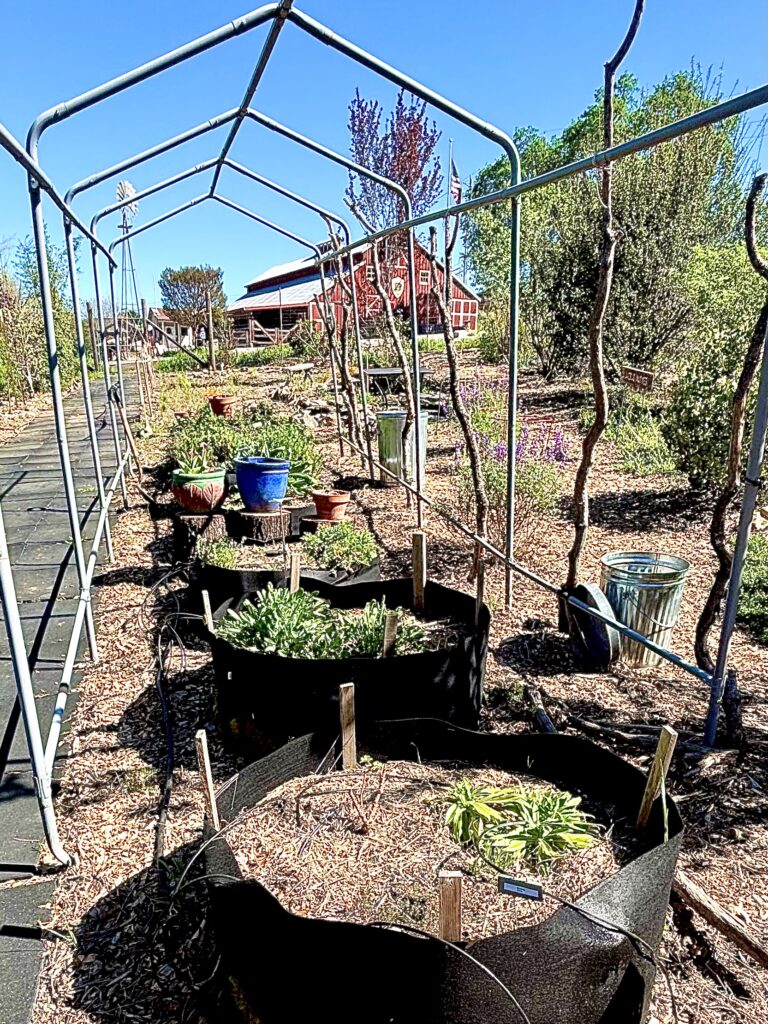
Also popular in the Demonstration Garden is the raised bed vegetables. Poking around the area, end of season lettuce was spotted along with a few asparagus and garlic. While it was still a bit early for artichokes, one was beginning to bloom nicely. Weeding and prep work was going on in anticipation of planting annuals.
Among the traditional raised beds was a new bed type Harper said was a “hugelkultur,” involving a Northern European practice in which a deep bed is dug about three feet below ground and filled with wood. “You create a reservoir of old rotten wood and it kind of forms like a sponge so that it holds the water better and also allows you to grow a whole lot more of the fungi and things,” Harper explained. “We like to give different ideas a shot to see what grows.”
Among other areas to check out is a Contemplation Garden of aromatic plants; among them various kinds of lavender and rosemary, which are great pollinator plants that are especially good to have blooming early in the season to attract bees early. It somewhat supplanted an earlier Mission Garden, although an olive tree, grapes and a pomegranate still occupied a border area. “A lot of people who had done that garden had gone so it was transitioned over to accommodate Master Gardeners with other ideas,” Harper surmised.
Tori James/Calaveras Enteprise
Against a wall adjacent to the orchard, was a row of “espalier” style wire-trained and pruned bushes and trees. A demonstration cutting bed was planted with daisies and such for bouquets. A Mediterranean Garden featured plants that generally do well in Calaveras County since it also has a “Mediterranean” climate.
Harper pointed out a brand new blueberry patch, planted with different varieties. It occupied a sunny space formerly reigned over by a huge almond tree that fell last year. Harper recounted, “Since I was a kid, I remember that tree from riding the school bus during kindergarten in 1965. It had beautiful pink-white.blossoms. It was a producer and a bummer to lose. The bright spot was that it opened a sunny area for the blueberry garden!”
At the bottom of the orchard a Cactus Garden played neighbor to a Crevice Garden fashioned from a stacking of local rocks from which Alpine plants had established deep roots and were growing in the cracks. A short walkway arbor of grapes intermixed with kiwi fruit leads to the Kids Garden, a spot where children’s activities and a summer reading hour regularly take place. Planted with kid-friendly flora like thornless blackberries, it was a colorfully whimsical place with natural seating and grow boxes that cleverly featured peek-a-boo plastic sides that could be revealed to show how plants’ root systems were growing underground.
Expert advice
Discussing spring gardening tips, Harper confirmed that the county is located in growing Zones 9a and 9B and that the unusually warm spring made blooms come out ahead of schedule. “April is usually peak bloom for roses but it’s already here,” she shrugged.
As plants that were winter-dormant are sprouting new growth, she advised. “Don’t give up on those plants that are a bit slower to get going. We were just about ready to tear out some native plants we had planted in the fall even though the nursery instructions told us to be patient. When we came up with trowels to clear out the bed of weeds and make the final call, lo and behold, there were

Tori James/Calaveras Enterprise
bright green new sprouts popping out around last year’s dead stalks.
“I think one of the best things the Master Gardeners can provide–especially in the foothills–is experience on what might be the most likely to survive in their yards and what they can do to increase their plants chances,” Harper continued. “We have Master Gardeners that are experienced in growing plants in their own yards from Copperopolis to Burson, Mokelumne Hill, Angels Camp, Murphys, Arnold and Dorrington. I’ve learned the most from hearing these gardeners just chat about what they’ve tried in their own gardens and what worked and didn’t work!”
She encouraged locals to come by the Demonstration Garden during its weekly public hours on Thursdays. “Everytime anyone comes in with a question, we get to learn,” she enthused. “So I always encourage people to bring in whatever it is that they are struggling with or whatever pictures are great. Don’t bring us too many diseased plants or put them in a bag.
“We love to assist and we always learn more when we help and see something new that we haven’t seen before and get a hold of our UCA (advisors) and our folks and chase it down!”
The Master Gardeners also have a hotline and a help desk so people can go online, ask questions there, and send photos upon reply via the Help email. For the county’s commercial clients, Hardeep Singh, the Academic Farm Adviser, can provide advice to commercial clients.
Debbie Powell, who is the UCCE Master Gardeners coordinator for Calaveras and Tuolumne counties, noted that the annual Master Gardeners training program was currently in progress and meeting at the San Andreas Library as well as at the Demonstration Garden. Next year, the training will rotate to Tuolumne County.
“Our Master Gardeners literally come from all walks of life,” she shared. Noting that many had given over a thousand hours volunteering, she said Harper herself had over 2,500 volunteer hours in. Along with working in the Demonstration Garden, the volunteers take on other projects as they come up and will be providing volunteer labor to community garden projects starting up at St. Matthews Church and the San Andreas Senior Center.
Powell said that in 2025, the Master Gardeners contributed a total of 5,380 volunteer hours and that based on an hourly rate of $38, she estimated the value of their time was at least $204,440. To date, the group has logged 47,605 hours, providing over $1.8 million in volunteer services.
As for upcoming activities, the Master Gardeners’ Annual Kids Day, a free event, is slated for Saturday, May 9 from 10 a.m. until noon. Traditionally held the day before Mothers Day, it includes a Plant Sale.
The UCCE Master Gardeners Demonstration Garden is located in San Andreas at the Calaveras County Government Center, 891 Mountain Ranch Road. To reach the Help Line, call (209) 754-2880 and leave a message. For more information or to make contact online, visit ucanr.edu.
Tori James/Calaveras Enterprise
Comments are closed.