
Debra Stinton Othitis
Colorado Master Gardener, Special to The Tribune
National Arbor Day is always celebrated on the last Friday in April. However, Colorado observes Arbor Day on the third Friday in April because it is better suited for local planting.
If you plan to commemorate this holiday by planting a tree, it’s important to know that some trees should be avoided for various reasons.
INVASIVENESS
Invasive trees, identified on the Colorado Department of Agriculture Noxious Weed List, are non-native, highly invasive species that devastate local ecosystems, out-compete native vegetation and damage agricultural land. Species such as Russian olive, Elaeagnus angustifolia, and Siberian elm, Ulmus pumila, are legally required to be controlled.
INFRASTRUCTURE DAMAGE/SAFETY HAZARD
Even though Gen. William Jackson Palmer, the founder of Colorado Springs, spent his own money to have 600 cottonwoods (Populus deltoides) shipped in by rail and planted along Monument Valley Creek, these are not recommended for planting today in urban areas.
Their weak, brittle wood breaks in frequent wind/snow storms, invasive root systems damage sewers, and they have high water needs. Silver maples (Acer saccharinum) also have brittle wood, are prone to storm damage, and not suited for this region’s dry climate.
PESTS/DISEASE
Ash trees (Fraxinus species) are highly susceptible to the fatal emerald ash borer, considered to be one of the most destructive forest insects ever to invade the U.S. It is present in Colorado but has not been identified in El Paso or Teller counties to date. Black walnut trees (Juglans nigra) are subject to cankers disease and secretion of chemicals toxic to other plants.
MULTIPLE DRAWBACKS
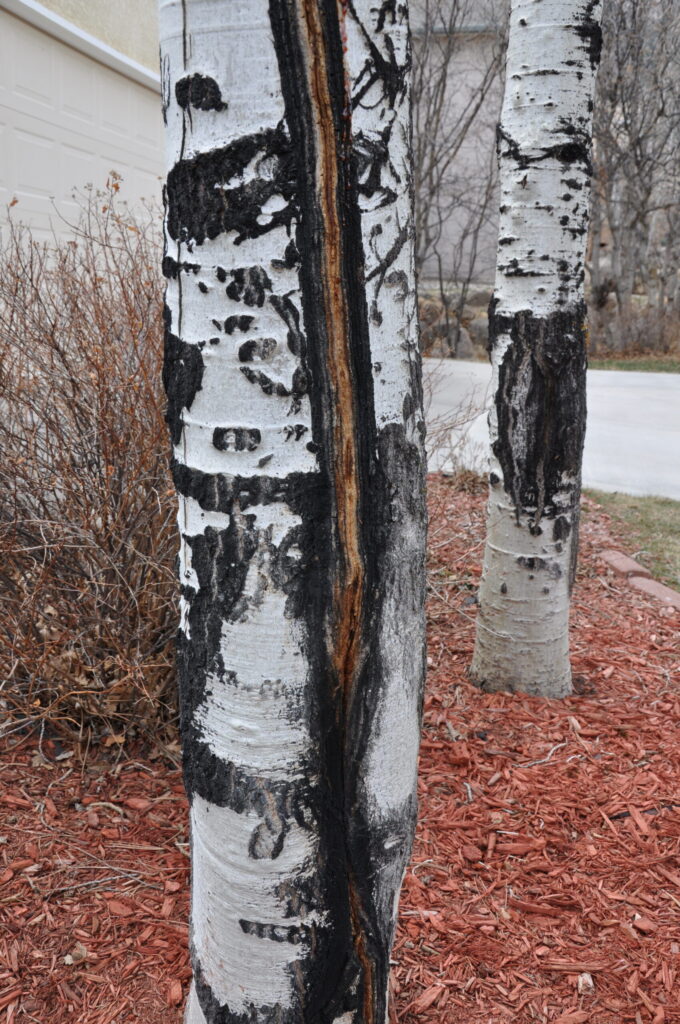
North American quaking aspen (Populus tremuloides) have a growth habit that can be problematic for homeowners. The natural pattern for these trees is to form clone colonies that can grow to miles in length. Homeowners will be challenged to manage the aggressive root suckers aspen use to form that clone colony.
Between disease and storm damage, they generally don’t live more than about 20 years in home landscapes, during which time they can become structurally unsound, falling to damage property or cause injury. Aspen trees are not recommended for urban landscapes, and your neighbors will thank you for not planting these trees.
Although not on the noxious list, the Callery pear (Pyrus calleryana ‘Bradford’), often mistaken for the coveted flowering crabapple trees like Malus floribunda, has invasive habits and has been outlawed in several states. This thornless ornamental tree is particularly susceptible to limb breakage or splitting from strong winds, snow or ice. It is also known to have an offensive odor.
The in-person help desk is closed for the season. Submit gardening questions online at ask.extension.org or call 719-520-7684. Questions will be routed to El Paso County Master Gardeners and answered remotely and by phone.
Comments are closed.