
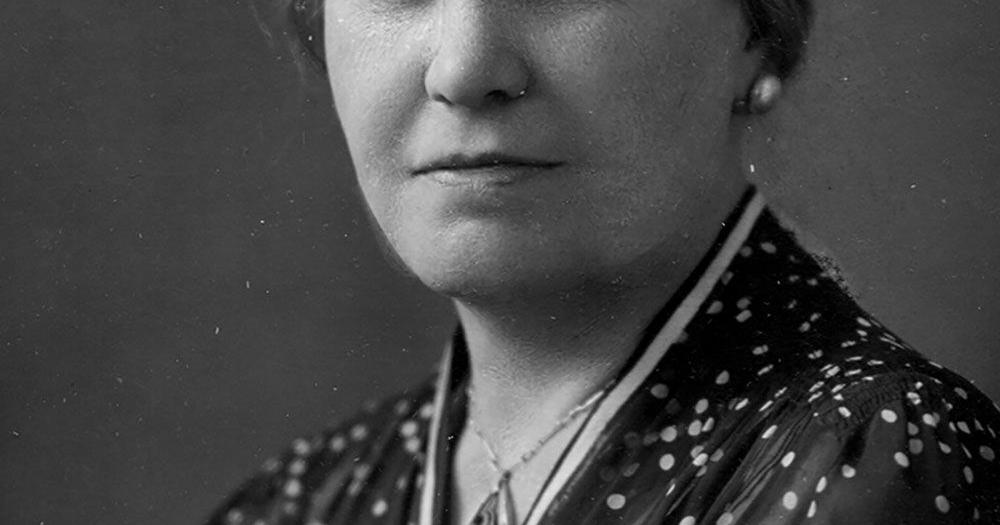

Webster Groves resident J.P. (Minnie) Larson founded the “Better Homes and Garden Club,” later the Wester Groves Women’s Garden Association, in 1926.
As the The Webster Groves Women’s Garden Association celebrates its 100th anniversary, its members are taking a look back. It all started with a comforter, a few friends and a love of gardening.
On Jan. 28, 1926, Mrs. J.P. (Minnie) Larson invited a handful of friends to her Webster Groves home to form a new club dedicated to making the community a more beautiful place. They called it “The Better Homes and Garden Club,” and they chose the date to honor Larson’s late sister, Ina Bliss. That small gathering marked the beginning of what would grow into a century of gardening, friendship and civic pride.
Larson was born in Raritan, Illinois, in 1875, the daughter of Swedish immigrants. She married John Larson in 1903, and the couple moved to Webster Groves, raising 10 children on Selma Avenue. John Larson owned the Lohse Patent Door Company and served on the local school board, while Minnie Larson became deeply involved in community life, helping start the first public kindergarten, and serving on the library board and the PTA.
Her garden club took root quickly. A second club formed in 1927, and a third formed in 1929. By 1932, seven clubs came together to form the Webster Groves Garden Club Association — now known as the Webster Groves Women’s Garden Association. By 1951, the 25th anniversary year, there were 17 clubs buzzing with activity.
Over time, the organization’s name evolved from “The Better Homes and Gardens Garden Club” to “The Home Garden Club,” then “Webster Groves Garden Club,” and finally, in 1989, its current name — the Webster Groves Women’s Garden Association.
What hasn’t changed is the club’s purpose and mission: “The Webster Groves Women’s Garden Association promotes the love of gardening through education, conservation, civic beautification, and philanthropy in our community.”
The Webster Groves Women’s Garden Association continues to thrive today. The three active clubs — The American Beauties (Group 4), The Rosy Posies (Group 5) and The Daffy-Dils (Group 23) — include more than 50 members. The clubs meet monthly to swap gardening tips, enjoy educational programs and collaborate on projects that brighten the community.
“Its Work Is All Over Webster Groves”
Over the years, members of the Webster Groves Women’s Garden Association have left their mark all over Webster Groves. In the 1930s, the association took part in a “War Against Mosquitoes,” beautified the Frisco train station and local schools, and created a garden center at the library with the donation of more than 150 books. In 1955, it established a bird sanctuary at Blackburn Park that still exists today.
The association’s longest-running project is Ruhe Park. Tucked at Elm and Glendale avenues, it’s home to the daylily circle garden (formerly the Margaret Blackburn Rose Garden established in 1941), the Centennial Butterfly Garden (1996) and a Blue Star Memorial Marker honoring members of the U.S. Armed Forces (2006). Recent updates include new plantings, irrigation, steps and an overlook, plus a bluebird trail added in 2025 that quickly attracted new residents with feathers.
Beyond Ruhe Park, the association has tackled countless projects — planting trees, restoring historic gardens and helping schools with horticultural grants. Its work is everywhere in Webster Groves.
A Celebration 100 Years In The Making
Every spring, the Webster Groves Women’s Garden Association hosts its annual plant sale, honors five residents with a “Garden of the Month” award and highlights local businesses that add to the city’s natural charm. This year, in celebration of 100 years, look for pots of pink tulips — the same flower that graces the association’s logo — blooming across town.
The highlight of the centennial celebration was a “Centennial Tea” on March 26, which brought together members, former members and supporters. The event featured a special pictorial history exhibit, first shown in January at the Webster Groves Public Library, highlighting the faces and milestones that shaped the association’s story.
From Larson’s living room to a century of civic gardens, the Webster Groves Women’s Garden Association has bloomed alongside the city it serves. Its roots run deep, its branches reach far and its petals still turn toward the sun.
For information about joining or to learn more, visit wgwga.org.
Information for this article is from historical information compiled by Karen Halla, Group 4 and the Centennial Anniversary History written by Wanda Lovan, Group 23.
Comments are closed.