
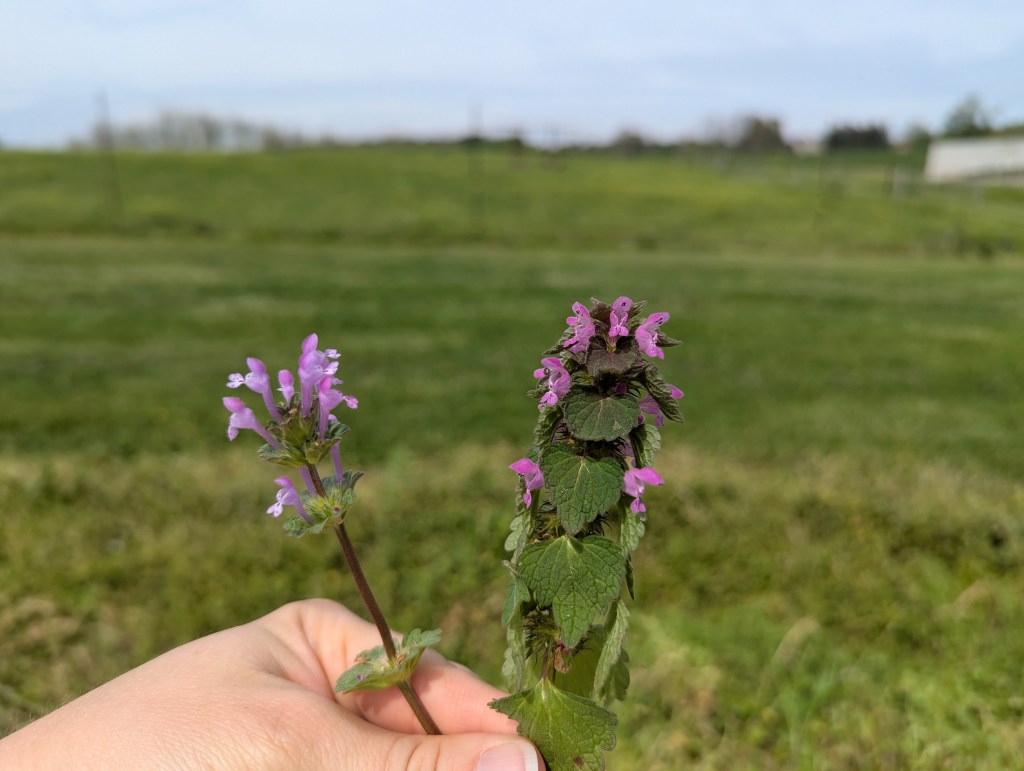
What are the patches of pinkish-purple flowers I see in weedy lawns and flower beds?
Given the season and their preference for disturbed environments, the two likely candidates are purple deadnettle (Lamium purpureum) and henbit (Lamium amplexicaule). They’re very common non-native weeds in the mint family, which bloom in the spring.
Although these two Lamiums can provide floral resources for some pollinators within an otherwise low-ecological-value lawn, insect pollinators and other wildlife would be better served by having more access to native spring-blooming plants like wild violets, spring beauty, pussytoes, fleabane, and star chickweed. Several chickweed species grow in Maryland, but those found in a lawn or garden bed are usually non-native.
Both Lamiums are winter annuals, so they’ll die off on their own by summer, having completed their life cycle. In areas where you want to discourage them in future years, preventative efforts begin in autumn, since their seeds germinate as the weather cools. The only herbicide-free approach is to pull or mow the Lamium you see growing to prevent the next generation of seeds produced by pollinated flowers. In lawns, maintain the turf in good health and vigor so it can crowd out most weeds on its own. In garden beds, use mulch to cover any bare soil surface between plants to deny weed seedlings space to establish.
While not too important for control measures, henbit and purple deadnettle can look very similar until you get used to their distinctive differences. One main separating trait is the foliage: leaf shape and how they attach to the stem. Henbit foliage is scallop-edged and circular-looking when viewed from above, with more of a tiered layering compared to purple deadnettle. The latter’s foliage is more triangular in shape, overlaps with the leaf layer below it when a stem is viewed from above or the side, and the youngest leaves at the growing tip are often tinged plum-purple.
What’s causing a hard, lumpy stem swelling near the base of my rose shrub?
Probably an infection called crown gall, which creates deformities on shrub stems, often near the soil line. Euonymus, forsythia and roses are common victims. Galls can begin semi-soft but harden with a cracked surface over time, though plants won’t necessarily display symptoms the same season or year they were infected.
The bacteria responsible live in soils and can infect a wide variety of plant species, though what kills the plant or causes dieback is often a secondary infection where another pathogen takes advantage of the weakened tissue as a point of entry. The crown gall bacteria themselves need a wound on the plant in order to begin an infection, which can arise from bark cuts during planting to soil-dwelling insect feeding or even contaminated sap spread from branch to branch on unsterilized pruning tools.
No curative treatments exist. Pruning out any visible galls is only a temporary fix because the bacteria are distributed throughout the plant. Prevention takes the form of simply avoiding plant injury, trimming broken branches with clean and sharp tools, and growing shrub species naturally more resistant to this disease. Healthy soils with lots of diverse microbial life may also help to suppress crown gall. For example, beneficial microbes might out-compete the crown gall bacteria on root surfaces. Soil health is improved by adding organic matter and avoiding compaction and overfertilization.
University of Maryland Extension’s Home and Garden Information Center offers free gardening and pest information at extension.umd.edu/hgic. Click “Ask Extension” to send questions and photos.
Comments are closed.