
QuickTake:
Starts, seeds, schedules — these tips will help keep your garden producing edible produce almost year-round.
For me, planting season spans about 10 months. And the most important thing to remember about planting time is that not everything goes in at once and that some things need to be planted over and over.
Cool-season crops go in first. Lettuce and other greens, peas, cabbage, broccoli and cauliflower can be planted right now — what are you waiting for? Carrots, onions and beets, too.
But tomatoes, squash, corn, beans and melons (if you dare) need warmer soil. Mid-May works well in a cool year, perhaps a bit earlier if spring is warm and dry.
Lettuce planted in March will be bolting — no longer producing edible leaves but instead growing seeds — by June. You’ll need to plant more in May, so when the tomatoes ripen in August, you can make BLTs. Another planting of lettuce and other greens during a cool and hopefully wet spell in September or October will extend the salad season into the fall and early winter.
Corn should get planted three or four times a year — May, June, July, and, if you have the right spot, August — for a harvest that might occur as late as Halloween. Some of the late plantings can go where the bolted June lettuce was growing, but saving some space early for things you want to plant later will make those later crops easier to squeeze in. And if you already grew (and ate) a crop of lettuce where a new crop of corn is going in, you’ll need to do some mid-season fertilization.
Most of my soil preparation is done with a shovel. I turn over what is needed for a bed (not a row) of lettuce. A bed six plants wide will choke out weeds, save water and leave more of your garden in food production and less in rows. For larger plants — squash, tomatoes and peppers, for instance — I turn over and fertilize a 12-inch by 12-inch by 12-inch hole in the middle of a mulched or cover-cropped area.
I never use a rototiller. It’s bad for the soil, and it exposes more patiently waiting weed seeds. I know many folks love the look and relative ease of planting a patch of earth that’s been rototilled, but I urge you: Try just the shovel and the small patch turning method for a few things, like the lettuce and tomatoes this year. You may, like I did, abandon the rototiller. Because I am planting my garden a little at a time, doing it by hand is not too strenuous.
Here is a random list of planting ideas that have worked for me:
Pole beans (Blue Lake) are easier to harvest and take up less space than bush beans. It is also fun to watch the tendrils grow a foot overnight. Don’t build the structure higher than you can reach. The beans can grow up to 15 feet and require a ladder to pick.
Plant a variety of tomato plants. Each year, different ones seem to do better. Three feet apart is good. I buy six packs of tomato starts in April and put them in bigger pots. Bury part of the stem after picking off the leaves. If you have a four-inch high plant, pick off the leaves on the bottom two inches. Bury the plant so it goes deeper into the soil, and the whole side will grow roots.
When you put them in the ground in mid-May, pick off more leaves, and again bury them deeply. You will get a good root system much deeper into the soil.
Carrots like sweet soil. If you think of it, add some lime to the soil in the fall. Carrots take a long time to sprout, so I put a piece of cardboard over the bed for five days to keep the soil damp.
Beets have two to four seeds per “seed.” They are a lumpy group of seeds, really. That means you often get three beets growing one-eighth of an inch apart. Transplant the ones that are touching.
Broccoli produces more than one head. After the first main harvest, leave the plant in, and like a fairy tale (or horror movie), it will grow five new heads, albeit smaller ones. Cut those off, and bingo, five more heads per head. While the broccoli planted in March will slow down in mid-summer, each plant can live for a year, sometimes two, and will produce a lot in the spring and another crop in the fall and winter. Alternate cauliflower and broccoli. The cauliflower mostly makes just one head, so you can remove the plants after harvest, so the fairy tale broccoli has more room to grow.
Cabbage also produces a fall crop of mini heads after the summer harvest. Leave the plants in if you have room for a second harvest or two- to three-inch diameter heads, September through November.
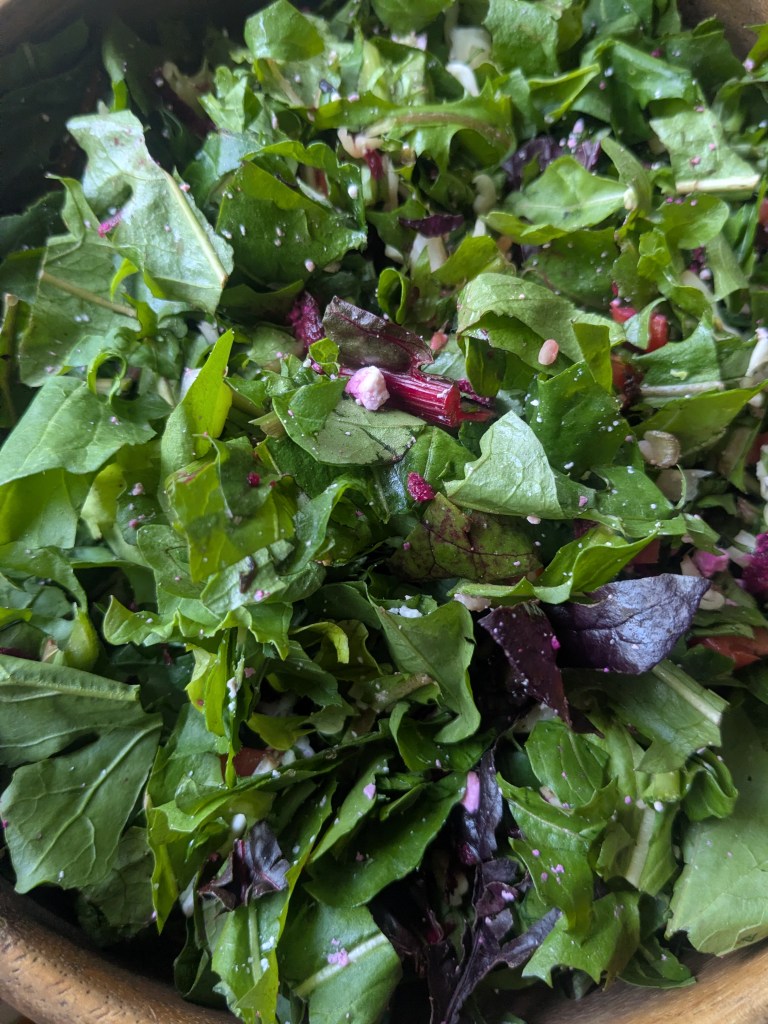 Produce your own “salad mix” from lettuce beds that yield leafy greens multiple times. Credit: John Fischer
Lettuce can be harvested multiple times. Either break off a few outer leaves or do what farmers do: cut off the top of the plant, leaving four-inch-high “stumps.” New leaves will come up, and you can do the same haircut again and again.
Starts are helpful. In addition to the tomatoes, there are some things I put in as starts purchased from a nursery: peppers, some cabbage, cauliflower and broccoli. But planting from seed is the essence of gardening and, in many cases, produces better results. Corn, lettuce, carrots, beets and beans all do better from seed. If you want to plant seeds in little containers and transplant them after they sprout, that is fine. I just don’t want you to miss the miracle of putting a pinhead-sized seed into the ground and harvesting a head of romaine lettuce 40 days later.
Comments are closed.