
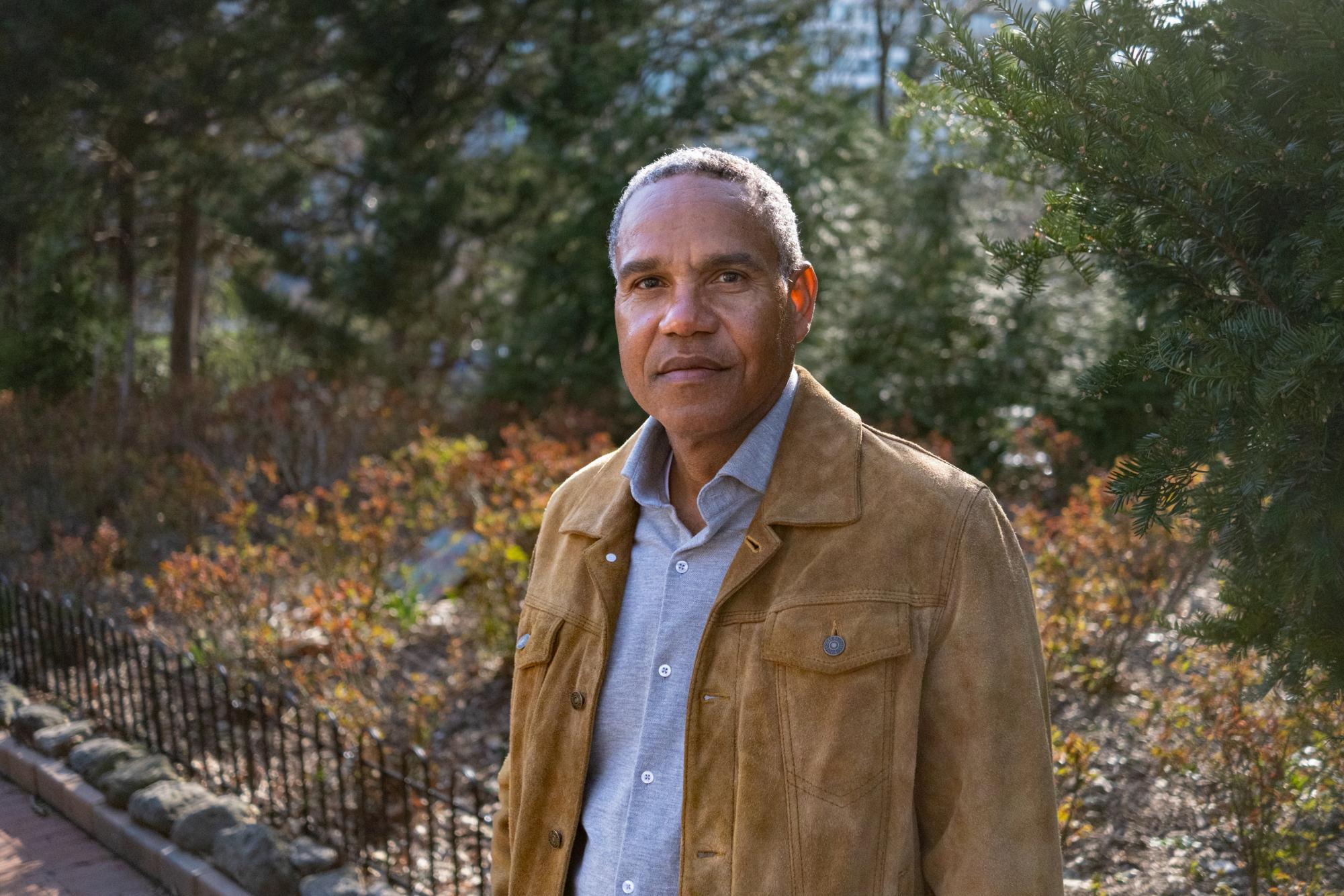
Foggy Bottom Association Garden Committee Director Peter Maye tends to his neighborhood one bloom at a time, watching even the smallest patches of soil come to life.
Since joining the Garden Committee — which three Foggy Bottom neighbors founded in 2005 — Maye has helped carry its mission beyond private yards and into public spaces, where flowers now line sidewalks and cluster beneath lampposts on nearly every block. He echoed the words of fellow committee members who say their work has grown into more than beautification, drawing residents together and turning gardening into a shared investment in the neighborhood’s identity.
“My favorite part is experiencing all the people coming out, volunteering, giving back, supporting the neighborhood, making this is our space,” he said.
Committee members and volunteers work year-round, Maye, who has helmed the committee for nine years, said. Spring is for planting, mulching and weeding, while summer relies on rain to keep the gardens alive. In the fall, members rake leaves when city crews fall behind, and the committee spends winter planning for the next season. Snow provides natural moisture for the dirt, Maye said, helping plants survive the heat of summer.
Maye said the committee is currently trimming overgrown areas, clearing excess leaves and replacing an evergreen tree on 26th and I streets throughout the neighborhood that didn’t survive the winter. The group is also continuing its annual routine of fertilizing gardens and mulching green spaces, he said, also pointing to the committee’s work cleaning up Triangle Park, located across from the 7-11 on New Hampshire Ave, where litter has built up. They are also working to add more drought-tolerant plants to the park like knockout roses, he said.
Maye said the committee’s planting efforts in recent years have led to more established gardens, requiring less new planting this season.
With the wide span of work the committee pursues throughout the year, he said GW students eager to give back to the neighborhood have been valuable volunteers over the years, helping offset challenges in maintaining a consistent workforce as many Foggy Bottom residents work full-time, have limited availability or move away after a few years.
“People are really busy in this neighborhood,” Maye said. “We’ve had a range of people over time that come in and do what they’re able to do, give the time that they’re able to give. We really appreciate that, and we take what we can get, then we keep going.”
Maye said the committee hires a landscaping crew to do the heavy lifting and areas that require more manpower than available in the pool of volunteers, using funds from donors and grants from the FBA to fund their work. The committee maintains spaces including the park at 26th Street, the river rock garden at 25th and K streets, the corner garden at 26th and K streets and Triangle Park. Although the sites are maintained by the District, Maye said the city often lacks the time and resources to keep up, leaving the committee and volunteers to step in and shape the neighborhood’s green spaces.
Maye said the Garden Committee operates with a flexible structure, with members joining and leaving from year to year. As a fully volunteer-run group, he said the committee has adapted over time to maintain the neighborhood’s green spaces. He added that his favorite part of the role is seeing community members come together to give back and support the neighborhood.
“This is where you live,” he said. “You’re giving back to making the space the best that it can be, so that’s always such a joy. Being part of that is very rewarding.”
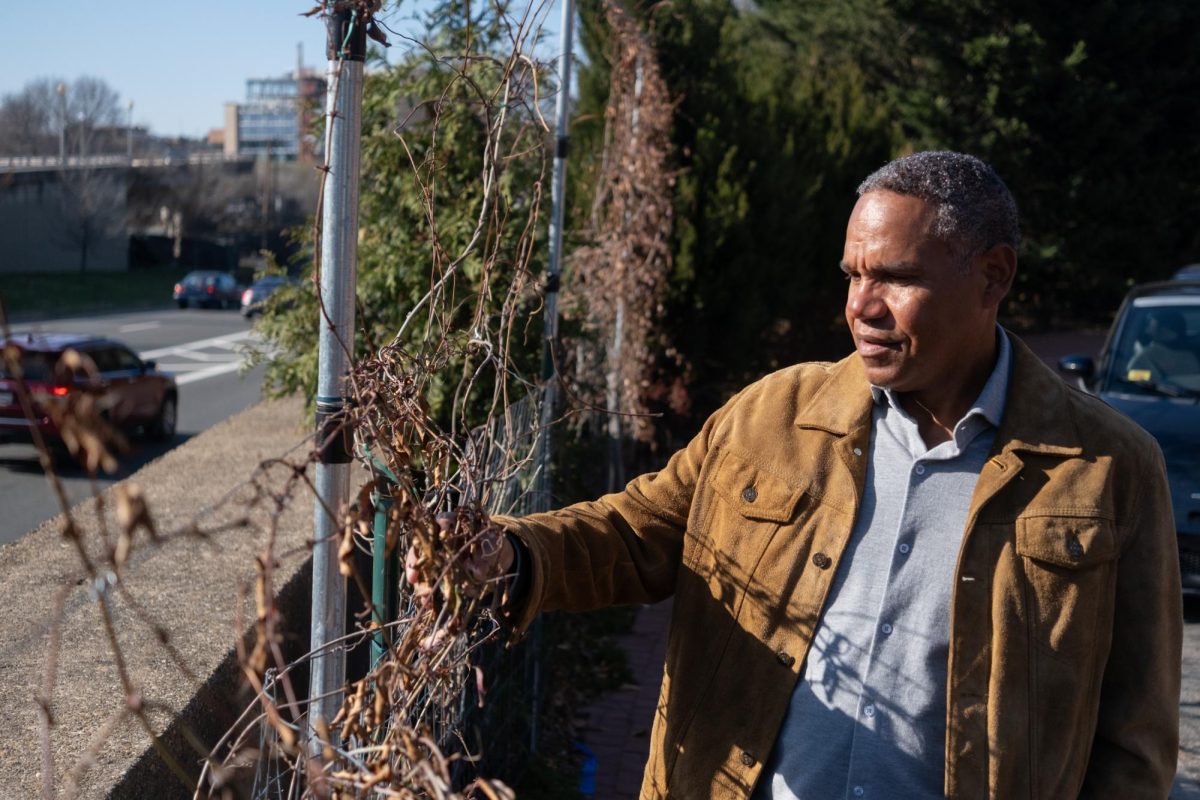 Peter Maye inspects vines planted near the side of the highway. (Cooper Tyksinski | Assistant Photo Editor)
Denise Vogt, a Garden Committee volunteer and co-founder of the FBA’s History Project Committee, said she has lived in Foggy Bottom for more than 30 years and joined the group to beautify the neighborhood, connect with nature and build relationships with neighbors. As a longtime resident, she said gardening has long been part of the community’s identity, with residents finding creative ways to add color to small yard spaces despite limited room.
“People do really take pride in their property,” she said. “Every spring, I’ve noticed that if one individual starts working on their garden and maintaining and planting, it has an effect on other neighbors to want to beautify their spaces. It has that domino effect of people wanting to beautify.”
She said D.C.’s limited space — often narrow, three-foot-wide curbside plots — forces residents to be intentional about what they plant. As a former landscape designer, Vogt said she focuses on maximizing small spaces while selecting flowers that complement each other and bloom at the same time.
“It’s an art of its own,” she said. “As you go through different neighborhoods while you’re here, you’ll see really some spectacular garden spaces that evolve have evolved over the years because certain evergreens need to have time to grow to fill out their space, and the perennials need to have time to grow to fill the space they’ve now occupied, versus how they look when you first plant them.”
She said she saw her student neighbors starting their own gardens, planting perennials in their own small plot of rented land just last week, making it a small, yet noticeable bright spot for the community to see when they pass by. Vogt said the Garden Committee brings people of the neighborhood together from all different backgrounds, careers, interests and age groups.
Gardening with others, she said, gives her a sense of joy and accomplishment, putting in the hard work to plant and seeing the work come to fruition once the flowers bloom.
“It brings great joy and pride to have these spaces be maintained and full of blooming, just as the physical work and the camaraderie is what makes the garden committee attractive,” she said.
Foggy Bottom resident Sadie Cornelius, who volunteers with the committee, said she noticed the neighborhood’s gardens and public spaces soon after moving from Shaw in 2021, with flower beds lining nearly every block. Although the committee has shrunk over time as residents move in and out, she said a strong sense of pride and community remains in maintaining the neighborhood’s greenery.
Compared to her experience in Shaw, where residents were more independent, Cornelius said Foggy Bottom’s gardening efforts foster a shared sense of responsibility for public spaces.
“That explained why there were so many beautiful spaces in the neighborhood, because of the people behind it,” she said.
Diana Anos contributed reporting.
Comments are closed.