
Native may be the new buzzword for choosing landscape plants, but it often gets in the way of good gardening.
Not knocking native plants; after all, this past president of the Mississippi Native Plant Society grows and lectures on their benefits and uses. But when it comes to translating their crucial role in supporting wildlife and creating a “sense of place” in our region into tangible action, a lot gets lost in good intentions and lip service. Being native may not be the tipping point for getting them into gardens, at least for most folks.
Sometimes we get put off when they are referred to as wildflowers, which sound weedy, without realizing that when used as just regular garden plants they become cultivated, no longer “wild.”
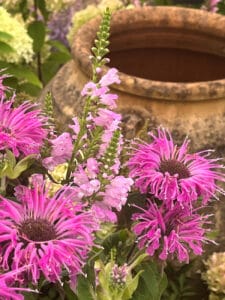
Bee balm (Monarda) attracts bees, butterflies and hummingbirds, illustrating Felder Rushing’s point that plants don’t have to be strictly native to provide strong value in the garden. Photo Courtesy of Felder Rushing
Oh, we have long routinely planted many natives without thinking of them as such. Think oaks, pines, magnolias, redbud, dogwood, yaupon holly, bald cypress, cedar, yucca, river birch and yellow Carolina jessamine vine, all widely used because they work as garden plants more than their being native. Ditto with herbaceous Mississippi plants, including coreopsis (our official state wildflower), purple coneflower, Rudbeckia (perennial black-eyed Susan), ferns and phlox, all enjoyed for generations just because they are pretty and easy to grow in our/their climate.
And even more are showing up in garden centers, in spite of many not looking all that attractive when young and in pots compared to more familiar plants, including red coral honeysuckle, gaura, blue star (Amsonia), Monarda, New England aster, obedience (Physostegia), blazing star (Liatris), true Louisiana iris, perennial salvias and Asclepias, the most important host plant for monarch butterflies but which has the unfortunate folk name of butterfly weed.
You have to be a pretty keen gardener to recognize just by the label a pot of leafless stems called Callicarpa (beautyberry), or small clumps of foliage labeled as Stokes aster or narrow-leaf sunflower. And most gardeners pass over little pots of what will be small, very pretty, non-spreading pollinator magnets sold as Solidago once they discover they are types of goldenrod.
And truth is, not just natives have great benefits to birds, bees and other urban wildlife; my old-fashioned, nonstop flowering abelia shrub, African blue basil, lantana and zinnias have more butterflies than most native flowers. Over a longer season.
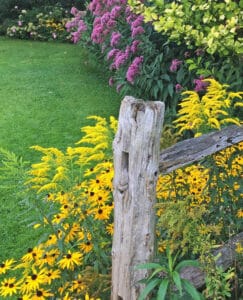
Rudbeckia and goldenrod add bright color and strong pollinator value to the garden. Felder Rushing says that plants should be chosen for performance and beauty, not just whether they are native. Photo Courtesy of Felder Rushing
What’s most important to garden-variety gardeners is how the plants can be used in regular landscapes where shape, size, foliage and seasonal flower colors are important. Butterflies, bees, hummingbirds and hover flies are lagniappe.
And they can all be used together. This is how it is widely done in English, European and Japanese gardens, where our native plants are just more imports. Nobody over there makes a big deal; they just plant them as good garden additions, as individuals or small groups right along with daylilies, iris, roses and the like.
I guess what I am saying is that we have grouped and put native plants onto a pedestal, instead of seeing some of them as just regular garden beauties exceptionally adapted to our climate and with added wildlife value.
Here’s what I suggest: Just use the native plants you like best for what they are, more than what they represent. For those that are a bit untidy, don’t just plant wild — group several around an acceptable accent such as a wagon wheel, urn, bit of fence, large piece of driftwood, a group of birdhouses or a birdhouse. And add some more familiar plants to give neighbors peace of mind. Just enjoy them for what they are and appreciate whatever other benefits they bring. Without all the virtue signaling.
Felder Rushing is a Mississippi author, columnist and host of the “Gestalt Gardener” on MPB Think Radio. Visit his blog at felderrushing.blog. Email gardening questions to [email protected]
Posted in Columns
Quality, in-depth journalism is essential to a healthy community. The Dispatch brings you the most complete reporting and insightful commentary in the Golden Triangle, but we need your help to continue our efforts. In the past week, our reporters have posted 44 articles to cdispatch.com. Please consider subscribing to our website for only $2.30 per week to help support local journalism and our community.
Comments are closed.