
With the arrival of spring, horticulture experts say now is the perfect time to get outside and start pruning — but only if you do it the right way.At the Arnold Arboretum of Harvard University, crews have been hard at work, taking advantage of a short window before plants come out of dormancy and new growth begins.“Disease, damage and dead — get those out as soon as possible,” said Scott Phillips, assistant manager of horticulture at the Arboretum.Experts say pruning during early spring offers a key advantage: Plants are still dormant, which reduces the risk of spreading disease.“A lot of fungus lives on branches,” Phillips explained. “If you prune when it’s active in the summer, you’re opening up a wound for infection. In the winter, there are fewer diseases.”How to prune properlyProper technique is just as important as timing.Phillips recommends removing large branches in stages, cutting them back in smaller sections to prevent tearing, which could expose a branch to infection and rot. When making the final cut, a two-step approach helps protect the plant.“You want to make an undercut, then an above cut,” he said, explaining that if a branch were to tear, the undercut would stop the tear from traveling.He also points to a critical detail many homeowners overlook: the branch collar, a slightly raised node where the branch meets the trunk.“If you find these little healing centers, it will callous over really nice,” Phillips said. “I want to get a half-inch above that. It will die back and then callous right over.”Don’t overdo itWhile it may be tempting to trim everything back, experts caution against over-pruning. After removing dead, diseased and damaged pieces, cut back no more than a third of a shrub. And not all plants should be pruned right now.Early spring bloomers — like rhododendrons, azaleas, forsythia and lilacs — already have buds forming. Cutting them now would mean fewer flowers this season.“Anything that is going to flower in the next month or two, just wait until it’s done flowering,” Phillips advised.Taking the time to prune carefully now can make a big difference in the months ahead, leading to healthier trees and shrubs, stronger growth, and more vibrant blooms.
BOSTON —
With the arrival of spring, horticulture experts say now is the perfect time to get outside and start pruning — but only if you do it the right way.
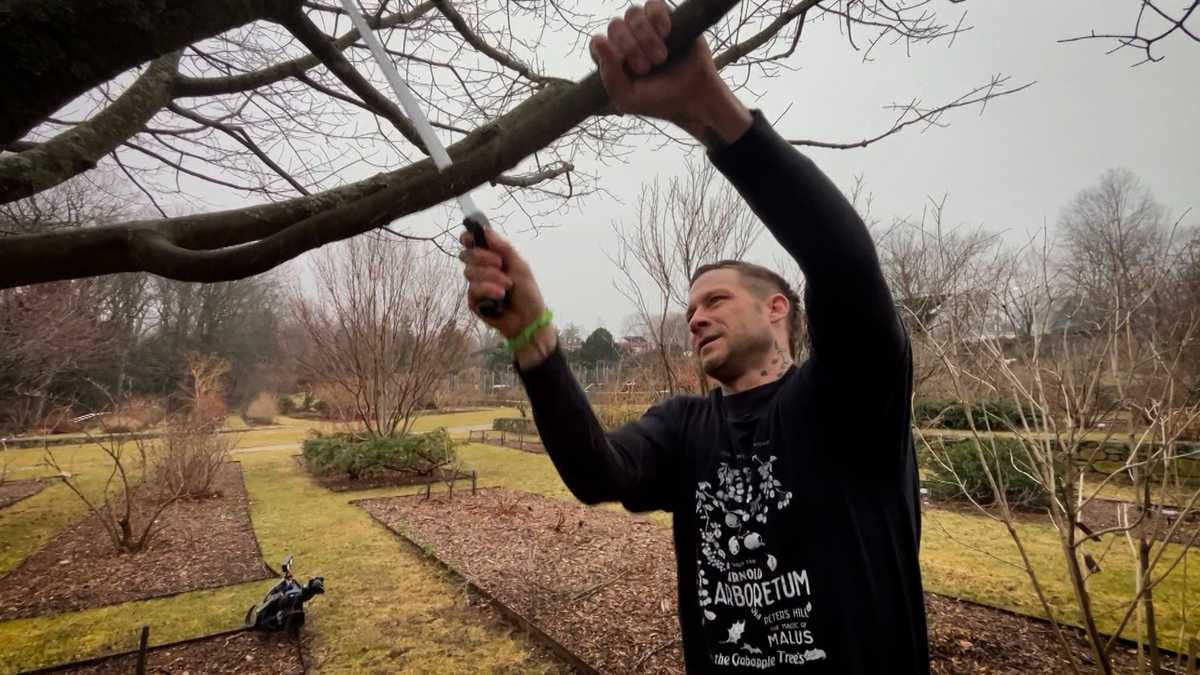
At the Arnold Arboretum of Harvard University, crews have been hard at work, taking advantage of a short window before plants come out of dormancy and new growth begins.
“Disease, damage and dead — get those out as soon as possible,” said Scott Phillips, assistant manager of horticulture at the Arboretum.
Experts say pruning during early spring offers a key advantage: Plants are still dormant, which reduces the risk of spreading disease.
“A lot of fungus lives on branches,” Phillips explained. “If you prune when it’s active in the summer, you’re opening up a wound for infection. In the winter, there are fewer diseases.”
How to prune properly
Proper technique is just as important as timing.
Phillips recommends removing large branches in stages, cutting them back in smaller sections to prevent tearing, which could expose a branch to infection and rot. When making the final cut, a two-step approach helps protect the plant.
“You want to make an undercut, then an above cut,” he said, explaining that if a branch were to tear, the undercut would stop the tear from traveling.
He also points to a critical detail many homeowners overlook: the branch collar, a slightly raised node where the branch meets the trunk.
“If you find these little healing centers, it will callous over really nice,” Phillips said. “I want to get a half-inch above that. It will die back and then callous right over.”
Don’t overdo it
While it may be tempting to trim everything back, experts caution against over-pruning. After removing dead, diseased and damaged pieces, cut back no more than a third of a shrub.
And not all plants should be pruned right now.
Early spring bloomers — like rhododendrons, azaleas, forsythia and lilacs — already have buds forming. Cutting them now would mean fewer flowers this season.
“Anything that is going to flower in the next month or two, just wait until it’s done flowering,” Phillips advised.
Taking the time to prune carefully now can make a big difference in the months ahead, leading to healthier trees and shrubs, stronger growth, and more vibrant blooms.
Comments are closed.